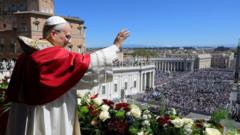
The rain had stopped, but the stones of St. Peter’s Square remained slick, reflecting a sky that couldn’t quite decide if it was mourning or celebrating. Beneath the towering colonnades, thousands of people stood shoulder to shoulder. They weren't there for a lecture. They were there for a signal.
Pope Leo walked toward the altar with a gait that carried more than just the weight of eighty-odd years. He carried the expectations of a planet that feels, quite acutely, like it is spinning off its axis. This was his first Easter Mass—the moment where the liturgy meets the headlines—and the air felt thick with a tension that no incense could mask.
Think of a father standing in a room full of children who have stopped speaking to one another and started reaching for heavy objects. That is the Vatican on a global scale. The Pope doesn't have an army. He doesn't have a seat at the UN Security Council. He has a voice, a balcony, and a tradition that demands he look the world in the eye and ask it to be better than its worst impulses.
The Geography of Grief
When the Pope looked out at the crowd, he wasn't just seeing the vibrant umbrellas of tourists or the stiff collars of the clergy. He was looking past the Tiber, past the borders of Italy, toward the charred remains of neighborhoods in Gaza and the cold, muddy trenches of Ukraine.
Peace is a word we use so often it has become smooth and featureless, like a stone tumbled in a river for a thousand years. We forget it has edges. We forget it has a cost.
During his Urbi et Orbi message—the address "to the city and the world"—Leo didn't stick to the safe, ethereal heights of theology. He went into the dirt. He spoke of the "futility of war," a phrase that sounds poetic until you apply it to a specific kitchen table where a family no longer sits because a missile decided their zip code was a target.
War is an admission of failure. It is the moment where human imagination runs dry. Leo’s plea was a demand for a "general exchange of all prisoners" between Russia and Ukraine. It wasn't a suggestion. It was a challenge to the men in power to remember the humanity of the people they hold in cages.
The Empty Chair at the Table
Imagine a woman named Olena in Kyiv. She spends her Easter morning scrolling through a Telegram channel, looking for a glimpse of her son in a grainy video from a prisoner-of-war camp. For her, the Pope’s words aren't "news." They are a lifeline. They are a hope that someone with a microphone is finally saying the thing that matters: Bring them home.
Now imagine a father in Gaza, sheltering in a tent, trying to explain to his daughter why the sky is screaming. When Leo called for an immediate ceasefire and the delivery of humanitarian aid, he was speaking directly into that father’s silence.
The Pope highlighted the tragedy of the children. They have forgotten how to smile, he said. That is a chilling observation. A child who forgets how to smile is a child who has been robbed of the very essence of being. This isn't about politics or borders or ancient grievances. It is about the fundamental biological right to joy.
The Ghost of Cold Logic
We live in a time that worships "realism." The "realists" tell us that weapons are the only language the world understands. They tell us that peace is a luxury we cannot afford until the "other side" is crushed.
Leo’s first Easter was a direct assault on this brand of realism. He argued that the real fantasy is believing we can build a future on a foundation of corpses.
He spoke to the leaders of nations—the men in suits who move pieces across a map—and reminded them that their choices have a pulse. The "logic of weapons" is a circular one. It feeds itself. It grows. It demands more steel, more gunpowder, and more blood until there is nothing left to defend.
The Pope’s role in this is unique. He is perhaps the only figure on the global stage who can speak to a billionaire in New York and a refugee in Sudan with the same vocabulary. He isn't selling a policy. He is defending an idea: that every human life is an unrepeatable miracle, and to extinguish it for the sake of a few miles of territory is a sacrilege against the very concept of existence.
The Silence Between the Words
The most striking part of the day wasn't the bells or the choir. It was the silence.
When the Pope stopped speaking, the square was quiet. It was the kind of silence that happens when people realize the truth is uncomfortable. It’s easy to cheer for peace in the abstract. It’s much harder to support the concessions, the handshakes, and the difficult compromises required to actually achieve it.
Leo didn't offer an easy path. He didn't promise that the fighting would stop tomorrow because he asked nicely. He did something more important: he refused to let us look away.
We are masters of distraction. We check our phones, we argue about trivia, and we pretend that the suffering of people three thousand miles away is a movie we can turn off. The Easter Mass is designed to be the opposite of a distraction. It is a confrontation.
He mentioned Syria. He mentioned Lebanon. He mentioned the ongoing struggles in Africa. He was mapping the world’s pain, not to be a pessimist, but to show that no corner of the earth is invisible to the eyes of mercy.
The Invisible Stakes
Why does a man in a white robe in Rome matter to a secular world?
Because we are starving for a moral North Star. Our politics are transactional. Our economies are cold. Our social lives are digitized and fragmented. In the middle of all that noise, there is a deep, human hunger for someone to stand up and say, "This is wrong, and we must stop."
Leo’s message wasn't just for the leaders of the G7 or the commanders in the field. It was for the person standing in the square, and the person reading the news on their commute. It was a call to reject the "globalization of indifference."
Indifference is a quiet killer. It’s the shrug we give when we see another headline about a bombing. It’s the way we harden our hearts so we can finish our coffee. Leo’s first Easter was a hammer brought down on that shell of indifference. He was trying to crack us open.
He spoke of the Risen Christ, but even for those who don't share his faith, the metaphor holds. It is a story about life overcoming death, about the possibility of a new beginning when everything seems lost. It is the ultimate "what if."
The Long Road from the Balcony
As the Mass ended and the crowds began to filter out into the streets of Rome, the sun finally broke through the clouds. It caught the gold on the altar and the white of the Pope’s vestments.
He looked tired. The physical toll of the ceremony was visible in the way he gripped the arms of his chair. But there was a stubbornness in his eyes. It is the stubbornness of a man who knows that his words might be ignored by the powerful, but will be whispered by the powerless.
Peace isn't a treaty signed in a palace. It isn't a line on a map. Peace is the moment a mother in a war zone stops listening for the sound of an explosion and starts listening to the breath of her sleeping child.
Pope Leo stood on that balcony and held up a mirror to the world. We didn't necessarily like what we saw. We saw a world that is angry, scarred, and dangerously close to the edge. But he also showed us that we have a choice. We are not spectators in the tragedy of history. t
The guns are loud, but they are not the only sound. There is the sound of a voice calling for a different way. There is the sound of a heartbeat. And as long as those things persist, the story isn't over.
The white robe moved back into the shadows of the basilica, leaving the world to decide what to do with the silence he left behind.