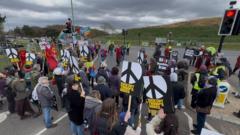
The arrest of seven individuals at RAF Waddington on charges of supporting a proscribed or targeted activist group represents more than a localized protest; it functions as a stress test for the United Kingdom’s updated National Security Act and the operational resilience of the Ministry of Defence (MoD). While media coverage often focuses on the optics of the demonstration, a rigorous analysis reveals a calculated collision between civil liberties, the legal definitions of domestic extremism, and the logistics of base security. To understand the implications of this event, one must dissect the intersection of three distinct variables: the expansion of police powers under recent legislation, the tactical methodology of Palestine Action, and the specific strategic value of the Waddington site.
The Strategic Significance of RAF Waddington
RAF Waddington serves as the hub of the UK's Intelligence, Surveillance, Target Acquisition, and Reconnaissance (ISTAR) capability. This site is not a mere symbolic target; it is the nerve center for the MQ-9B SkyGuardian and the Protector RG Mk1 programs. From an operational standpoint, the base represents a critical node in the "Kill Chain"—the structural process of finding, fixing, tracking, targeting, engaging, and assessing a threat.
Protest activity at this specific location seeks to interfere with the cognitive load of base operations. Even if physical breaches are unsuccessful, the presence of demonstrators requires the redirection of military police resources, the activation of rapid response protocols, and the potential temporary suspension of flight sorties for safety assessments. This creates a friction coefficient in military readiness that activists exploit to exert political pressure through operational delay.
The Legal Mechanism: Section 12 and Beyond
The arrests in question hinge on a specific shift in the British legal framework. Historically, protest-related arrests were governed primarily by the Public Order Act 1986. However, the recent introduction of the Public Order Act 2023 and the National Security Act 2023 has fundamentally altered the risk profile for activists.
The Threshold of Proscription and Support
The accusation of "supporting" a specific group—in this case, Palestine Action—triggers a different tier of the judicial system than simple trespass. When the state move to arrest individuals under the auspices of supporting a group involved in organized disruption, the legal focus shifts from the action (the protest) to the association (the membership or ideological alignment).
- The Identification Variable: Police must prove that the individuals were not merely present but were acting as part of a coordinated effort by a named entity.
- The Intent Variable: Under new statutes, "interference with key national infrastructure" is a specific offense. RAF Waddington is classified under this category, meaning the evidentiary burden for the prosecution is lowered while the potential sentencing grows more severe.
This creates a "Chilling Effect" by design. By categorizing the seven individuals as supporters of a targeted organization rather than independent protesters, the state utilizes a strategy of Categorical Deterrence. This approach aims to dismantle the organizational hierarchy of activist groups by making the mere act of association a high-stakes legal liability.
Tactical Evolution: The Asymmetric Protest Model
The methodology employed by groups like Palestine Action follows an asymmetric warfare model. They do not seek to defeat the MoD in a direct confrontation; instead, they aim to drive up the "Cost of Doing Business." This cost is calculated through several vectors:
- Legal Costs: The state must fund prolonged prosecutions and high-security court proceedings.
- Physical Reinforcement: Constant threats necessitate expensive upgrades to perimeter fencing, sensor arrays, and 24/7 surveillance.
- Reputational Friction: Forcing the state into visible arrests of citizens creates a narrative of heavy-handedness that can erode public trust in defense institutions over time.
The activists utilize a decentralized cell structure. By the time seven people are arrested, the organization has likely already factored those arrests into their "attrition budget." The arrests are not a failure of the protest; from the activists' perspective, they are a confirmation of the protest's efficacy in forcing a state response.
The Failure of Current Security Paradigms
The fact that seven individuals were able to stage a demonstration of sufficient scale to warrant these specific charges suggests a vulnerability in the "deterrence by detection" model. Base security often relies on a perimeter-out approach, but this ignores the socio-political intelligence required to preempt disruption.
The current security bottleneck is not the lack of physical barriers, but the Legal Response Lag. There is a period between the arrival of protesters and the legal authorization for removal where the operational capacity of the base is compromised. This "Grey Zone" is where the most significant damage to military efficiency occurs.
Quantifying the Impact on Defense Procurement
There is a direct correlation between these protests and the stability of the defense supply chain. RAF Waddington is a consumer of technology provided by external contractors. When activists target the base, they are simultaneously targeting the confidence of these contractors. If a site is perceived as insecure or a magnet for constant litigation, the logistical overhead for maintaining contracts at that site increases.
This creates a secondary effect: Contractual Inflation. When private defense firms have to account for the risk of site-wide disruptions or the harassment of their staff at base entrances, those risks are priced into future government contracts. The taxpayer, therefore, pays a "protest premium" on defense procurement.
Predictive Modeling for Future Disruption
Based on the trajectory of the RAF Waddington arrests, we can project a shift in state tactics toward Preemptive Interdiction. The police will likely move away from reacting to protests at the gate and toward using digital surveillance to intercept coordination before activists reach the site.
However, this strategy faces a significant bottleneck: the European Convention on Human Rights (ECHR). Article 10 (Freedom of Expression) and Article 11 (Freedom of Assembly) remain the primary defense against the total securitization of protest. The courts are currently in a period of "Interpretive Volatility," where judges are struggling to balance the new, stricter laws against long-standing human rights protections.
The outcome of the trials for these seven individuals will set the benchmark for this balance. If the prosecution successfully links them to "supporting" an organization in a way that warrants long-term imprisonment, it will mark a definitive shift in the UK’s tolerance for disruptive dissent.
Strategic Recommendation for Infrastructure Management
To mitigate the impact of such events, the Ministry of Defence must move beyond the "Arrest and Process" cycle. The focus should shift to Operational Decoupling.
- Logic: Decrease the physical visibility of critical ISTAR functions.
- Action: Accelerate the transition to remote, distributed command centers that do not require high-profile, centralized hubs like the traditional "base" model. By distributing the human element of drone and surveillance operations across multiple nondescript locations, the "Target Value" of any single site is diminished.
- Legal Counter-Measure: Establish a clearer "Buffer Zone" statutory framework around Type-1 National Infrastructure. This would allow for the immediate removal of individuals before they can establish the "locked-on" positions that lead to hours of operational downtime.
The arrests at Waddington are a symptom of an aging security philosophy. The state is currently using blunt legal instruments to fight a highly liquid, decentralized form of activism. Until the infrastructure itself is hardened through decentralization rather than just physical walls, the friction will continue to degrade the efficiency of the UK's defense posture.