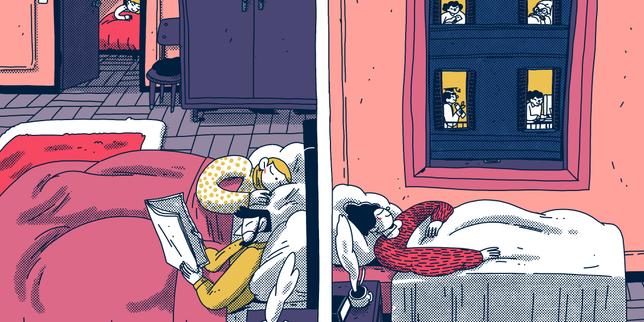
The doorbell rings at 9:00 PM on a Tuesday. It is a sound that, for most of us, triggers a mild sense of annoyance or a fleeting thought about a late delivery. But for Claire, a retired teacher living in a quiet suburb of Lyon, that chime is a heavy, physical weight. Behind the wood of her front door stands a person she has never met. This person carries their entire life in a backpack that has seen better decades, and they are there because the alternative is a park bench or a concrete stairwell where the wind tunnels between office buildings.
Claire is part of a quiet, growing network of "solidarity hosts." These are people who have looked at the crumbling infrastructure of state-run emergency housing—the saturated hotlines, the overflowing shelters, the bureaucratic labyrinths—and decided to turn their spare bedrooms into a frontline defense against the street.
It is an act of radical vulnerability.
Most people think of hospitality as a transactional exchange. We host friends for the social capital of a dinner party, or we host strangers through apps for the digital capital of a few extra euros. But what happens when the transaction is stripped away? When there is no five-star rating system, no insurance policy, and no clear exit strategy if things "go wrong"?
The Architecture of the Unknown
The math of homelessness is cold and relentless. In cities across Europe, the gap between available emergency beds and the number of people sleeping rough is not a gap; it is a chasm. When a person calls a social services hotline and hears a recorded message or a polite "try again tomorrow," the biological clock of survival starts ticking.
Consider a hypothetical young man named Elias. He is twenty-four, his asylum claim is in a legal limbo, and his temporary permit to stay in a hostel expired at noon. He has exactly 14 euros. If he sleeps on the street tonight, his chances of finding a job or staying healthy enough to navigate his legal case drop by half. The street is a trap that hardens around you the moment you sit down on the pavement.
This is where the host enters the frame.
Associations like Welcome France or Réfugiés Bienvenue act as the precarious bridges between Claire’s quiet hallway and Elias’s desperate night. They don't just match a bed to a body. They attempt to match two human histories that, under any other circumstances, would remain parallel lines.
But let’s be honest about the friction. We live in a culture of curated safety. We install Ring doorbells to vet the delivery driver. We use facial recognition to unlock our phones. To bring an unknown person into the sanctuary of the home—the place where we are most unguarded, where we sleep and shower and leave our mail on the counter—is to defy every modern instinct of self-preservation.
The Myth of the Perfect Guest
The biggest hurdle isn't the physical space. It’s the internal narrative. Hosts often start with a romanticized version of the "deserving" guest: a quiet, grateful scholar who stays out of the way and speaks perfect French.
Reality is messier.
Trauma doesn't always look like a sad face in a documentary. Sometimes it looks like a guest who sleeps until 2:00 PM because they haven't felt safe enough to close their eyes in months. Sometimes it looks like a guest who is irritable, or who smokes out the window despite the house rules, or who simply doesn't know how to use an induction stove.
"The first three days are the hardest," Claire admits. She’s reflecting on a period where she hosted a young woman from Guinea. "You find yourself listening to their footsteps in the hallway. You wonder if you should lock your bedroom door. You feel guilty for wondering if you should lock your bedroom door. It’s a psychological tug-of-war between your values and your lizard brain."
The organizations managing these stays know this. They aren't selling a Hallmark movie. They provide "coordinators"—essentially social mediators—who act as a pressure valve. If the guest is struggling with paperwork, the coordinator handles it. If the host feels overwhelmed by the presence of a stranger, the coordinator listens.
They are managing the "risk," but the risk is rarely what people imagine. It’s not violence or theft. In the vast majority of these solidarity stays, the "failure" is simply a mismatch of expectations. It’s the realization that living with a stranger is hard work, regardless of whether that stranger is a refugee or a roommate from Craigslist.
When the Safety Net Fraying
Why are citizens doing this at all? It is a question that points directly to a systemic paralysis.
In many regions, the state has effectively outsourced its moral obligations to the private living rooms of its citizens. The 115 emergency number in France, for instance, is frequently described as a lottery where the odds are stacked against the caller. When the institutional safety net is full of holes, the individual becomes the patch.
This creates a strange, unintended tension. On one hand, the solidarity of these hosts is a beautiful testament to human empathy. On the other, it is a symptom of a broken machine. If Claire didn't open her door, Elias would be on the street. Because Claire does open her door, the pressure on the state to provide a permanent solution is momentarily eased.
We are watching a shift from "rights" to "charity." A right is something the state owes you; charity is something a stranger chooses to give you. When housing moves from the former to the latter, it becomes conditional. It depends on whether you are "likable" or whether a host has a spare room in a specific zip code.
Yet, for the person standing on the doorstep at 9:00 PM, this philosophical debate is irrelevant. They don't need a lecture on the failures of the welfare state. They need a pillow.
The Geography of the Kitchen Table
The transformation usually happens in the kitchen.
There is something about the act of sharing a meal—or even just sharing the space where meals are made—that dissolves the "Other." When Elias shows Claire how to make a specific type of tea, or when Claire explains the baffling complexity of local trash recycling, the labels of "Host" and "Refugee" begin to peel off.
They become two people navigating the mundane.
"You start to see the person behind the 'case file,'" says Marc, another host who has taken in three different people over the last two years. "You realize they have the same boring anxieties as you. They worry about their teeth. They miss their mothers. They find the weather depressing. Once you see the boredom in someone, you stop being afraid of them."
This is the invisible stake of the movement. It isn't just about preventing frostbite or providing a roof. It is about the restoration of dignity through proximity. In a shelter, you are a number in a bunk. In a home, you are the person who likes their coffee with two sugars. That distinction is the difference between surviving and existing.
The Exit Strategy
The most haunting question in this entire social experiment is the one that stays unvoiced: What happens if it doesn't work?
If a host decides they can no longer cope, or if a guest’s behavior becomes genuinely problematic, the "solidarity" can feel very fragile. The associations promise a "relocation" within 24 or 48 hours, but in a world where beds are scarce, that promise is a logistical nightmare.
The fear of being the person who "puts someone back on the street" is a powerful deterrent. It keeps some people from ever signing up, and it keeps others hosting long after they have hit their emotional limit.
This is the hidden cost of kindness. It is an emotional tax paid by those who refuse to look away. They take on the stress of the state, the trauma of the guest, and the judgment of neighbors who ask, "Aren't you afraid of what might happen?"
But then there is the other side.
There is the moment when Elias gets his papers. Or the moment he finds a small studio apartment of his own. Or the moment he simply gets a job at a local bakery and comes home with a baguette to share as a thank you.
These aren't "game-changing" miracles in the grand scheme of the housing crisis. They are small, quiet victories. They are proof that trust, while dangerous, is also the only thing that actually builds a floor under someone’s feet.
Tonight, thousands of people will sleep in beds that do not belong to them, in homes owned by people who owe them nothing. They will wake up, use a stranger's towel, and walk out into a world that is largely indifferent to their existence. But for a few hours, the wind won't reach them. The door is locked, the radiator is humming, and the geography of the city feels just a little bit smaller, and a little bit kinder.
Claire sits in her living room after her guest has gone to bed. The house is quiet. The "what if" still lingers in the back of her mind, a low-frequency hum that never quite disappears. But she thinks of the girl from Guinea, now living in a shared flat in Marseille, who still sends a text every Sunday just to say she is safe.
Claire realizes that the door doesn't just let a stranger in. It lets the world in. And while the world is often terrifying, it is much harder to fear it when it’s sitting at your table, drinking your tea, and asking how to say "goodnight" in your language.