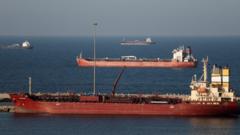
The security of the Strait of Hormuz is not a matter of "securing a route" in a general sense; it is a problem of managing a high-frequency, low-latency kinetic bottleneck where 20% of the world’s daily liquid petroleum passes through a chasm only 21 miles wide at its narrowest point. For the United Kingdom, the strategic calculus involves a mismatch between historical naval prestige and current hull-count realities. To maintain energy security and fulfill defense obligations, the UK must transition from a model of broad presence to one of high-density technical interdiction and "all options" contingency planning.
The Triple Constraint of Hormuz Transit
The operational environment within the Strait is defined by three intersecting constraints that dictate how the Royal Navy and its allies must deploy assets.
1. Geographic Determinism and Thermal Inversion
The Strait is characterized by shallow waters and complex acoustic profiles. Thermal inversion layers in the Persian Gulf often mask the signature of small, fast-attack craft (FAC) and diesel-electric submarines. For a Type 45 destroyer, the primary challenge is not a peer-to-peer blue water engagement but "clutter management." The radar cross-section of a thousand fishing dhows provides the perfect "noise" for asymmetric actors to hide "signals"—specifically, suicide GPS-guided boats or short-range anti-ship missiles (ASCMs).
2. The Volumetric Flow of Global Energy
The economic impact of a disruption at Hormuz is non-linear. Because global oil markets operate on "just-in-time" delivery cycles, even a 48-hour closure triggers a massive spike in Brent Crude due to the immediate repricing of risk by insurance syndicates (Lloyd’s of London). The UK’s reliance is not just on the physical molecules of oil reaching its shores, but on the stability of the global price floor.
3. Legal Ambiguity of "Innocent Passage"
Under the United Nations Convention on the Law of the Sea (UNCLOS), ships enjoy the right of transit passage. However, Iran’s interpretation of these laws often differs, particularly regarding warships. The UK’s "all options" approach must balance the need for aggressive escorting with the risk of being labeled the aggressor in a contested legal theater, which could trigger "cluttered" kinetic escalations that insurance markets cannot quantify.
The Cost Function of UK Maritime Escorts
The Royal Navy’s current posture relies on the "Montrose Model"—permanent presence supplemented by rotational Type 23 frigates and Type 45 destroyers. The analytical flaw in this model is the exhaustion of air-defense cells against low-cost threats.
- The Interceptor-to-Threat Ratio: A Sea Viper missile, costing upwards of £1 million, is a high-spec solution for a low-spec problem. If an adversary launches a swarm of $20,000 loitering munitions, the UK faces an "economic attrition" curve where it wins the tactical engagement but loses the strategic resource war.
- Hull Availability vs. Mission Creep: With the fleet size constrained, deploying a carrier strike group (CSG) to the region provides a massive psychological deterrent but leaves other theaters, like the High North or the Mediterranean, under-resourced. The "all options" strategy must therefore pivot toward unmanned systems and "loyal wingman" underwater tech to augment the physical presence of manned ships.
Operational Frameworks for "All Options"
When the UK government discusses "all options," it refers to a tiered escalation matrix designed to deter without igniting a regional conflagration.
The Intelligence-Led Interdiction Pillar
The first option is not kinetic; it is digital. By integrating UK Space Command assets with maritime patrol aircraft (P-8A Poseidon), the RN creates a persistent "God’s eye view" of the Strait. The goal is to identify anomalous behavior in Iranian Islamic Revolutionary Guard Corps Navy (IRGCN) fast boats before they leave territorial waters. Predictive modeling of swarm patterns allows the UK to position assets to block routes rather than react to attacks.
The Kinetic Escalation Matrix
If a ship is seized or attacked, the Royal Navy must move from passive escort to active kinetic defense. This includes "fire-and-forget" systems that can target multiple incoming FACs simultaneously. The "all options" mantra includes the deployment of Royal Marines (42 Commando) specialized in VBSS (Visit, Board, Search, and Seizure) operations from Merlin and Wildcat helicopters.
Tactical Realism: The Capability Gap
The United Kingdom must address the technical reality that a single Type 45, while an air-defense marvel, can only be in one place at once. The Strait of Hormuz is a "linear" problem—ships follow specific lanes. This creates a predictable target profile.
- The Drone Swarm Bottleneck: The primary threat in 2026 is no longer the Kilo-class submarine but the swarm-based loitering munition.
- The Response Strategy: The Royal Navy must integrate directed-energy weapons (DEW) like DragonFire to lower the "cost-per-shot" in the Strait. Without DEW, the UK's "all options" are limited by the depth of its magazine of expensive traditional missiles.
Insurance Risk as a Weapon of War
In Hormuz, the "weapon" of choice is often not a missile but a press release. By creating an atmosphere of insecurity, an adversary can drive the "War Risk" premium for tankers so high that the Strait becomes economically impassable without a physical blockade. The UK’s "all options" must therefore include a financial guarantee or a "State-Backed Indemnity" for UK-flagged vessels to ensure continuity of supply during periods of high kinetic tension.
The Strategic Shift to Multilateralism
The UK cannot secure the Strait of Hormuz alone. The "all options" framework is inherently tied to the International Maritime Security Construct (IMSC) and Operation Sentinel.
- Coalition Integration: By sharing the burden of escorting with the US Navy (5th Fleet) and other partners, the UK maximizes its hull-availability.
- Technological Interoperability: Data-sharing across Link 16 and future integrated battle networks (JADC2-aligned) ensures that a UK frigate can utilize sensor data from a US drone or a French satellite.
The United Kingdom's "all options" strategy for the Strait of Hormuz requires a departure from traditional naval grandiosity toward a lean, data-integrated force that prioritizes "cost-effective lethality." The Royal Navy should focus on the deployment of unmanned underwater vehicles (UUVs) to monitor the sea floor for acoustic sensors and the rapid integration of directed-energy weapons to counter low-cost aerial threats. Only by decoupling the cost of the interceptor from the cost of the threat can the UK maintain a long-term presence in a contested kinetic bottleneck. The final play is the move from "Presence" to "Persistence"—using autonomous systems to maintain a 24/7 watch over the shipping lanes, freeing up manned hulls for high-intensity theater defense.
Would you like me to analyze the specific technical capabilities of the Type 45's Sea Viper system in a swarm-defense scenario?