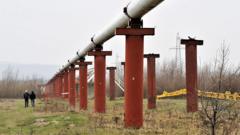
The headlines are screaming "blackmail" and "betrayal" as if the geopolitical energy grid were a polite dinner party. Most analysts are currently obsessed with the friction between Kyiv and its neighbors—specifically Hungary and Slovakia—over the restriction of Russian oil through the Druzhba pipeline. They frame it as a desperate, messy power play by Volodymyr Zelensky to force the EU’s hand.
They are wrong.
What the "lazy consensus" fails to grasp is that the current pipeline row isn't a diplomatic tantrum. It is a necessary, albeit brutal, market correction. For decades, Central Europe has lived in a state of artificial energy security, subsidized by a dependency that everyone knew was a ticking time bomb. Ukraine isn't "blackmailing" its allies; it is finally charging the market rate for the existential risk it carries while acting as the continent's involuntary plumber.
The Myth of the "Reliable Transit Partner"
The standard narrative suggests that Ukraine is breaking a sacred bond of transit reliability. This assumes that "reliability" exists in a vacuum. It doesn't.
I’ve spent years watching energy traders hedge against "political risk," but they rarely account for the absurdity of the Druzhba setup. We are talking about a scenario where a country under active invasion is expected to maintain the infrastructure that fuels its aggressor’s economy—and the economies of neighbors who often block military aid to that very same country.
The idea that transit should remain "business as usual" while the terminal points are at war is a financial hallucination. Ukraine is simply aligning its infrastructure policy with its military reality. If Hungary and Slovakia didn't see this coming after February 2022, that isn't a failure of Ukrainian diplomacy. It is a failure of Central European risk management.
Why "Diversification" Was Always a Lie
Let’s look at the data. Hungary and Slovakia have had over two years to decouple from Lukoil. Instead, they leaned in. While the rest of the EU scrambled to build LNG terminals and secure North Sea contracts, some players decided to bet on the status quo, hoping the "cheap" Russian crude would keep flowing forever.
The problem is that Russian oil was never actually cheap. It was sold at a discount that carried a massive, unpriced geopolitical premium. By cutting off Lukoil, Ukraine is forcing a "mark-to-market" event on European energy strategy.
- Fact: The Adria pipeline from Croatia exists.
- Fact: It has the capacity to supply the region.
- Fact: It costs more than Russian piped oil.
The "blackmail" outcry is actually a complaint about having to pay the real price of energy in a world without Russian subsidies. Ukraine is effectively acting as the ultimate auditor, revealing that the "energy security" of Central Europe was actually just a credit line from the Kremlin that has finally been called in.
The Logistics of the "Squeeze"
To understand the mechanics here, you have to look at the chemistry of the refineries. The Slovnaft refinery in Bratislava and the MOL refinery in Hungary are calibrated for Urals—a sour, heavy crude. Switching to lighter, sweeter blends from the global market isn't just a matter of turning a different valve; it requires technical retrofitting and a higher "crack spread" (the difference between the price of crude and the petroleum products extracted from it).
Critics argue that Ukraine is "weaponizing" its geography. Of course it is. Geography is a weapon. In any other industry, if a supplier (Russia) tried to kill the distributor (Ukraine), the customers (Hungary/Slovakia) would have found a new logistics chain immediately. The fact that they didn't—and are now crying foul—suggests they expected Ukraine to subsidize their comfort with its own blood and soil.
The Intellectual Dishonesty of "European Solidarity"
There is a particular brand of irony in seeing officials in Budapest invoke EU rules against Kyiv. They cite the 2014 Association Agreement, claiming Ukraine is violating its commitment to transit energy.
This is a classic "suit and tie" defense for a "street fight" problem.
Solidarity is a two-way street. You cannot systematically undermine a neighbor's defense efforts and then demand that same neighbor maintain your industrial profit margins. If the EU wants a stable energy landscape, it must stop treating Ukraine as a passive pipe-holder and start treating it as the gatekeeper it has become.
The Downside: Markets Hate Volatility
I’ll admit the counter-risk: this move increases the "volatility tax" on everyone. When you disrupt a major flow of $70-per-barrel oil, the replacement isn't just $85 oil; it’s $85 oil plus the cost of uncertainty.
Investors in European manufacturing are watching this and wondering if the continent has any cohesive energy policy at all. The risk isn't just a lack of oil; it’s the lack of a predictable regulatory environment. By squeezing the pipeline, Ukraine is introducing a variable that many institutional investors find "un-investable."
But here’s the cold truth: the volatility was already there. Ukraine didn't create the instability; it just stopped hiding it.
Stop Asking if it’s Legal—Ask if it’s Logical
People keep asking: "Is Ukraine allowed to do this under international law?"
That is the wrong question.
The right question is: "Why would any rational actor continue to facilitate the enrichment of an enemy?"
Imagine a scenario where a tech company's servers are hosted by a competitor who is actively trying to bankrupt them. Would you expect that company to keep paying the electricity bill for those servers? Or would you expect them to pull the plug the moment they had the leverage?
Kyiv has found its leverage. In the brutal logic of 21st-century warfare, infrastructure is just another front. If the EU wants the oil to flow, it needs to provide a security guarantee that makes the transit worth the risk.
The New Reality of Energy Transit
We are moving into an era where "neutral" transit no longer exists. Every kilometer of pipe is a political statement. The Druzhba pipeline—ironically named "Friendship"—is a relic of a Soviet-era design intended to create exactly this kind of leverage.
Ukraine is currently dismantling that legacy. They aren't just cutting off Lukoil; they are cutting the umbilical cord of the old Eastern Bloc.
The whining from Bratislava and Budapest isn't the sound of victims; it’s the sound of a legacy system crashing. The era of cheap, blood-soaked energy is over. If the neighbors can't handle the new price of admission, they shouldn't blame the gatekeeper. They should blame their own refusal to build a fence when they had the chance.
The "blackmail" narrative is a comfort blanket for the unprepared. Ukraine is simply teaching a masterclass in modern sovereignty: if you control the flow, you control the conversation.
Pay up or go cold.