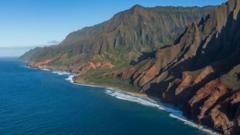
The sky over Kauai is a deceptive masterpiece. To a tourist peering through the plexiglass of a helicopter, the jagged emerald cliffs of the Na Pali Coast look like a prehistoric dream, a place where time forgot to move. But to the pilots who dance between those ridges, the air is a living, breathing thing. It is a chaotic invisible river that can turn from a gentle breeze into a hammer in the span of a heartbeat.
On a Tuesday that began like any other, that hammer fell.
The facts, as recorded by the cold ink of a preliminary report, are sparse. A Robinson R44, a light and nimble bird favored for its visibility, went down near the remote cliffs of the Hanakoa Valley. Three people were on board. None of them walked away. In the sterile language of aviation authorities, it was an "uncontrolled descent into terrain." In the language of the human heart, it was the end of three individual universes.
We often treat these events as statistics, a brief flicker on a news feed before we scroll to the next tragedy or triumph. We talk about safety records, maintenance logs, and weather minimums. We analyze the torque of the rotors and the pitch of the blades. Yet, the real story isn't in the wreckage. It is in the coffee cup left half-full on a kitchen counter that morning. It is in the excited text sent to a family group chat minutes before takeoff: "You won't believe how beautiful this is."
The Gravity of the Island
Hawaii is not just a destination; it is an obsession. For those who save for years to visit, a helicopter tour is the crown jewel of the trip. It is the only way to see the "Jurassic Park" falls or the hidden cathedrals of rock that no trail can reach. This demand creates a relentless rhythm. Pilots fly multiple "turns" a day, hopping from the Lihue airport into the wilderness and back again.
Consider the pilot. Usually, these are men and women who live for the vertical. They aren't just bus drivers in the sky; they are artists of physics. They understand that a helicopter does not want to fly. Unlike an airplane, which has the natural grace of a glider, a helicopter stays aloft through a violent struggle against gravity. It is a thousand parts vibrating in loose formation, held together by engineering and sheer will.
When something goes wrong in a place like Hanakoa, the options vanish. The terrain is a vertical maze of thick jungle and razor-sharp lava rock. There are no flat spots. No easy outs. If the engine coughs or the wind shears off a cliff face with too much teeth, the pilot has seconds to make a choice that will define every life on board.
The Weight of a Small Bird
The Robinson R44 is a specific kind of machine. It is a piston-powered aircraft, meaning it relies on an engine similar in concept to what you’d find in a high-performance car, rather than the massive turbines found in larger commercial choppers. It is light. It is responsive. It is also more susceptible to the whims of the atmosphere.
In the aviation community, there is a recurring debate about the use of light, single-engine aircraft for commercial tours in high-stakes environments. The data shows that the R44 has been involved in numerous incidents over the decades, leading to various safety mandates, including bladder-style fuel tanks to prevent post-crash fires. But no amount of engineering can account for the "micro-climates" of Kauai.
One valley can be drenched in sun while the next is a swirling cauldron of mist and downdrafts. A pilot enters a canyon thinking they have a clear path, only to find the "door" has slammed shut behind them as a cloud bank rolls in from the Pacific. It is a high-stakes game of hide-and-seek with the weather.
The Human Cost of the View
What do we owe the three souls who perished?
We owe them more than a shrug and a comment about the "risks of travel." We owe them an acknowledgment of the fragility of our adventures. We go to these places to feel alive, to touch the sublime, to see something so grand it makes our daily worries feel small. There is a profound irony in seeking that feeling of life and finding its opposite.
The recovery efforts in Hawaii are never easy. Search and rescue teams have to rappel into canyons or hover precariously over dense canopy just to reach a site. They work in a silence that is heavy with the salt of the ocean and the scent of crushed ferns. When they find the site, they aren't looking at "terrain impact." They are looking at luggage, cameras, and the tangible remains of a vacation that was supposed to be the highlight of a lifetime.
Behind the headlines, there are the families. They are the ones who get the phone call that feels like a physical blow. They are the ones who have to navigate the bureaucracy of grief—the National Transportation Safety Board (NTSB) investigations, the insurance claims, the long wait for answers that may never be fully satisfying. For them, the "dry facts" of a crash report are a roadmap of their greatest loss.
A Different Kind of Turbulence
There is a psychological phenomenon known as "get-there-itis." It is the internal pressure a pilot feels to complete a mission, especially when passengers have paid hundreds of dollars for a "once-in-a-lifetime" experience. It is a silent passenger in the cockpit. While there is no evidence yet that this played a role in the Hanakoa crash, it is a specter that haunts the entire industry.
The tension between commerce and caution is a tightrope. Every time a flight is canceled due to "marginal" weather, a company loses money and a tourist loses a dream. But the alternative is the silence that followed Tuesday's impact.
We must ask ourselves what we value in our pursuit of the spectacular. Is the view worth the margin of error? For most, the answer is a confident yes—until it isn't. We trust the machines, we trust the pilots, and we trust the sky. Most of the time, that trust is rewarded with a memory that lasts forever. Occasionally, it is met with the unforgiving reality of physics.
The Echo in the Valley
The investigation will take months, perhaps years. Experts will sift through the bent metal and the electronic data. They will look at the maintenance logs. They will check the pilot’s hours and recent sleep patterns. They will recreate the weather patterns down to the millibar. Eventually, a "probable cause" will be issued.
But for the community in Kauai, the cause is already felt. It is the missing sound of a specific tail number coming home. It is the sight of the emergency lights flickering against the dark green backdrop of the mountains.
The beauty of the Na Pali coast remains. The waterfalls still tumble into the sea, and the cliffs still glow red in the setting sun. But for three families, that beauty is now forever intertwined with a shadow. The islands are spectacular precisely because they are wild, and the wild does not make promises. It only offers experiences, some of which come at a price that defies calculation.
The rotors have stopped turning in Hanakoa, but the ripples of that moment are moving outward, crossing the ocean to homes where three chairs will now sit empty. We read the news and we feel a momentary chill, a brief recognition of our own mortality, before we go back to our coffee and our screens. We forget that for some, the world didn't just change; it ended in a valley of emerald green, under a sky that looked like a masterpiece.
Somewhere in a hangar, a mechanic picks up a wrench. A new pilot checks the wind. A tourist signs a waiver. The cycle continues, driven by the human need to see what lies over the next ridge, even when we know that the air is heavy with the ghosts of those who flew there before us.