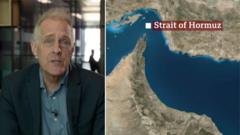
The Strait of Hormuz is a geographic anomaly that holds the global economy hostage. At its narrowest point, the shipping lanes are only two miles wide. Through this tiny needle’s eye, nearly 21 million barrels of oil pass every single day. That represents roughly one-fifth of the world’s daily liquid petroleum consumption. If those lanes close, the global supply chain doesn't just slow down; it breaks. The difficulty of passing through this corridor isn't just about rocks and shallow water. It is a calculated, multi-layered gauntlet of asymmetrical warfare, aging international law, and the terrifying physics of modern naval combat.
A Geography Built for Ambush
The strait connects the Persian Gulf with the Gulf of Oman and the Arabian Sea. While the entire waterway is about 21 miles wide at its pinch point, the depth and underwater topography force massive Very Large Crude Carriers (VLCCs) into two specific lanes. One lane is for inbound traffic, the other for outbound. A two-mile wide buffer zone separates them.
These ships are not nimble. A fully loaded supertanker can take over two miles just to come to a full stop. They are essentially floating islands of steel and flammable liquid moving at a crawl. This makes them the ultimate "soft targets." To their north lies the Iranian coastline, jagged with cliffs and hidden coves that provide perfect cover for land-based anti-ship cruise missiles and fast-attack craft.
The water depth is another silent enemy. Much of the Persian Gulf is surprisingly shallow. This limits the maneuverability of deep-draft vessels and makes the deployment of naval mines exceptionally effective. A single "smart" mine, triggered by the specific acoustic signature of a tanker’s hull, can paralyze the entire lane. Clearing these mines is a slow, agonizing process that requires specialized vessels that most navies have neglected in favor of flashier destroyers.
The Doctrine of Asymmetrical Suffocation
Iran knows it cannot win a traditional blue-water naval battle against a carrier strike group. Instead, they have perfected the art of "swarming." The Islamic Revolutionary Guard Corps Navy (IRGCN) operates hundreds of small, fast boats armed with rocket launchers, torpedoes, and man-portable air-defense systems.
In a confined space like the Strait, numbers beat technology. A billion-dollar destroyer can track twenty targets, but it cannot easily stop fifty explosive-laden speedboats hitting from all angles at 50 knots. This tactic turns the narrowness of the Strait into a weapon. The high volume of civilian traffic creates a "cluttered" environment where identifying a threat before it strikes is nearly impossible. Radar becomes a mess of signals. Thermal sensors struggle with the heat haze reflecting off the water. By the time a threat is identified, the engagement distance is often less than a mile.
The Legal Gray Zone of Territorial Waters
International law adds a layer of friction that few analysts discuss. Under the United Nations Convention on the Law of the Sea (UNCLOS), ships enjoy the right of "transit passage" through international straits. However, the Strait of Hormuz is entirely comprised of the territorial waters of Iran and Oman.
Iran has signed but never ratified UNCLOS. They argue that they only recognize "innocent passage," a much more restrictive standard. Under innocent passage, a coastal state can temporarily suspend transit if it deems the passage prejudicial to its peace or security. This legal ambiguity is used as a tool of harassment. Iranian officials often cite environmental concerns or "maritime violations" as a pretext to board and seize tankers.
This creates a massive insurance nightmare. When a ship enters the Strait, it isn't just navigating water; it is navigating a shifting legal minefield. The moment a "security incident" occurs, War Risk Insurance premiums for every vessel in the region skyrocket. For a single VLCC trip, these costs can jump from $30,000 to over $150,000 in a matter of hours. These costs are eventually paid by the person filling up their car in London, Tokyo, or New York.
The Illusion of Alternatives
Politicians often point to pipelines as the solution to bypassing the Strait. On paper, it looks simple. The Abu Dhabi Crude Oil Pipeline (ADCOP) can move 1.5 million barrels per day to the port of Fujairah. Saudi Arabia’s East-West Pipeline can move roughly 5 million barrels per day to the Red Sea.
The math doesn't add up.
Even if every bypass pipeline in the region operated at 100% capacity—which they never do due to maintenance and technical constraints—they could only handle about 6.5 million barrels per day. That leaves 14 million barrels with nowhere to go but through the water. There is no "Plan B" for the volume of energy the world requires. The infrastructure to replace the Strait of Hormuz simply does not exist and likely never will due to the staggering cost and the geological reality of the Arabian Peninsula.
The Electronic Fog of War
Modern transit through the Strait is now complicated by a new variable: Electronic Warfare (EW). In recent years, ships have reported massive GPS interference and "spoofing" in the area. Spoofing is far more dangerous than simple jamming. Jamming tells the captain their GPS is broken. Spoofing tells the captain they are ten miles away from their actual location.
In a narrow two-mile lane, a ten-mile error is catastrophic. Ships have been lured into Iranian territorial waters by manipulated signals, providing a legal "justification" for seizure. The reliance on digital navigation has created a vulnerability that 18th-century sailors never had to worry about. Crew members are now being trained to return to visual navigation and radar-range fixing, but the speed of modern commerce makes these manual methods difficult to maintain.
The Logistics of a Failed Passage
If a ship is disabled in the Strait, the problem is not just the lost cargo. It is the blockage. Because the deep-water channel is so narrow, a grounded or sinking tanker becomes a physical barrier. Salvaging a 300,000-ton vessel in a high-threat environment is a logistical impossibility.
The environmental impact would also be permanent. The Persian Gulf is a semi-enclosed body of water with very slow circulation. A major spill in the Strait would circulate inward, devastating the desalination plants that provide drinking water for millions of people in Kuwait, Qatar, and the UAE. The Strait isn't just an oil pipe; it's a lifeline for survival in the desert.
The Strategic Stalemate
Passing through the Strait of Hormuz is hard because it is the world's most effective lever. Every actor in the region knows that a total closure would lead to a global depression, but they also know that the threat of closure is often more valuable than the act itself. This tension creates a permanent state of low-level conflict.
The difficulty is baked into the geography, amplified by the technology of cheap drones and expensive missiles, and cemented by a global thirst for oil that shows no sign of waning. As long as the world runs on petroleum, those two miles of water will remain the most dangerous transit point on the planet.
Western navies continue to dump billions into high-end defenses, but the math of the Strait remains stubbornly in favor of the harasser. You cannot secure a hallway when the walls themselves are part of the trap.
Check the daily transit logs of the US Naval Institute to see the current density of the Strait’s traffic.