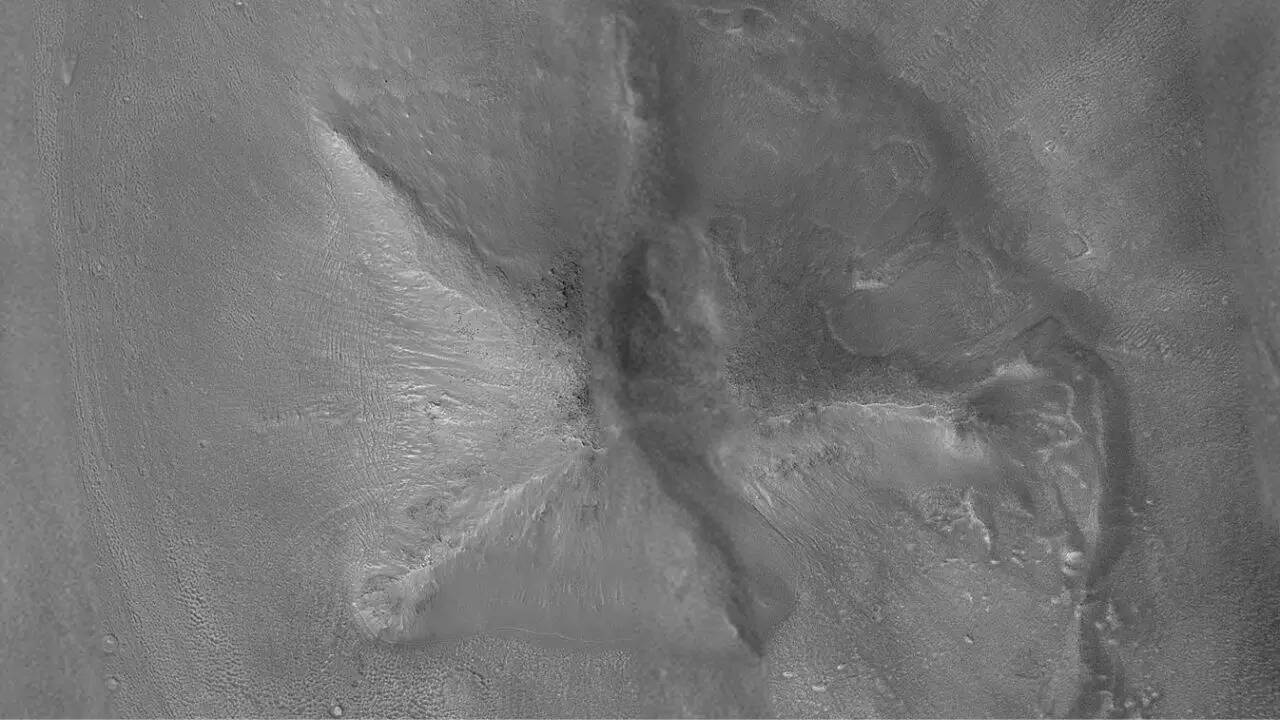
The internet is currently obsessed with a sharp, three-sided geometry captured in the Martian dust. Viral posts across social platforms claim that NASA’s Curiosity rover has finally stumbled upon the smoking gun of an ancient civilization—a "perfect" pyramid rising from the arid plains of Gale Crater. In reality, this viral sensation is not a monument to a lost Martian dynasty but a textbook case of pareidolia fueled by low-resolution shadows and a fundamental misunderstanding of planetary geology.
While the image looks striking at a glance, it is a small rock, likely no larger than a foot tall, shaped by millions of years of wind erosion. This process, known as ventifacting, creates sharp edges and flat faces on rocks as sand-laden winds blast them from specific directions. To the untrained eye, the resulting symmetry looks intentional. To a geologist, it is the inevitable result of a steady wind and a long timeline.
The "three-sided pyramid" is a ghost. It is a trick of light and shadow that thrives because the human brain is biologically hardwired to find familiar patterns in chaotic data.
The Architecture of a Viral Hoax
The lifecycle of this story follows a predictable, cynical pattern. It usually begins on a fringe forum or a dedicated "UFO hunter" YouTube channel. A user takes a high-resolution Raw Instrument Image from the Jet Propulsion Laboratory (JPL) public database and applies heavy cropping and contrast adjustments. By blowing up a tiny portion of the frame and cranking the shadows, a natural rock formation begins to look like a megalithic structure.
Once the "discovery" is posted, it is picked up by content farms that prioritize clicks over verification. These outlets use loaded language to suggest a cover-up, asking "What is NASA hiding?" rather than "What are we looking at?" This creates a feedback loop. By the time the image hits the mainstream, the context—the scale of the rock, its surroundings, and the geological history of the region—has been stripped away.
We see this repeatedly because Mars occupies a unique space in the collective imagination. It is close enough to be reached but distant enough to remain a canvas for our projections. From the "Face on Mars" in 1976 to the "Martian Bigfoot" and the "Alien Doorway" of recent years, every generation gets the optical illusion it deserves.
The Physics of the Martian Wind
To understand why these shapes exist, you have to look at the atmosphere. Mars has an atmospheric density about 1% that of Earth’s. While the air is thin, it is highly active. Seasonal dust storms can cover the entire planet, and local winds are constant.
When wind carries fine basaltic sand, it acts like a natural sandblaster. On Earth, we see this in the Antarctic Dry Valleys or the Namib Desert. Rocks that stay in one place for eons are carved into ventifacts. If the wind direction is consistent, or if the rock periodically shifts to expose a new side, it develops multiple flat faces (facets) and sharp edges (brines).
The pyramid in question is a classic ventifact. Its "perfect" lines are actually slightly irregular when viewed from other angles, a fact the viral posts conveniently ignore. NASA’s Curiosity and Perseverance rovers have photographed thousands of these stones. Most are lumpy and unremarkable, but statistically, out of millions of rocks, a few will inevitably resemble something manufactured.
Why the Truth Struggles to Compete
There is a massive financial incentive to keep the mystery alive. Ad-supported websites and social media influencers generate significant revenue by "debunking" NASA’s official stance. They frame scientific skepticism as a lack of imagination or, worse, a deliberate conspiracy to gatekeep the truth about extraterrestrial life.
This creates a dangerous gap in public literacy. When people are told that a clear geological feature is a "pyramid," they lose trust in the actual, breathtaking science being conducted on the surface. We are currently analyzing complex organic molecules and ancient riverbeds that could prove Mars once supported microbial life. That is a profound, difficult, and slow-moving reality. A "pyramid" is a fast, easy dopamine hit that requires no background in chemistry or physics.
The Cognitive Trap of Pareidolia
Evolutionary biology is the primary culprit here. Early humans who could spot a tiger hiding in the tall grass survived. Those who didn't, died. As a result, our brains are optimized to find "signals" even when there is only "noise."
This is why we see faces in clouds, Jesus on a piece of toast, and pyramids on Mars. In the case of the three-sided rock, the brain ignores the surrounding rubble and focuses on the one object that matches a known human construct. We aren't seeing Mars; we are seeing a reflection of our own architectural history.
The Problem with Digital Enhancement
Modern digital photography on Mars doesn't work like a film camera. The rovers use Mastcams and ChemCams that take multiple exposures and combine them. When a fringe theorist "enhances" these images, they are often just amplifying image artifacts—the digital noise that occurs when a sensor struggles with high contrast.
If you look at the raw data for the pyramid rock, the "walls" are not smooth. They are pitted, weathered, and consistent with the volcanic basalt found throughout the crater. There is no mortar, no joining, and no scale. If this were a pyramid built by sentient beings, it would be a pyramid for ants.
The Role of NASA’s Public Image
NASA is often criticized for being "boring" in its rebuttals. Scientists use cautious language. They speak in probabilities. A geologist will say, "The morphology is consistent with aeolian erosion of a basaltic substrate."
The conspiracist says, "It’s an ancient tomb."
The latter is a better story. It sells more copies. It gets more shares. But the former is the one that actually gets us closer to understanding our place in the solar system. The irony is that the real Mars is far more interesting than the fictionalized version. We are looking at a planet that died, and by studying its rocks—even the pyramid-shaped ones—we are learning how to prevent our own world from following the same path.
Beyond the Viral Snapshot
If we want to find life or civilization on Mars, we won't find it in a grainy crop of a single rock. We will find it in the isotopic ratios of the soil and the methane spikes in the atmosphere. These are the "hard" signals that the scientific community is hunting.
The three-sided pyramid is a distraction. It is a monument to our own desire for company in a vast, silent universe. We want to find something familiar in the dark, so we invent it. The next time a "megalith" goes viral, look at the scale bar. Look at the shadows. Ask if the wind had a hand in the carving.
Investigate the source of the claim. If the person posting it is selling a book on "Forbidden Archeology," you aren't looking at a discovery. You are looking at a marketing campaign.
Mars is a graveyard of many things, but ancient civilizations aren't one of them. It is a graveyard of our assumptions. Every time we send a rover, we expect to find something that looks like us, but we keep finding something much stranger: a world that evolved entirely without us, following the cold, indifferent laws of geology and time. Stop looking for architects in the dust and start looking at the dust itself.