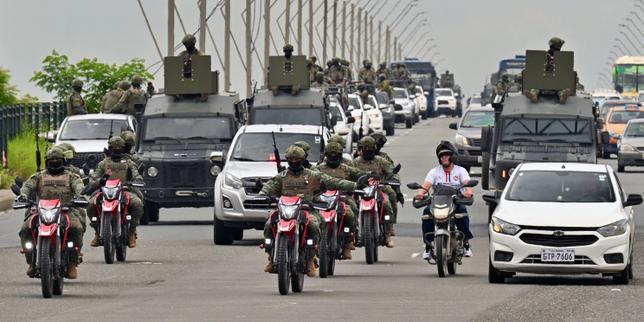
Ecuador just hit the panic button. In a move that signals either total desperation or a final line in the sand, the government launched a fifteen-day blitz involving 75,000 military personnel. They aren't doing it alone. The United States is providing the backbone of intelligence and logistics. If you've been following the descent of this once-peaceful Andean nation, you know this isn't just another routine patrol. It's a full-scale mobilization in a country that’s become the primary transit point for cocaine heading to Europe and North America.
The sheer scale of this operation is hard to wrap your head around. We're talking about nearly the entire active-duty force of the Ecuadorian military hitting the streets, the ports, and the jungle borders all at once. For two weeks, the rules of engagement have shifted. This isn't just about local crime anymore. It’s a direct confrontation with international cartels that have effectively turned Guayaquil into a war zone.
Why 75,000 Soldiers Won’t Fix the Root Problem
Deploying 75,000 troops sounds impressive on a news ticker. It looks even better in government press releases. But let's be real for a second. Military force is a blunt instrument. It's great for seizing physical territory or guarding a port, but it's notoriously bad at dismantled shadow economies. The cartels—largely backed by Mexican organizations like Sinaloa and the Jalisco New Generation—don't wear uniforms. They don't hold static positions.
They melt away.
When the army rolls into a neighborhood in Esmeraldas or the Guasmo district of Guayaquil, the "soldiers" of the drug trade simply put their guns under their mattresses and wait. They’ve got more patience than the national budget has cash. Fifteen days of high-intensity operations can disrupt a supply chain, sure. It might even spike the price of a kilo in Antwerp for a week. But once those 75,000 troops head back to their barracks, the vacuum remains.
The real issue in Ecuador isn't a lack of soldiers. It’s the rot inside the institutions. Over the last three years, we've seen "Metastasis" and "Purge"—huge judicial investigations that revealed how deeply cartel money has bought judges, police commanders, and politicians. You can't shoot your way out of a corrupted court system.
The American Shadow Over the Fifteen Day Blitz
The United States isn't just a bystander here. The involvement of Washington is the "open secret" that makes this specific operation different from the half-dozen state of emergencies declared over the last year. We're seeing a return to the heavy-handed security cooperation that was sidelined during the Correa years.
What does "support from the United States" actually look like on the ground? It’s not just boots. It’s eyes.
- P-3 Orion and Poseidon surveillance flights tracking semi-submersibles in the Pacific.
- Real-time signals intelligence provided by the DEA and Southern Command.
- Vetting units to make sure the Ecuadorian officers leading these raids aren't on a cartel payroll.
Washington is terrified of Ecuador becoming a failed state. They've seen this movie before in Colombia and Mexico. The difference is that Ecuador is dollarized. Using the U.S. dollar makes it the perfect laundry for dirty money. By supporting this fifteen-day push, the U.S. is trying to stabilize the "logistics hub" before it completely collapses into a narco-democracy. It’s a high-stakes gamble. If 75,000 troops can’t secure the ports for even two weeks, it sends a message of weakness, not strength.
Port Control is the Only Metric That Matters
Forget the arrests of low-level "chimbas" or street dealers. If you want to know if this operation is working, look at the ports. Guayaquil handles roughly 85% of Ecuador’s non-oil exports. It’s also where the vast majority of cocaine is stuffed into banana containers.
The military has been tasked with taking over "operational control" of these perimeters. Honestly, it’s a nightmare job. There are thousands of containers moving through every day. Even with scanners and dogs, you can only check a fraction of them without grinding the national economy to a halt. The cartels know this. They use "blind hook" methods—breaking into a legitimate container, tossing in the bags, and replacing the seal—in seconds.
Unless this fifteen-day operation leads to a permanent, uncorruptible military presence in the ports, it’s just theater. The exporters are terrified. They're paying "protection" money to the gangs and then paying for private security on top of that. It's a double tax that’s killing the legitimate economy.
The Human Cost of Militarization
You can't put 75,000 soldiers on the street without things getting messy. We’ve already seen reports from human rights groups about "heavy-handed" tactics in the poorer barrios. When the state treats every young man in a certain zip code as a potential terrorist, you lose the "hearts and minds" battle instantly.
The gangs—Los Choneros, Los Lobos, Los Tiguerones—they provide "services" in these areas. They provide micro-loans. They provide a twisted form of order. If the military comes in, breaks down doors, and then leaves after two weeks, they leave the population vulnerable to retaliation from the gangs they "helped" the army identify. It’s a vicious cycle that usually ends with more recruitment for the cartels, not less.
Stop Thinking of This as a Short Term Win
The biggest mistake the Ecuadorian public can make is thinking this two-week window will bring back the "Old Ecuador." That country is gone. The murder rate has surged to over 40 per 100,000 people, making it one of the most violent places in the world.
Fifteen days of operations can only do one thing: buy time.
It buys time for the government to implement the tax hikes needed to fund the security forces long-term. It buys time for the new "mega-prisons" to be finished. And it buys time for the international community to realize that Ecuador’s problem is a global problem.
If you're looking for a sign of success, don't look at the number of people handcuffed in the town square. Look at the murder rate in Guayaquil three months from now. Look at whether the "shakedown" culture in small businesses starts to fade. If the violence bounces right back to previous levels on day sixteen, then the 75,000-troop deployment was just an expensive parade.
Watch the ports. Watch the judicial appointments. If the government doesn't follow this military push with a massive purge of the courts, those 75,000 soldiers were basically just acting as high-priced security guards for a system that’s already been sold.
Anyone following this should be tracking the "Plan Fenix" updates from the presidency. Don't get distracted by the flashy videos of soldiers fast-roping onto ships. Focus on the container seizure stats and the conviction rates of the "high-value targets" supposedly being captured. That's the only data that doesn't lie.