The alarm rings at 5:15 AM. It is a sound that doesn’t signal the start of a day so much as the resumption of a calculation. For Sarah, a dental assistant in a mid-sized city, the first thought isn’t about coffee or the weather. It is about the weight of a single disposable nappy.
She lifts her eighteen-month-old son, Leo, and performs a mental audit. If she changes him now, she has four left in the pack. That has to last until Thursday. If she waits another hour, she might save one. This is the granular, exhausting arithmetic of the working poor. Sarah is not unemployed. She is not "on the dole." She works forty hours a week, her paycheck is steady, and yet she is drowning in the shallow end of the economy. Also making news recently: Finland Is Not Keeping Calm And The West Is Misreading The Silence.
We are told that work is the way out. For decades, the social contract was simple: if you show up, if you contribute, your basic needs will be met. But that contract has been shredded by a thousand small price hikes. Today, a new class of struggle has emerged. These are the parents who earn too much for state support but too little to actually live. They exist in a gray zone where the cost of being a productive member of society—commute, childcare, professional attire—consumes the very wages earned.
The Illusion of the Living Wage
The numbers tell a story that the headlines often miss. While national employment statistics might look healthy, the internal organs of the household budget are failing. Inflation is not just a graph on a news broadcast. It is a predator. When the price of basic infant formula jumps by 25 percent in a single year, it isn't a luxury that gets cut. It is a caloric deficit for the parents. More details regarding the matter are covered by NPR.
Consider the "poverty premium." It is the expensive irony of being broke. Sarah cannot afford the £30 bulk box of nappies that would last three weeks. Instead, she buys the £5 small packs at the corner shop because that is the only cash she has on Tuesday. By the end of the month, she has paid double the price per unit compared to a wealthy shopper. Poverty is not just a lack of money; it is a lack of time and the inability to plan for the future because the present is screaming too loud.
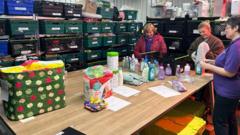
Food banks, once the final safety net for the destitute, are seeing a shift in their clientele. The people in line are wearing hi-vis jackets. They are wearing NHS scrubs. They are checking their work emails on their phones while they wait for a crate of canned pasta. This is a systemic shift. When work no longer guarantees a bed and a full stomach, the fundamental logic of our society begins to warp.
The Invisible Stakes of the Nursery
The trauma of this struggle isn't just financial. It is biological.
Stress is a neurotoxin. When a parent is constantly calculating whether they can afford to turn the heating on for an hour, they are stuck in a state of high cortisol. This affects how they interact with their children. It thins the patience. It dulls the joy of a first step or a new word because every milestone is shadowed by the cost of the next shoe size.
Imagine a hypothetical father named David. David works in logistics. He is proud, disciplined, and tired. He skips lunch three days a week, telling his colleagues he’s "trying a new fast." In reality, those £6 lunches are the difference between his daughter having fresh fruit or just white bread for her school snacks. He is trading his own physical stamina for her developmental health.
This is the hidden cost of the current crisis: the erosion of the human spirit. When you work a full day and still cannot provide the most basic dignity for your child, a specific kind of shame sets in. It is a quiet, corrosive feeling. It makes people withdraw from their communities. It makes them stop voting. It makes them feel like the system hasn't just failed them—it has mocked them.
The Breaking Point of the Safety Net
The current infrastructure of support was built for a different era. It was designed to help people transition from unemployment back into the workforce. It was never intended to support people who are already working at full capacity.
The "taper rate" of benefits often means that if Sarah takes an extra shift or receives a small raise, she loses more in childcare subsidies than she gains in take-home pay. It is a trap disguised as a ladder. We have created a world where working harder can actually make you poorer.
The reality is that food and hygiene are now competing for the same few coins. We are seeing reports of parents "stretching" nappies—leaving them on longer than is hygienic—to save money. We see "reusable" hacks born not of environmentalism, but of desperation, using old towels and duct tape. These are not choices made by neglectful parents. These are choices made by people backed into a corner by a grocery bill that grows faster than a salary.
The Necessity of Radical Empathy
To solve this, we have to look past the spreadsheets. We have to stop viewing poverty as a character flaw and start seeing it as a math problem that has become unsolvable for the average person.
The cost of essentials—energy, rent, basic nutrition—has decoupled from the median wage. This isn't a "lifestyle" issue. You cannot "budget" your way out of a 40 percent increase in the cost of milk when your wages moved by 3 percent. You cannot "avocado toast" your way out of a housing market that demands half your income for a damp two-bedroom flat.
The solution isn't just a slight adjustment to a tax credit. It is a fundamental reassessment of what a "living wage" actually means in a world where the floor has fallen through. It requires a realization that if the people who keep our hospitals running and our shelves stocked cannot afford to feed their own children, the economy isn't "growing." It is cannibalizing itself.
The Echo in the Kitchen
Tonight, Sarah will sit at her kitchen table after Leo has gone to sleep. She will have a cup of tea—no milk, because the milk is for his cereal tomorrow—and she will open her banking app.
She will look at the balance.
She will look at the calendar.
She will see that there are six days left until payday and £14 in the account.
She will go to the cupboard and count the remaining nappies one more time, as if a new one might have appeared in the last hour.
She is not looking for a handout. She is looking for a way to make the numbers stop lying to her. She is looking for the promise that her work matters, that her effort counts, and that her son’s future isn't being traded away for a few pence of corporate margin.
The light in the kitchen flickers. She turns it off to save a fraction of a penny on the electric bill.
Silence.
She sits in the dark, a productive member of society, wondering how she became a ghost in her own life.