The UAE fuel price committee’s decision for April 2026 sits at the intersection of a localized deregulation framework and a volatile global supply-demand imbalance that has pushed Brent crude toward $115 per barrel. While retail consumers focus on the immediate per-litre cost at the pump, the actual determination of these prices follows a structured mathematical correlation between international benchmarks, regional logistics, and operational margins. Understanding the upcoming shift requires deconstructing the three primary variables that dictate the price of Special 95, Super 98, and Diesel in the Emirates: the global benchmark trajectory, the refined product premium, and the domestic distribution cushion.
The Correlation Mapping of Brent to Retail Pricing
The UAE shifted from a subsidized model to a market-linked pricing mechanism in 2015. This policy ensures that the Ministry of Energy and Infrastructure aligns domestic rates with international averages, though it is not a 1:1 instantaneous reflection. There is a lag-time factor where the committee evaluates the preceding month’s average rather than a single day’s peak.
With Brent crude approaching $115, the upward pressure is structural rather than speculative. When global crude sustains levels above $110, the cost of input for refiners increases, which is then passed through the supply chain. In the UAE context, the "Price Committee" uses a proprietary formula that accounts for:
- The Mean of Platts Arab Gulf (MOPAG) benchmarks.
- Shipping and freight insurance costs (Mean of Platts).
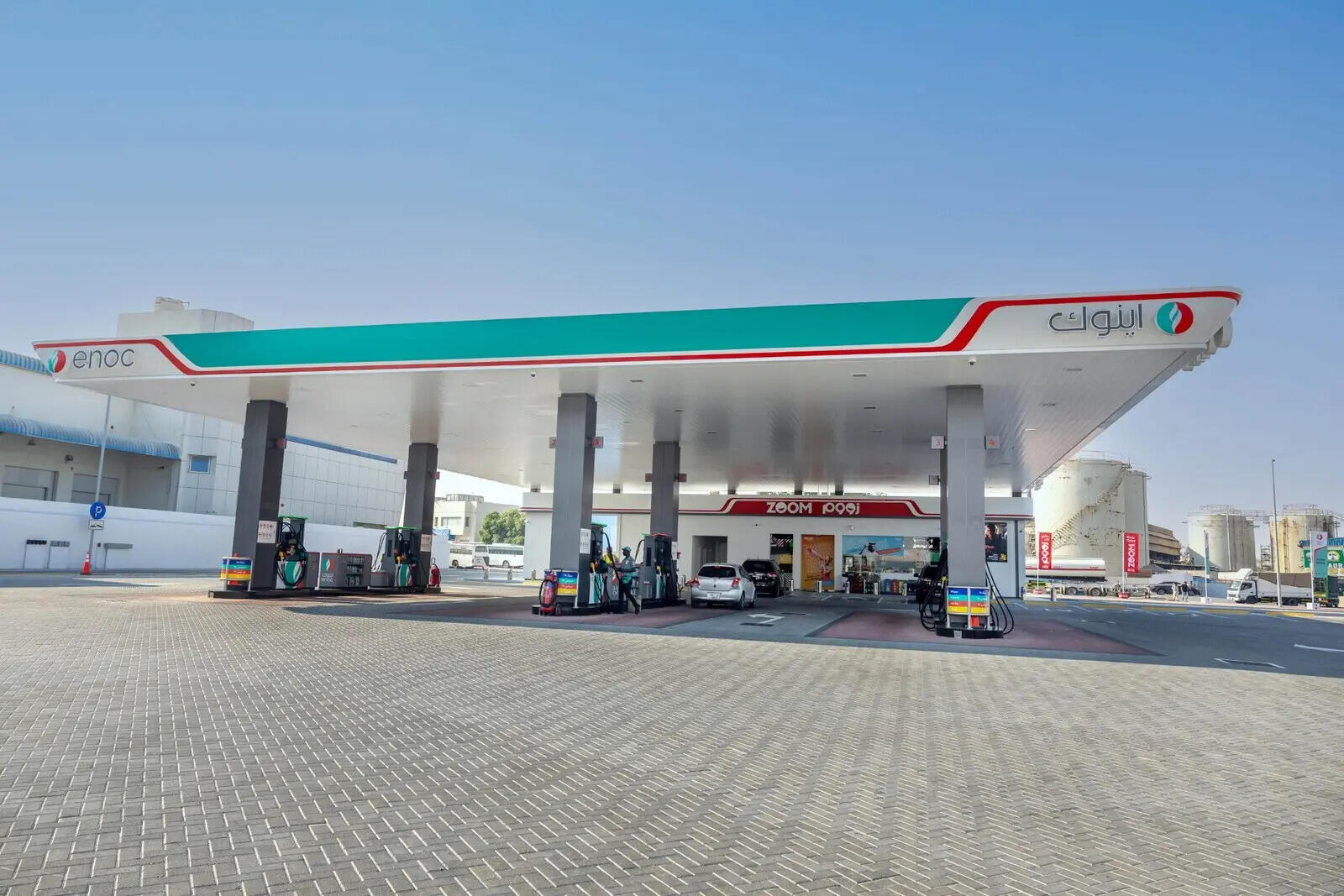
- The fixed retailer margin for entities like ADNOC Distribution, ENOC, and Emarat.
The current escalation toward $115 represents a 15-20% increase from the price floors seen in earlier quarters. This creates a high probability of a significant upward revision for April 2026, as the "smoothing effect" used by the committee to prevent hyper-volatility reaches its upper limit.
The Refined Product Premium Bottleneck
A common analytical error is assuming that crude oil prices are the sole determinant of gasoline costs. In reality, the "crack spread"—the difference between the price of crude oil and the petroleum products extracted from it—is the more accurate predictor for UAE motorists.
Even if crude stabilizes at $115, a shortage in global refining capacity can drive Special 95 prices higher than the crude spike would suggest. Currently, global refinery utilization is near its ceiling. The bottleneck exists in the conversion of heavy or light sweet crude into high-octane fuels. If regional refineries in the Middle East face maintenance cycles or if European demand for refined exports increases due to geopolitical shifts, the "premium" added to the base crude price expands.
For the April 2026 cycle, the data indicates a tightening of refined product stocks. This means that even if Brent were to retreat slightly to $112, the retail price in the UAE might still rise because the underlying value of the finished gasoline (Super 98) remains elevated due to scarcity in the refined market.
The Geopolitical Risk Premium and Logistics
The UAE’s geographical position provides a logistical advantage, yet it does not insulate the market from the "Geopolitical Risk Premium." At $115 per barrel, the market is pricing in significant disruptions in global transit corridors.
The cost of moving fuel involves:
- War Risk Insurance: Sudden spikes in regional tension increase the insurance premiums for tankers operating in the Strait of Hormuz and the Gulf of Oman.
- Bunker Fuel Costs: Ironically, as fuel prices rise, the cost of the ships transporting that fuel also rises, creating a secondary inflationary loop.
These logistical overheads are factored into the "landed cost" of fuel in the UAE. While the UAE produces its own oil, the pricing committee adheres to international parity to prevent "arbitrage"—where fuel bought cheaply in the UAE could be illegally exported to higher-priced markets, draining domestic supply.
Impact Analysis by Fuel Grade
The April 2026 adjustment will likely affect the three main fuel categories with varying degrees of intensity based on their specific demand elasticities.
- Super 98 (High Octane): This grade typically sees the most aggressive price swings. It is the preferred choice for high-performance engines and luxury segments. Its pricing is most closely tied to the international MOPAG Super 95 benchmark plus a fixed octane-enhancement premium.
- Special 95: The "middle" grade used by the majority of the UAE’s private vehicle fleet. The committee often attempts to minimize the volatility here to protect middle-class disposable income, but at $115 Brent, the room for absorption is non-existent.
- Diesel: This is the backbone of the UAE’s logistics and construction sectors. Diesel pricing has a direct "pass-through" effect on the Consumer Price Index (CPI). If diesel prices surge in April, the cost of transporting food, electronics, and construction materials will rise within 14 to 30 days.
The Limits of Market-Linked Forecasting
Predicting the exact fils-per-litre increase requires acknowledging the "Discretionary Buffer." The UAE Fuel Price Committee maintains the authority to decouple domestic prices from global benchmarks if the volatility threatens national macroeconomic stability. However, this is a rare intervention.
The primary limitation of forecasting for April 2026 is the "End-of-Month Volatility" trap. If crude prices drop sharply in the final 72 hours of March, the monthly average used by the committee might be lower than the current $115 spot price suggests. Conversely, a late-month spike can lock in higher prices for the entirety of April, even if oil prices crash on April 2nd.
Operational Strategy for Fleet Managers and Private Motorists
The transition to a $115 oil environment necessitates a shift from reactive refueling to strategic consumption management.
- Hedging through Loyalty and Aggregation: Large-scale fleet operators in the UAE utilize fuel cards that offer "rebate-at-pump" structures. At prices exceeding 3.50 AED per litre, these 2-3% rebates represent significant operational savings.
- Octane Discipline: Many modern engines categorized for "Super 98" can operate safely on "Special 95" without significant loss in efficiency, provided the manufacturer's minimum RON (Research Octane Number) is met. Motorists should verify engine requirements to avoid paying for an octane rating their vehicle cannot utilize.
- The Diesel Surcharge Clause: Logistics companies should ensure that their contracts for April 2026 include a dynamic fuel surcharge. Relying on fixed-price shipping while the underlying fuel cost is market-linked at $115 is a recipe for margin collapse.
The data suggests that the UAE is entering a "High-Floor" era for energy costs. The era of 2-dirham gasoline is functionally over as long as global Brent maintains a triple-digit baseline. The April 2026 announcement will likely confirm a new psychological threshold for the market, where the 3.50 to 4.00 AED per litre range becomes the standard operating environment rather than a temporary spike.
The most effective response to the April 2026 price hike is the immediate optimization of route efficiency and vehicle maintenance. Fuel efficiency drops by approximately 1% for every 10 PSI of under-inflation in tires; in a high-cost environment, these marginal gains are the only controllable variables in a market dictated by global macro-forces. Fleet managers must prioritize telematics to reduce idle times, as idling in heavy Dubai or Abu Dhabi traffic at $115-oil equivalent fuel prices represents a direct and preventable drain on quarterly EBITDA.