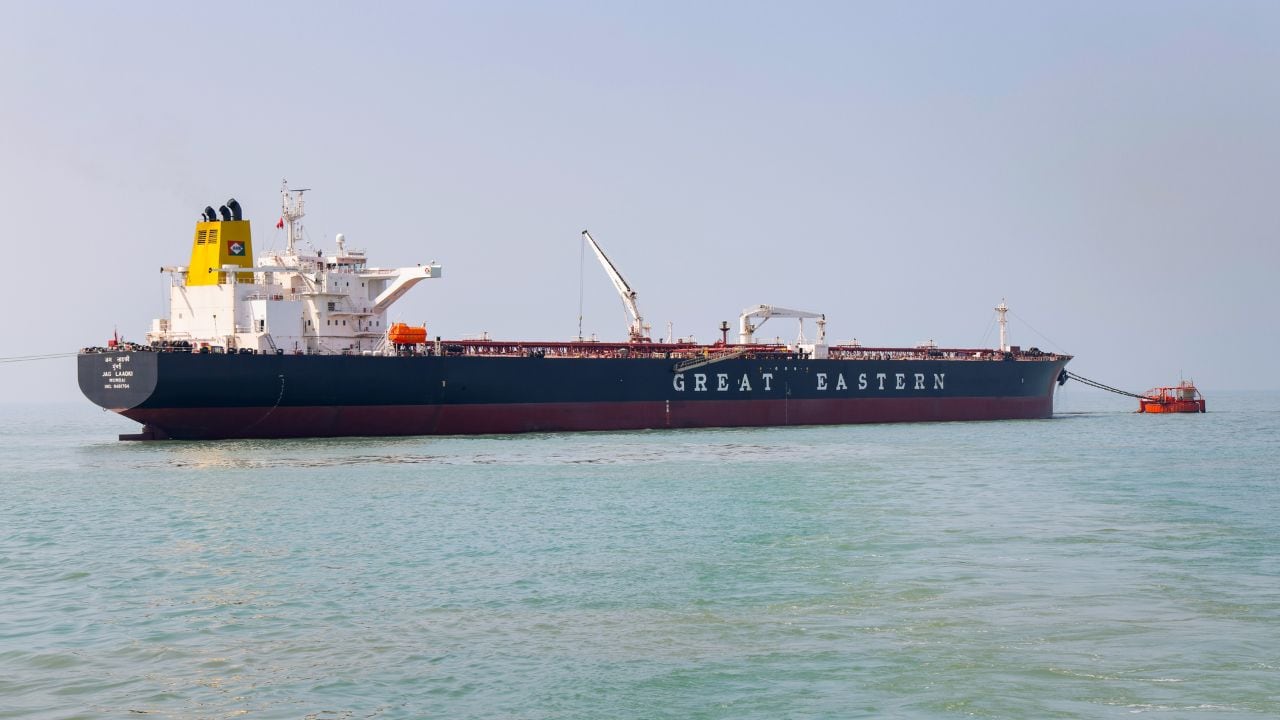
The sea does not care about sanctions. It does not read the news, and it certainly doesn't understand the intricacies of a price cap. To the steel hull of a Suezmax tanker, the ocean is simply a series of coordinates, a long haul from the icy ports of the Baltic to the humid refineries of the East. But lately, those coordinates have been shifting. A massive, invisible hand is rerouting the world’s most essential commodity, turning a predictable flow into a frantic scramble for the best price.
For months, the story was simple: Russia, shunned by the West, had found a permanent home for its crude in China. It was a partnership of necessity. Beijing’s industrial hunger seemed bottomless, and Moscow’s need for cash was absolute. But the map is changing again. The tankers that once signaled for the South China Sea are increasingly banking toward the Indian Ocean.
India is grabbing more.
To understand why this matters, you have to look past the spreadsheets and into the belly of an Indian refinery. Picture a foreman in Jamnagar. He isn't thinking about geopolitics. He is thinking about the margins. He is looking at a grade of crude—Urals—that used to be the lifeblood of Europe but is now looking for a new place to land. If he can get it for a few dollars less than the Middle Eastern benchmarks, he wins. His company wins. And in a country of 1.4 billion people where energy costs dictate the price of every onion and liter of milk, that discount is more than a business "win." It is a survival strategy.
The Pivot of the Giants
The redirection of Russian oil isn't just a minor logistical tweak. It is a tectonic shift in how the world’s energy is distributed. China has long been the primary destination, the reliable big brother that kept the Russian economy breathing. But China is a shrewd buyer. They know when they have a monopoly on a seller's options, and they press that advantage.
Russia, sensing the danger of being entirely dependent on a single buyer who can dictate terms, has started looking for leverage. They found it in New Delhi.
India’s appetite for discounted Russian barrels has ballooned from a trickle to a flood. It is a strange, delicate dance. On one hand, India maintains deep ties with the United States and Europe. On the other, it cannot ignore the math. When the West imposed a price cap and sanctions, they hoped to starve the Kremlin’s war chest. Instead, they created a two-tier market. They created a "shadow fleet" of tankers that operate outside Western insurance circles, and they created a massive incentive for non-aligned nations to buy at a steep discount.
Consider the journey of a single cargo. A year ago, that ship might have unloaded in Rotterdam. Six months ago, it would have been destined for Ningbo. Today, it’s being diverted mid-voyage, sold to an Indian refiner who offered a slightly better premium or a more flexible payment arrangement. This isn't just trade; it's a high-stakes game of musical chairs played with millions of barrels of oil.
The Invisible Stakes
Why does India want this oil so badly that it’s willing to risk the occasional diplomatic friction with Washington? It comes down to the sheer scale of the subcontinent's development.
Every day, thousands of new motorbikes hit the roads in Uttar Pradesh. New factories are spinning up in Gujarat. The electricity grid is expanding into villages that, until recently, relied on kerosene lamps. All of this requires energy. If India buys oil at the "market price" set by Brent or Murban, it drains its foreign exchange reserves. If it buys Russian oil at a $10 or $15 discount, it saves billions.
Those billions don't just sit in a bank. They become the cushion that prevents a fuel price hike at the local petrol station. In a democracy as noisy and vibrant as India's, fuel prices are political dynamite. A government that keeps the lights on and the trucks moving is a government that stays in power.
But this redirection creates a friction point with China. Beijing isn't used to being outbid, especially for Russian resources. The "no limits" partnership between Putin and Xi is being tested by the very thing that usually strengthens such bonds: cold, hard cash. Russia needs the highest price it can get under the constraints of sanctions. If India provides a better outlet than China, the oil will go to India.
It is a reminder that in the world of commodities, loyalty is a luxury. Interest is the only currency that never devalues.
The Geometry of the Shadow Fleet
The mechanics of this diversion are as fascinating as they are opaque. To move this much oil without triggering Western sanctions, a massive infrastructure of "grey" shipping has emerged. These are older tankers, often owned by shell companies in Dubai or Hong Kong, flying flags of convenience from nations that don't particularly care about the G7 price cap.
They move in the shadows. They perform ship-to-ship transfers in the middle of the Atlantic or the Mediterranean, swapping oil like a mid-air refueling maneuver to hide its origin. By the time the crude reaches a refinery in India, its pedigree is blurred. It’s just "crude" now.
This system is inefficient. It’s expensive. It’s risky. But it is working. The volume of Russian oil reaching India has hit record highs, often at the direct expense of shipments that were originally "bound for China."
The Ripple Effect on the Global Market
What happens when two of the world’s three largest oil consumers start fighting over the same discounted barrels? The rest of the market feels the heat.
Traditional suppliers like Saudi Arabia and Iraq are finding themselves squeezed out of their historical strongholds. For decades, the Middle East was the undisputed king of the Asian oil market. Now, they are watching Russian tankers sail past the Persian Gulf to deliver oil to their oldest customers. To keep their market share, the Saudis have to pivot toward Europe—the very market Russia was forced to vacate.
It is a complete inversion of the global energy map. The pipes and shipping lanes that were designed to move oil from East to West and North to South are being forced to run in reverse. It’s like trying to change the plumbing of a house while the water is still running at full pressure. Something eventually has to give.
The diversions also highlight a growing reality: the West’s ability to control global trade through the financial system is waning. When India and Russia trade oil, they aren't always using dollars. They are experimenting with Rupees, Rubles, and Dirhams. They are building a parallel financial universe where the SWIFT system and the US Treasury have no say.
This isn't just about oil anymore. It's about the plumbing of the global economy. If you can move millions of barrels of oil without the dollar, you can move anything.
The Human Core of the Commodity
It is easy to get lost in the talk of millions of barrels per day and the "Suezmax" vs. "VLCC" tanker classifications. But at the end of every shipping route is a person.
There is a truck driver in Punjab who can afford to keep his rig on the road for another week because the diesel price didn't spike. There is a family in a Chinese manufacturing hub wondering why the local refinery is suddenly scaling back production or looking for more expensive alternatives. There is a sailor on a rusting tanker in the Indian Ocean, 3,000 miles from home, hoping the engine holds out long enough to reach the port of Mundra.
These are the people who live in the gaps between the headlines. They don't care about the Bloomberg terminal's latest flashing red text. They care about the heat, the light, and the cost of the commute.
The "diversion" of Russian oil isn't a dry business event. It is a desperate, ingenious, and occasionally dangerous restructuring of the world's most vital resource. It is a story of how gravity—the economic gravity of a billion people rising into the middle class—eventually pulls everything toward it, even the oil that was supposed to go somewhere else.
The tankers will continue to turn. The routes will continue to shift. And as long as there is a discount to be had, the hunger of the subcontinent will remain the most powerful force on the water.
The sun sets over the Arabian Sea, casting a long, golden shadow over a line of tankers waiting to offload. They carry a cargo that was meant for the East, now claimed by the South. In the darkness of the hulls, the oil remains the same. But on the surface, the world has become an entirely different place. Ships that were supposed to turn left are now turning right, and in that simple change of heading, the future of the global economy is being rewritten.
Would you like me to analyze the specific impact these oil diversions are having on the internal inflation rates of the Indian economy compared to China's industrial output?