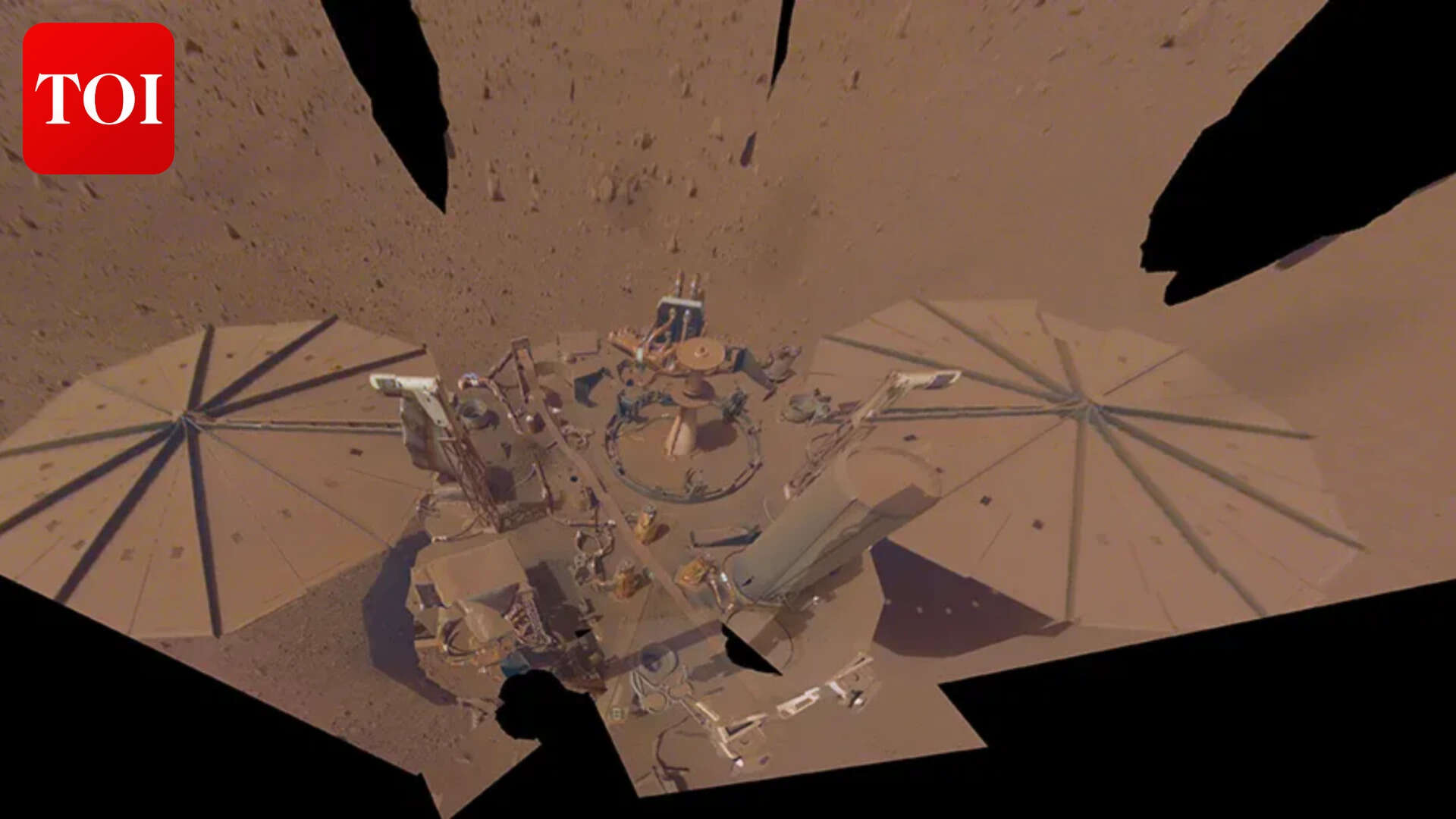
Mars is spinning faster every year. It is a subtle shift, measured in fractions of a millisecond, but for planetary scientists, it is the equivalent of a heart monitor skipping a beat. Data captured by NASA’s InSight lander before its power finally failed reveals that the Martian rotation is accelerating by roughly 4 milliarcseconds per year squared. This means the length of a Martian day is shortening by a fraction of a millisecond annually. While that might seem like a rounding error to the average observer, it represents a massive, unexplained transfer of energy within the Martian system that challenges our understanding of how dead planets behave.
Most celestial bodies slow down over time. Earth is a prime example; the gravitational drag of our Moon acts like a brake on a spinning wheel, gradually lengthening our days. Mars lacks a massive moon to provide that stabilizing friction. Its two small satellites, Phobos and Deimos, are little more than captured asteroids with negligible gravitational influence. Without a cosmic anchor, Mars is reacting to its own internal and atmospheric shifts with surprising volatility.
The Ice Accumulation Theory
One of the leading explanations for this planetary "spin-up" involves the redistribution of mass. Think of a figure skater. When they pull their arms in toward their chest, they spin faster to conserve angular momentum. Planets operate on the same physical laws. If mass moves from the equator toward the poles, or if the shape of the planet itself becomes more compact, the rotation speed must increase.
For Mars, this mass shift is likely tied to the post-glacial rebound. During previous eras, massive amounts of ice accumulated at the Martian poles, weighing down the crust. As that ice retreats or shifts due to long-term climate cycles, the land beneath it slowly rises back up. This "relaxation" of the planet's shape, moving from a slightly flattened sphere toward a more perfect circle, shifts the center of gravity just enough to kick-start an acceleration.
Liquid Hearts and Sloshing Iron
The acceleration also provides a rare window into the Martian interior. By measuring the "wobble" of the planet—technically known as its precession—scientists can infer what lies beneath the rusted dust. The InSight data, processed through the Rotation and Interior Structure Experiment (RISE), suggests that Mars possesses a liquid metal core.
This isn't just a static ball of molten iron. The core appears to be sloshing. There is a decoupling between the solid mantle and the liquid center, creating internal friction and momentum transfers that we are only beginning to quantify. If the core and the mantle are not rotating at the exact same speed, the drag between these layers can cause fluctuations in the surface rotation.
$L = I \omega$
In the equation above, $L$ represents angular momentum, which remains constant in a closed system. As the moment of inertia ($I$) changes due to internal mass redistribution, the angular velocity ($\omega$) must adjust accordingly. On Mars, we are seeing the visible result of a deep, invisible reshuffling of planetary weight.
The Problem with Atmospheric Drag
We cannot ignore the Martian atmosphere, thin as it may be. While Earth’s atmosphere is thick and provides a consistent buffer, the Martian air is 99% less dense. However, it is highly reactive to solar cycles. Large-scale dust storms, which can envelop the entire planet for months, change the temperature and density of the air.
These storms alter the atmospheric torque on the planet's surface. When the wind blows with enough force over a vast enough area, it can actually push against the mountains and craters of the planet, acting as a minute sail. Over decades, these cumulative nudges add up. The current acceleration might not be a permanent feature of Mars, but rather a temporary phase driven by a century of particularly intense weather patterns.
Why This Shatters the Dead Planet Myth
For decades, the consensus was that Mars is a geologically "dead" world. It lacks the plate tectonics that define Earth and the volcanic ferocity of Io. Yet, an accelerating rotation suggests a world that is still very much in flux. A planet that changes its spin is a planet with an active interior and a dynamic relationship with its environment.
This discovery complicates our plans for long-term exploration. If the Martian day is shrinking, our timing systems for autonomous rovers and future habitats will eventually require "leap seconds" similar to those used on Earth, but for the opposite reason. We aren't adjusting for a slowing world; we are adjusting for a world that is speeding up.
The data from InSight is the most precise measurement of Martian time ever recorded. By bouncing radio signals between Earth and the lander, scientists could detect shifts in position as small as a few centimeters over thousands of miles. This level of precision has turned Mars into a massive laboratory for general relativity and planetary dynamics.
The Limits of Our Knowledge
Despite the breakthroughs, we are still guessing at the exact ratio of these influences. We don't know how much of the acceleration is due to the "figure skater" effect of ice at the poles versus the "sloshing bucket" effect of the liquid core. Our models are only as good as the data points we have, and currently, those data points are concentrated around a single, now-defunct lander.
Furthermore, there is a counter-argument that we are observing a short-term fluctuation rather than a long-term trend. The solar system operates on timescales of millions of years. Watching a planet for four years and declaring a permanent change in its rotation is like watching a clock for one second and assuming it will always run fast. We need more sensors, more "clocks" on the surface, to determine if Mars is truly entering a new epoch of speed or if we caught it in the middle of a temporary shimmy.
The Engineering Challenge
For engineers, this shift is more than a curiosity. Precise landing coordinates for future missions depend on an exact model of planetary rotation. If the planet is spinning faster than expected, a spacecraft arriving in ten years might find its landing site has rotated a few hundred meters away from the projected target.
In high-stakes orbital insertions, those meters matter. We are moving from a period of "close enough" exploration to an era of "pinpoint" logistics. If we intend to land heavy cargo or human crews near specific mineral deposits or ice reserves, we must master the math of a shifting world.
The acceleration of Mars is a reminder that the universe is never truly static. Even a cold, desert world 140 million miles away is capable of surprising us with its restlessness. We are no longer just looking at Mars; we are feeling its pulse.
Check the latest orbital tracking updates from the Deep Space Network to see how these rotational shifts are currently affecting signal latency for the remaining rovers.