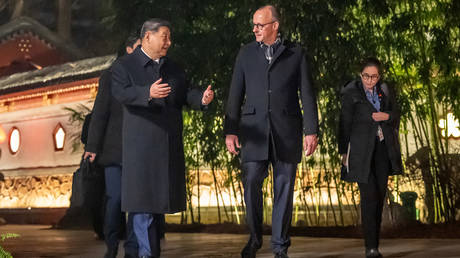
Stop reading the tea leaves of diplomatic "scheduling conflicts."
The mainstream financial press is currently obsessed with Scott Bessent’s assertion that a delayed summit between Donald Trump and Xi Jinping isn't about trade disputes. They’re buying the narrative that it’s just logistical noise or a minor calibration of personal chemistry.
They are wrong.
In the high-stakes theater of global macroeconomics, there is no such thing as a "delay" that isn't a deliberate exercise of leverage. To suggest that the two most powerful men on earth can't find a room to sit in because of a calendar overlap is a fundamental misunderstanding of how sovereign negotiation functions.
When a summit stalls, it isn’t because the paperwork isn't ready. It’s because one side hasn't been sufficiently squeezed yet.
The Myth of the Diplomatic Frictionless Plane
The "lazy consensus" suggests that trade wars are the primary friction point. The pundits argue that if we could just solve the soy and semiconductor math, the path to a handshake would be clear. This view treats international relations like a retail transaction.
I have sat in boardrooms where billion-dollar mergers were "delayed" for months. The stated reason? "Due diligence." The real reason? One CEO wanted to see if the other’s stock price would crater before the signing, giving them a 5% edge at the table.
On the geopolitical stage, this is magnified by a factor of a thousand. Trump’s strategy has never been about reaching a "fair" deal; it has been about creating a state of perpetual uncertainty that forces the opponent to overpay for stability. Xi, conversely, operates on a timeline that makes Western quarterly earnings look like a fever dream.
Delay isn't a sign of failure. It is the weaponization of time.
Why Bessent is Half-Right and Entirely Wrong
Scott Bessent, often cited as a steady hand, wants to soothe the markets. He wants you to believe that the underlying mechanics of the US-China relationship are stable enough that a missed meeting doesn't signal a breakdown.
He is right that "disputes" aren't the cause. But he is wrong about the alternative.
The delay is the content of the meeting. In the world of optics, the person who can afford to wait longer is the person who holds the superior hand. If Trump delays, he is signaling to the CCP that the US economy—buoyed by protectionist sentiment and a resurgent domestic manufacturing narrative—can outlast the structural debt crisis currently hollowing out Chinese provincial banks.
If Xi delays, he is betting that the American electoral cycle and inflationary pressures will force Trump’s hand.
To call this a "scheduling issue" is like calling a blockade a "navigation error."
The Real Numbers Nobody Wants to Talk About
While the media focuses on the "summit," the real data is screaming in the background. Look at the Yield Curve. Look at the divergence between the Shanghai Composite and the S&P 500.
- China’s Youth Unemployment: Officially "recalibrated," actually catastrophic.
- The Dollar Hegemony: Despite "BRICS" posturing, 88% of all foreign exchange trades still involve the greenback.
- The Manufacturing Gap: Moving a factory from Shenzhen to Vietnam or Mexico takes three years, not three months.
These are the variables that dictate when a summit happens. A meeting only occurs when the delta between these pressures reaches a breaking point.
Dismantling the People Also Ask Nonsense
You see the same questions popping up on search engines: "Will a Trump-Xi meeting lower prices?" or "Is the trade war over?"
These questions are built on a flawed premise. They assume that the goal of these leaders is "equilibrium."
It isn't.
The goal is dominance. If you are waiting for a summit to "fix" your supply chain costs, you have already lost. The unconventional truth is that the summit is a lagging indicator. By the time the cameras are clicking in Mar-a-Lago or Beijing, the actual shift in power has already occurred in the dark.
I’ve watched executives wait for a "clear signal" from the Fed or the White House before making a move. They get slaughtered. The winners are the ones who realize that the lack of a meeting is the clearest signal of all. It means the decoupling is accelerating, and no amount of "good vibes" between leaders will reverse the gravity of national interest.
The Cost of Optimism
The downside of my contrarian view? It’s exhausting. It’s much easier to believe Bessent’s version of the world where everything is just a bit of administrative friction.
But optimism in a trade war is a liability.
If you are a CEO or an investor, you must operate under the assumption that the "summit" is a phantom. It is a carrot dangled to keep the markets from panicking while the real structural knives are being sharpened.
The US is moving toward a fortress economy. China is moving toward a "dual circulation" model that prioritizes internal survival over global integration. These two paths do not meet at a summit. They cross like ships in the night, moving in opposite directions.
Stop Asking When and Start Asking Why
The press will keep asking for a date. They want a calendar entry they can pin a headline to.
Don't be that guy.
Ignore the "scheduling" updates. Watch the tariff implementation dates. Watch the export controls on high-bandwidth memory. Watch the naval movements in the South China Sea.
If the summit is delayed, it’s because the cost of the "peace" is still too high for one of the parties to pay.
Every day without a meeting is a day where the price of the eventual deal goes up. This isn't a stalemate. It’s an auction. And the currency being spent isn't dollars—it's time, and the pain tolerance of the working class in both nations.
If you’re still waiting for a press release to tell you where the global economy is going, you’re the liquidity for the people who actually know.
The delay isn't a glitch. It's the feature.
Go look at your exposure to East Asian logistics and ask yourself if a handshake can actually save your margins.
The answer is no.
Assume the summit never happens. Build your strategy on that bedrock, and you’ll stop being a victim of the "scheduling" spin.
The most powerful thing a leader can do is stay home.