The air in Hong Kong’s Sham Shui Po doesn't move. It stagnates, thick with the scent of roasted meats, exhaust, and the invisible weight of seventy years of history pressed into tiny, subdivided flats.
Consider Mrs. Wong. She is eighty-two. Her world has shrunk to the size of a postage stamp—a bed, a rice cooker, and a window that looks directly into the gray concrete of the building next door. To reach the pharmacy, she must navigate three flights of stairs that feel like a mountain range. Every step is a negotiation with gravity. When she reaches the street, the city doesn't welcome her. It rushes past her. The neon lights flicker with a frantic energy that she can no longer match.
Mrs. Wong is not an anomaly. She is a data point in a gathering storm.
Hong Kong is aging faster than almost any other city on earth. By 2050, roughly 40% of its population will be over the age of sixty-five. We often treat these numbers like a distant weather report, something to prepare for eventually. But for Mrs. Wong, the storm is already here. It is the silence of her room. It is the difficulty of finding a decent meal that doesn't require a hike. It is the terrifying reality that if she falls, the only person who might hear her is the television.
Across the water, six hundred miles to the south, Singapore decided to try something radical. They stopped looking at the elderly as a "problem" to be tucked away in hospitals or remote nursing homes. Instead, they built a village.
The Concrete Orchard
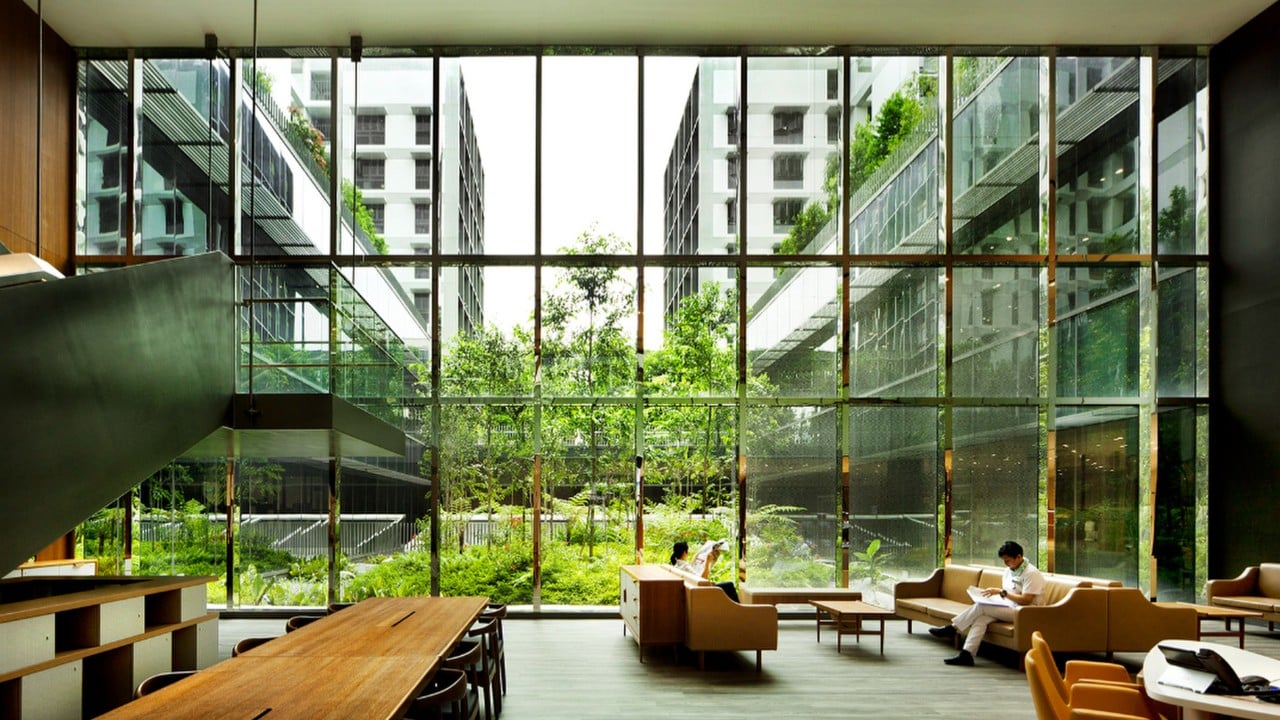
Kampung Admiralty does not look like a social service project. It looks like a spaceship landed in a garden.
In Singapore, the word "Kampung" refers to the traditional villages of the past—places where doors were left unlocked and grandmothers watched everyone’s children. The architects of this experiment wondered: Can we build a village vertically? Can we manufacture the intimacy of 1950s rural life inside a high-tech, multi-story complex?
The result is a layered cake of human necessity.
At the base, there is a buzzing plaza and a hawker center where the steam from laksa bowls rises into the air. Above that, a medical center provides everything from blood tests to surgery. Higher still, there are apartments designed specifically for seniors, and at the very top, a sprawling rooftop farm.
It sounds like a luxury development. It isn't. It is a survival strategy.
Imagine the contrast for someone like Mrs. Wong. In the Kampung model, she wouldn't be trapped in a walk-up. She would live in a studio with wide doorways and grab bars that don't look like hospital equipment. More importantly, she would live directly above a childcare center.
This is the secret sauce.
When you put a nursery and a senior center in the same building, something magical happens. The elderly don't just sit and wait for the clock to tick. They become teachers. They become "grandparents" to children whose own families might be across the city. The children, in turn, provide a reason to get out of bed. They provide noise. They provide life.
The Cost of Living Apart
Hong Kong’s current approach is a fragmented mosaic of "not enough."
We have high-end private nursing homes for the wealthy and grim, overcrowded facilities for the poor. The middle ground is a desert. Most seniors stay in their old apartments, isolated by "old-age-onset" disabilities and an urban design that prizes speed over accessibility.
The economic argument for the Singaporean model is undeniable. By integrating healthcare into the housing complex, you catch the flu before it becomes pneumonia. You catch the slight stumble before it becomes a hip fracture. In the long run, it is far cheaper to build a vertical village than to build more hospital wings.
But the economic argument is the least interesting part of the story.
The real stakes are found in the "loneliness epidemic." Science tells us that chronic isolation is as physically damaging as smoking fifteen cigarettes a day. It erodes the heart; it clouds the brain. When we build cities that force the elderly into the shadows, we are effectively designing a death sentence for the future versions of ourselves.
Is the Kampung model the answer?
It is an answer. It is a start. But it requires something Hong Kong is currently lacking: a willingness to tear down the walls between departments.
The Singaporean model works because the housing board, the health ministry, and the transportation department all agreed to work in the same sandbox. In Hong Kong, the bureaucratic silos are higher than the skyscrapers themselves. To get a bench installed in a park, you might need permission from four different agencies. To build a Kampung Admiralty, you need a revolution in the way we view the role of the state.
The Great Wait
Mrs. Wong doesn't know about Singapore’s experiments. She only knows that the milk in her fridge is three days old and her knees are swelling again.
There is a gap between the city as it is and the city as it could be. That gap is where we lose the most vulnerable members of our society.
Hong Kong prides itself on being a global financial hub. It is a city of "can-do" spirit and lightning-fast deals. But what happens when the deal-makers slow down? What happens when the "can-do" becomes "can-barely"?
We have spent decades building a city for the young and the mobile. We have built bridges for cars and staircases for the strong. Now, we must build a city for the fragile.
This isn't just about Mrs. Wong. It's about every one of us.
If we don't change the way we live together—if we don't start building villages instead of just buildings—we are all headed toward that same quiet room in Sham Shui Po. We are all waiting for a knock on the door that might never come.
The vertical village isn't just a design choice. It is a promise that we won't forget each other as we age. It is a promise that the city will still have room for us when our steps are short and our breath is thin.
Consider the rooftop garden again.
In Singapore, ninety-year-olds are planting okra and chili peppers. They are trading seeds and advice. They are looking down at the city, not up from a basement.
The silence has been replaced by the sound of soil being turned and children laughing three floors below.
That is the sound of a city that has decided to survive its own success.
Would you like me to help you create a detailed comparative table between the Hong Kong and Singaporean elderly care infrastructure to see where the specific gaps lie?