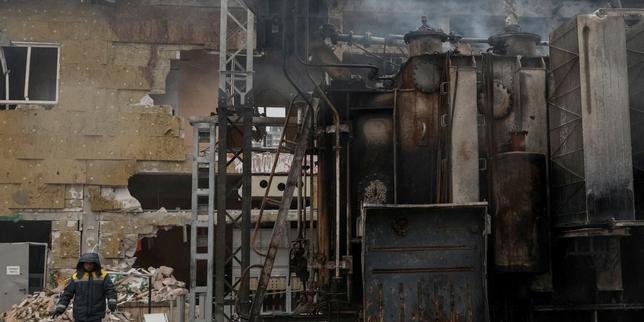
Ukraine is currently shifting its entire national security focus toward a brutal reality. The country cannot wait for the bureaucratic gears of Brussels to turn. While the European Union debates the long-term release of massive financial aid packages, President Volodymyr Zelensky has signaled a pivot toward "internal resources" to fortify the nation’s energy grid before the next winter cycle begins. This is not just a logistical update; it is a desperate re-engineering of a Soviet-era infrastructure into a decentralized, resilient web designed to survive a sustained campaign of aerial attrition.
The central challenge involves a race against the calendar. Kyiv knows that the grace period offered by warmer months is shrinking. To survive the 2024-2025 winter, the Ministry of Energy is focusing on three critical pillars: physical protection of hardware, rapid repair cycles, and a massive push toward distributed generation. The goal is to move away from large, vulnerable thermal power plants and toward a network of smaller, gas-piston and gas-turbine units that are harder to hit and easier to replace.
The Strategy of Distributed Generation
For decades, the Ukrainian power grid relied on the classic Soviet model of massive, centralized nodes. This was efficient for a peaceful industrial giant but became a liability under fire. A single well-placed missile at a transformer substation can currently plunge an entire region into darkness. To counter this, Ukraine is effectively trying to "shred" its energy footprint.
Small-scale power units are the priority now. These units, often the size of shipping containers, can be tucked away in urban environments or industrial zones. They provide electricity to local hospitals, water pumping stations, and heating hubs, ensuring that even if the main grid fails, the basic functions of civilization continue. The procurement of these units is being funded by diverting existing internal budgets and leveraging immediate bilateral grants from individual Baltic and Nordic partners, bypassing the slower multilateral channels of the larger European funds.
This shift requires a total overhaul of the distribution logic. It is no longer about managing a few massive flows of current. Engineers are now tasked with synchronizing thousands of tiny inputs. It is a technical nightmare, but it is the only way to ensure that a strike on a single plant does not trigger a cascading failure of the national network.
Hardening the Shell
Beyond the generation of power lies the problem of protecting what remains. Ukraine has implemented a multi-tiered defense system for its energy infrastructure. The first tier involves "gabions"—massive sand-filled cages designed to stop shrapnel from damaging sensitive electronics. The second tier is more ambitious: concrete covers and undergrounding for critical transformers.
However, passive defense has its limits. High-voltage transformers are massive, cooling-dependent machines that generate immense heat. You cannot simply bury them in a hole without sophisticated ventilation and fire suppression systems. The cost of "undergrounding" a single major substation can run into the tens of millions of dollars. Without the immediate release of European funds, Ukraine is forced to prioritize. They are choosing which cities live in relative light and which must endure managed blackouts. This is a cold, mathematical triage.
The European Funding Bottleneck
The political theater in Europe remains the primary obstacle to a more comprehensive recovery. While individual nations have been generous with spare parts—often raiding their own decommissioned plants for 1970s-era components that match Ukrainian specifications—the large-scale financial backing needed for a total grid modernization is stuck in a web of vetoes and conditions.
Zelensky’s mention of "internal resources" is a subtle but firm critique of this delay. It suggests that Ukraine is cannibalizing its own economy to keep the lights on. Every hryvnia spent on a gas turbine is a hryvnia not spent on shells or social programs. The pressure on the Ukrainian central bank is mounting. They are essentially printing stability, a move that carries long-term inflationary risks that will haunt the post-war recovery.
The Problem of Specialized Parts
You cannot buy a 750kV transformer off the shelf. These are custom-built machines with lead times that often exceed twelve months. The global supply chain for high-voltage equipment is already stretched thin by the global transition to renewable energy. Ukraine is competing with American and European utilities for the same manufacturing slots in factories in South Korea and Germany.
When European funds are delayed, Ukraine loses its place in the queue. By the time the money arrives, the delivery date for critical hardware may have slipped past the start of the next winter. This "time-poverty" is the hidden enemy of the Ukrainian energy sector.
The Gas Factor
Ukraine’s vast underground gas storage facilities remain its most potent "internal resource." These facilities, located deep underground in the western regions, are largely immune to conventional missile strikes. During the previous winter, Ukraine managed to rely almost entirely on its own gas production to meet heating needs.
The strategy for the coming months involves increasing domestic extraction and encouraging European traders to continue using Ukrainian storage. This creates a mutual dependency. If European companies have billions of cubic meters of gas stored in Ukraine, those companies will pressure their respective governments to provide the air defense systems necessary to protect the pipelines. It is a brilliant bit of geopolitical insurance.
The Workforce Crisis
Infrastructure is not just steel and copper; it is people. The Ukrainian energy sector is facing a severe labor shortage. Thousands of skilled linemen and engineers have been mobilized into the armed forces. Those who remain are working in conditions that would be unthinkable in any other modern democracy. They are repairing substations while air-raid sirens are still sounding.
The "internal resources" Zelensky speaks of include the sheer endurance of these crews. However, endurance has a breaking point. The government is now looking at ways to provide "economic reservations" for energy workers to keep them out of the trenches and on the power lines. It is a controversial move in a society where everyone is expected to serve, but a country with a collapsed grid cannot fight a modern war.
Tactical Decentralization vs. Centralized Command
There is an ongoing internal debate within Kyiv regarding how much control the central government should exert over energy decisions. Traditionally, Ukrenergo—the state-owned operator—has held a monopoly on the high-voltage lines. But the move toward distributed generation is empowering local mayors and regional governors.
Cities like Lviv and Dnipro are taking matters into their own hands, seeking their own direct partnerships with foreign cities to secure generators and mobile boiler houses. This fragmentation is efficient for survival, but it complicates the eventual goal of reintegrating into the European ENTSO-E power system. Ukraine is currently an island of "ad-hoc" engineering in a sea of highly regulated European standards.
The Cost of Cold
The economic impact of energy instability is profound. Factories cannot run on "hope and generators." The cost of electricity produced by a diesel generator is roughly five to seven times higher than the cost of grid power. For a manufacturing sector already reeling from the loss of eastern industrial hubs, this price hike is a death sentence.
If Ukraine cannot stabilize its grid using these internal resources, the result will be a new wave of refugees fleeing not just the bombs, but the cold and the lack of jobs. This is the strategic calculation behind the Russian strikes. They aren't trying to destroy the army; they are trying to make the state uninhabitable.
The Realities of the Next Twelve Months
The reliance on internal resources is a bridge, not a destination. Ukraine is effectively patching a sinking ship with whatever wood is available on deck while waiting for a professional repair crew that is arguing about the bill on the shore.
The immediate priority remains the procurement of air defense. All the "internal resources" in the world cannot save a transformer if a Kh-101 cruise missile makes a direct hit. The defense of the energy sector is now inseparable from the defense of the front line. Kyiv is forced to choose between protecting its troops or protecting its turbines.
To bridge the gap, the government is incentivizing private businesses to install solar panels and battery storage systems through tax breaks and simplified permitting. It is a "do-it-yourself" energy policy. It is messy, it is expensive, and it is the only way to ensure that when the first frost hits in October, the radiators stay warm and the internet stays on.
The international community must understand that every week of delay in the European funding pipeline translates directly into another week where Ukraine must burn through its own future just to survive the present. The internal resources are finite, and the clock is ticking toward a winter that will test the structural integrity of the Ukrainian state more than any battle in the Donbas.
Stabilizing the grid is now a race of logistics versus physics, and the margin for error has vanished.


