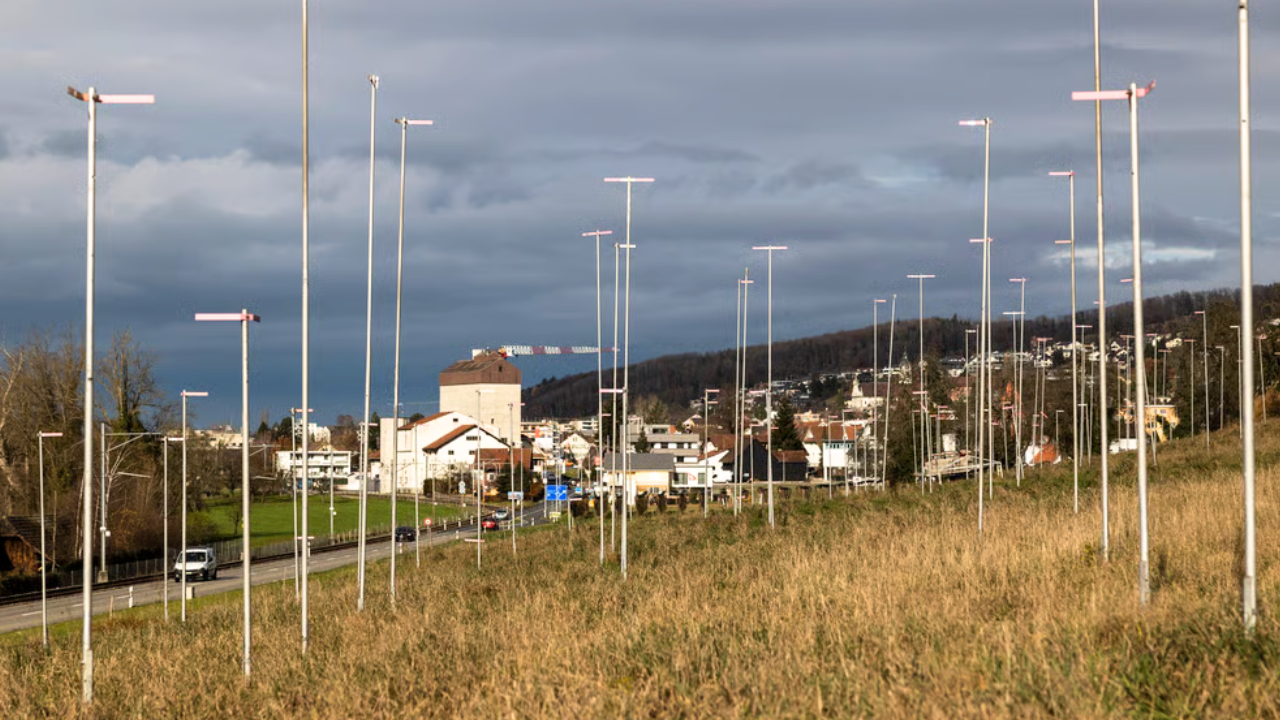
The travel brochures call them Baugespanne. They paint a picture of Swiss precision, where thin metal poles—the Gabarits—rise from the Alpine soil like skeletal ghosts of future chalets. The mainstream media loves this story. They frame it as the ultimate democratic tool, a way for neighbors to "visualize" change and protect their sunlight.
It’s a lie.
Those poles aren't about visualization. They are a weaponized form of architectural NIMBYism (Not In My Backyard) that has effectively frozen Swiss urban development in a block of carbon-neutral ice. While the rest of the world looks at those poles and sees "transparency," anyone who has actually navigated the Swiss land registry sees a $50,000-per-project ransom note.
The Aesthetic Tax You Didn't Know You Were Paying
The common misconception is that these poles exist to help you see where a building will stand. If that were true, we would use $500 drones and an AR headset. Instead, Swiss law mandates physical scaffolding that can cost a homeowner or developer between 5,000 and 50,000 CHF just to propose a change.
This isn't about design. It's about friction.
By forcing a physical footprint weeks before a shovel ever hits the dirt, the Swiss system invites every crank with a grudge and a protractor to file an objection. In Zurich or Geneva, a single neighbor can stall a multi-million-franc energy-efficient apartment block for years because the poles suggest their view of a distant, generic hill might be obscured by 3%.
We are told this is "direct democracy." In reality, it is the institutionalization of the status quo. When you make it this expensive and this visually jarring to suggest change, you ensure that only the ultra-wealthy or the massive institutional REITs can afford to innovate. The result? A housing crisis in a country with more than enough land and capital to solve it.
The Myth of Visual Transparency
Look at the mechanics. These poles mark the corners and the height of the roofline. They do nothing to show density, materials, or the actual "weight" of a building. A glass-and-steel masterpiece that reflects the sky looks identical in pole-form to a brutalist concrete bunker.
The Gabarits fail their primary mission because they strip architecture of its soul and reduce it to a height violation.
I’ve sat in planning meetings where local councils debated the "visual impact" of a project based on these sticks. It’s theater. It’s like trying to judge a painting by looking at the dimensions of the frame. By focusing on the silhouette, the Swiss system ignores the actual utility and sustainability of the structure. We are prioritizing the "right to a view" over the "right to a roof."
Why the Tech Fix is Being Suppressed
Why don't we use 3D modeling? Why isn't there a national app where you can point your phone at a lot and see the proposed building in high-fidelity 1:1 scale?
Because the "Visualized Building" isn't the goal. The process is the goal.
If you make it easy to see and approve a building, buildings get built. If buildings get built, supply increases. If supply increases, the astronomical property values of the existing homeowners—who also happen to be the voters—might actually stabilize.
The poles are a deliberate, analog barrier to entry in a digital age. They serve as a physical warning to the neighborhood: Someone is trying to change things. Gather your lawyers.
The Hidden Cost of the "Right to Object"
In most jurisdictions, if you want to stop a neighbor’s construction, you need a legal basis. You need to prove a violation of zoning, safety, or environmental law. In Switzerland, the poles facilitate "frivolous objections" as a local sport.
- The Professional Objector: I’ve seen cases where neighbors demand "compensation" (read: a bribe) to withdraw an objection sparked by the sight of those poles.
- The Aesthetic Police: Since the poles make a building look much larger and more intrusive than it actually is—because they lack transparency and depth—they trigger a visceral, lizard-brain "get off my lawn" response.
- The Shadow Effect: People obsess over shadows that won't exist. A pole creates a sharp line; a building creates a nuanced shadow. The poles lie about the environmental impact.
We are operating on 19th-century logic to solve 21st-century urban density problems.
The Paradox of Swiss Innovation
Switzerland prides itself on being a global hub for biotech, finance, and engineering. Yet, in the realm of physical space, it is a museum.
The Baugespanne are the bars of the cage. They ensure that every new structure is a compromise, sanded down by the complaints of the least imaginative person in the postal code. If we had applied this "visualized objection" standard to the historical centers of Bern or Lucerne 200 years ago, they would never have been built. The very landmarks people now fight to protect were once "intrusive" changes marked by some version of these poles.
Stop Romanticizing the Poles
When you see those tall, skinny sticks in a Swiss meadow, don't think "What a lovely democratic process."
Think about the young family in Lausanne paying 4,000 CHF a month for a two-bedroom apartment because the three new complexes that should have been built five years ago are still tied up in court over a pole-based objection.
Think about the architect who has to design for the "least offensive silhouette" rather than the most efficient use of thermal mass.
The Swiss poles are a masterpiece of psychological warfare. They turn "potential" into "threat." They transform a vacant lot into a visual scar before a single brick is laid. They are the most effective tool ever devised to make sure that nothing ever happens.
If we actually cared about transparency, we’d burn the poles and open the data. But transparency isn't the point. Power is. And in Switzerland, the power belongs to whoever has the longest pole and the most stubborn lawyer.
Tear them down. Use the digital twins we already have. Stop letting a 100-year-old tradition of sticks and wires dictate the future of European living. Otherwise, the only thing the Swiss will be able to build in fifty years is more poles.
Go to the land registry. Look at the pending objections. See the waste for yourself.
The poles aren't showing you a building; they're showing you the death of progress.