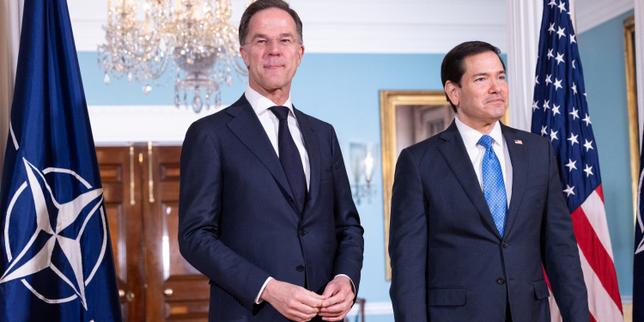
The North Atlantic Treaty Organization (NATO) operates not on the strength of its combined hardware, but on the perceived certainty of Article 5. When the United States—the guarantor of the nuclear umbrella and the primary logistical engine of the alliance—signals a conditional approach to mutual defense, the fundamental cost-benefit analysis for every member state shifts. The "Trump Effect" on NATO is less about specific rhetorical barbs and more about the introduction of a permanent risk premium into European security calculations. This shift moves the alliance from a status of collective security toward a fragmented model of transactional bilateralism.
The Credibility Gap and the Deterrence Function
Deterrence is a psychological equation where the cost of aggression must outweigh the perceived benefits. In the context of NATO, this equation is $D = P \times C$, where $D$ is deterrence, $P$ is the probability of intervention, and $C$ is the cost inflicted by that intervention. If you found value in this article, you should read: this related article.
When American leadership suggests that defense is contingent upon "paying your bills," the variable $P$ (probability) becomes a fluctuating metric rather than a constant. This creates a credibility gap. Once a security guarantee is qualified, it is effectively nullified in the eyes of a rational adversary. Russia’s strategic calculus no longer has to account for a monolith; it only needs to identify the specific threshold of American indifference.
Three Pillars of Atlantic Disintegration
The weakening of the pact is not a singular event but a degradation across three distinct operational pillars. For another perspective on this development, see the latest update from NBC News.
1. The Operational Readiness Paradox
The 2% of GDP defense spending target, established at the 2014 Wales Summit, was designed as a floor, not a ceiling. However, the focus on this specific metric as a "subscription fee" for protection ignores the reality of military interoperability. If European states increase spending purely to satisfy a political demand, the capital is often diverted into domestic procurement projects that lack "plug-and-play" capability with U.S. systems. The result is a larger aggregate spend but a less cohesive fighting force.
2. The Strategic Autonomy Divergence
The rhetoric of abandonment has forced a pivot toward "Strategic Autonomy," primarily led by France. This creates a feedback loop of distrust. As Europe attempts to build independent command structures, the U.S. views these efforts as a redundant waste of resources or a threat to American industrial dominance in the arms market. This friction reduces the efficiency of the Transatlantic Link, turning a unified front into a series of competing bureaucracies.
3. The Intelligence Sharing Bottleneck
Security alliances rely on the seamless flow of high-level signals intelligence (SIGINT) and human intelligence (HUMINT). When the leader of the alliance questions the value of the pact, intelligence agencies become more protective of their assets. The fear that sensitive data could be used as political leverage in future trade or defense negotiations leads to a "stovepiping" of information. A fragmented intelligence picture increases the reaction time required to counter hybrid warfare or "gray zone" provocations.
The Transactional Tax on Eastern Europe
The states on the Eastern Flank—Poland, the Baltics, and Romania—face a different reality than the "Old Europe" states like Germany or Spain. For these frontline nations, the weakening of NATO is an existential threat rather than a budgetary annoyance.
This creates a two-tier alliance. Frontline states are now forced to pay a "transactional tax," which involves purchasing American-made hardware (F-35s, Abrams tanks, Patriot batteries) not just for their technical specifications, but as a form of political insurance. This "pay-to-play" model undermines the spirit of the Washington Treaty and replaces a values-based alliance with a series of bilateral protection agreements. The risk is that if a state cannot afford the premium, their security becomes negotiable.
Decoupling the Nuclear Umbrella
The most significant, though often least discussed, consequence is the erosion of the nuclear umbrella. The U.S. Extended Deterrence (ED) policy is the only thing preventing a nuclear arms race within Europe. If Germany or Poland loses faith in the American nuclear guarantee, the domestic pressure to develop independent deterrents becomes mathematically unavoidable.
The proliferation of nuclear weapons within the European continent would fundamentally break the post-WWII security architecture. It would lead to a "re-nationalization" of defense policies, where each state looks only to its own borders, effectively ending the concept of "the West" as a geopolitical entity.
The Mechanism of Hybrid Exploitation
Adversaries like the Kremlin do not need to launch a full-scale invasion to "win" against a weakened NATO. They utilize the gaps created by political discord. When the U.S. signals a lack of commitment, it emboldens non-kinetic aggression:
- Cyber-attacks on critical infrastructure that fall just below the threshold of Article 5.
- Disinformation campaigns designed to pit European populations against their own defense spending.
- Weaponized migration used to destabilize the political cohesion of border states.
The lack of a unified response to these "gray zone" activities confirms the perception of a fractured alliance, further eroding the deterrent value of the pact.
Reconfiguring the European Defense Architecture
To mitigate the damage of a conditional U.S. commitment, the strategy for European members must shift from "wait and see" to a structural hardening of their own capabilities. This is not about replacing the U.S., which is impossible in the short to medium term, but about creating a "European Pillar" that can function autonomously if necessary.
- Standardization of Munitions: Europe currently operates 17 different types of main battle tanks, compared to one in the U.S. Realignment requires a ruthless pruning of national industrial interests in favor of a unified European defense market.
- Integrated Command and Control (C2): Europe must develop C2 structures that do not rely on U.S. satellite constellations or communication nodes. This requires heavy investment in the Galileo program and independent secure communications.
- Forward Positioning: Instead of relying on "tripwire" forces, European powers (UK, France, Germany) must maintain permanent, heavy divisions in the Baltics and Poland. This demonstrates that the cost of aggression will be met by Europe, regardless of the political climate in Washington.
The alliance is currently in a state of "decoupling by degrees." The historical certainty that defined the Cold War and the post-9/11 era has been replaced by a variable-rate security agreement. The survival of the Atlantic pact depends on its ability to evolve from a U.S.-dependent entity into a balanced partnership. Failure to achieve this rebalance will result in a return to the 19th-century "Balance of Power" model, a system that historically ends in large-scale continental conflict.
The strategic play is no longer to convince Washington of its duties, but for Europe to build the capacity to make American participation a choice between being a leader of a powerful bloc or an isolated spectator to Eurasian reorganization.