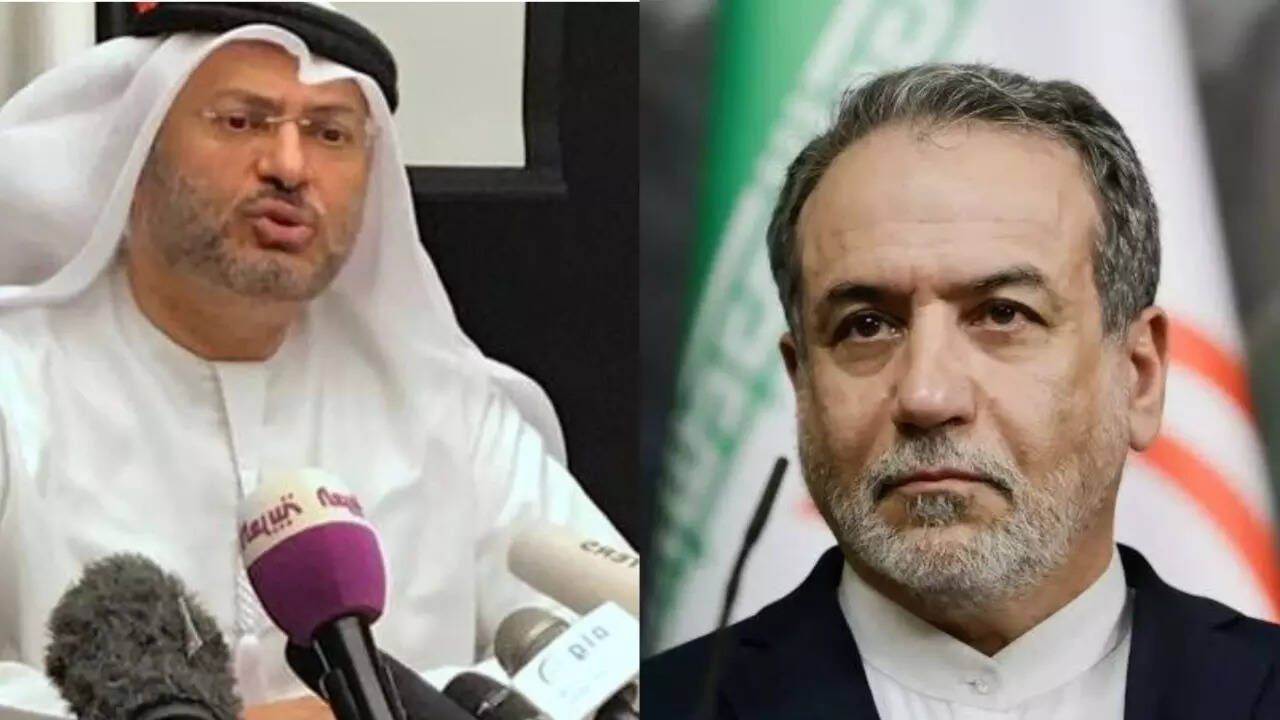
The modern Middle Eastern geopolitical framework operates on a zero-sum logic that the United Arab Emirates (UAE) has spent a decade attempting to decouple from its national security strategy. When Anwar Gargash, diplomatic advisor to the UAE President, issues a public rebuke of Iranian allegations regarding "aggression" or complicity in regional escalations, it signals a failure of the "de-escalation through economic integration" model. The friction between Tehran’s "Axis of Resistance" narrative and Abu Dhabi’s "Abrahamic Realism" has reached a structural breaking point where rhetorical ambiguity no longer serves as a viable buffer.
The Triad of UAE Strategic Autonomy
To understand the current friction, one must categorize the UAE’s foreign policy into three distinct functional pillars. Each pillar is currently being tested by the heightening kinetic conflict between Iran and the US-Israel alignment.
- The Shield of Multilateralism: The UAE utilizes international forums and bilateral de-escalation to prevent being characterized as a frontline state. By denying Iranian claims of allowing its territory to be used for offensive operations, the UAE is protecting its status as a safe-haven economy.
- Economic Interdependence as Deterrence: Significant trade volumes between Dubai and Iranian merchants act as a "soft" security guarantee. The UAE calculates that Iran is less likely to strike a critical clearinghouse for its own sanctioned economy.
- The Abrahamic Security Architecture: The normalization with Israel provides the UAE with access to advanced missile defense and intelligence-sharing. However, this creates a "security dilemma" where defensive enhancements are perceived by Tehran as offensive preparations.
The Mechanics of Misinformation in Proxy Warfare
The Iranian leadership often employs "rhetorical attribution" to externalize domestic or military failures. By accusing the UAE of supporting "aggression," Tehran seeks to achieve two tactical objectives. First, it attempts to drive a wedge between the Gulf Cooperation Council (GCC) states, testing the limits of their unified defense posture. Second, it serves as a warning shot to discourage the UAE from further integrating its air defense systems with US-led regional networks.
The UAE’s rejection of these claims is not merely a "denial" but a preservation of its Operational Sovereignty. If the UAE allows these accusations to stand unchallenged, it risks being labeled a legitimate target under the Iranian "Forward Defense" doctrine. This doctrine posits that threats must be neutralized at their source before they reach Iranian soil. Consequently, the UAE’s rebuttal is a legal and diplomatic necessity to maintain its "non-belligerent" status under international law.
The Cost Function of Regional Alignment
Every diplomatic pivot in the Persian Gulf carries a measurable cost. The UAE’s strategy is built on a complex cost-benefit analysis that weighs the following variables:
Kinetic Risk vs. Economic Premium
The UAE is a global hub for logistics (DP World) and aviation (Emirates/Etihad). The mere perception of regional instability increases insurance premiums (War Risk Surcharges) for maritime traffic in the Strait of Hormuz. When Iran accuses the UAE of aggression, it effectively threatens the UAE’s credit rating and its attractiveness for Foreign Direct Investment (FDI).
The Intelligence Bottleneck
A primary source of tension is the UAE’s reliance on Western technology for its "Falcon Eye" and THAAD (Terminal High Altitude Area Defense) systems. While these are defensive, the data-sharing requirements inherent in these systems create a transparency problem with Iran. Tehran views the presence of US-linked sensors as an extension of US power projection, regardless of the UAE’s stated intent.
Deconstructing the Iran-Israel-US Pressure Cooker
The current war is not a singular event but a series of interconnected friction points. The UAE finds itself at the geographic and political center of this "Triangular Conflict."
- The Iranian Variable: Iran utilizes its proxies (the "Ring of Fire") to stretch Israeli and US resources. To keep the conflict away from its borders, it uses aggressive rhetoric against neighbors to enforce a "neutrality" that favors Iranian interests.
- The Israeli Variable: Israel seeks "strategic depth" through its partners in the Abraham Accords. This includes potential basing rights or, at a minimum, intelligence cooperation.
- The US Variable: Washington is attempting to pivot away from direct Middle Eastern involvement by fostering a "Regional Integrated Air and Missile Defense" (IAMD).
The UAE’s refusal to be drawn into this triad as an active combatant is a masterclass in Hedging. However, hedging becomes exponentially more expensive as the kinetic intensity of the Iran-Israel shadow war increases. The "aggression" accusation from Tehran is a tool to force the UAE to choose between its security partners and its immediate neighbor.
Logical Fallacies in the Aggression Accusation
The Iranian claim that the UAE facilitates "aggression" collapses under rigorous structural analysis of the UAE’s military posture.
- Capability vs. Intent: While the UAE possesses significant strike capabilities, its military footprint is optimized for territorial defense and expeditionary counter-terrorism (as seen in its history in Yemen), not for high-intensity state-on-state offensive maneuvers against a much larger power like Iran.
- Geographic Vulnerability: The proximity of the UAE’s critical infrastructure—desalination plants, nuclear power (Barakah), and oil terminals—to the Iranian coast makes the "offensive launchpad" theory illogical. The UAE would face immediate, catastrophic retaliatory costs for any offensive involvement.
The Strategic Playbook for the UAE
The path forward for Abu Dhabi involves a "Double-Track Integration" strategy. This requires deepening security ties with the West and Israel in a discrete, non-provocative manner while simultaneously maintaining a high-level diplomatic channel with Tehran (The "Hotline Strategy").
This creates a state of Equilibrium through Ambiguity. By publicly rebuking Iranian officials, the UAE signals to its Western partners that it remains aligned with global security norms. By maintaining trade and private diplomatic channels with Tehran, it ensures that the "Price of Conflict" remains too high for Iran to ignore.
The UAE must now accelerate the localization of its defense industry. Reducing dependence on visible US "boots on the ground" while increasing indigenous capabilities (through entities like EDGE Group) allows the UAE to project strength without providing Iran the specific "foreign intervention" talking point it uses to justify escalation. Success in this theater depends on the UAE’s ability to remain "systemically important" to both sides of the conflict—too vital as a trade hub for Iran to destroy, and too strategic as a partner for the West to abandon.
The current diplomatic spat is the first of many "stress tests" for this model. The objective is not to win a rhetorical war with Tehran, but to ensure that the rhetoric never translates into a kinetic breach of the UAE’s sovereign airspace or maritime boundaries. The move toward a "Middle East 2.0" requires the UAE to navigate this narrow corridor where any deviation toward one pole invites a proportional strike from the other.
Leverage the current diplomatic friction to renegotiate the terms of regional intelligence sharing. The UAE should demand "Non-Belligerence Guarantees" from the US and Israel in exchange for continued participation in regional defense architectures, effectively using Iranian pressure as a bargaining chip to ensure that the UAE is never the designated "first responder" in a direct confrontation with Tehran.