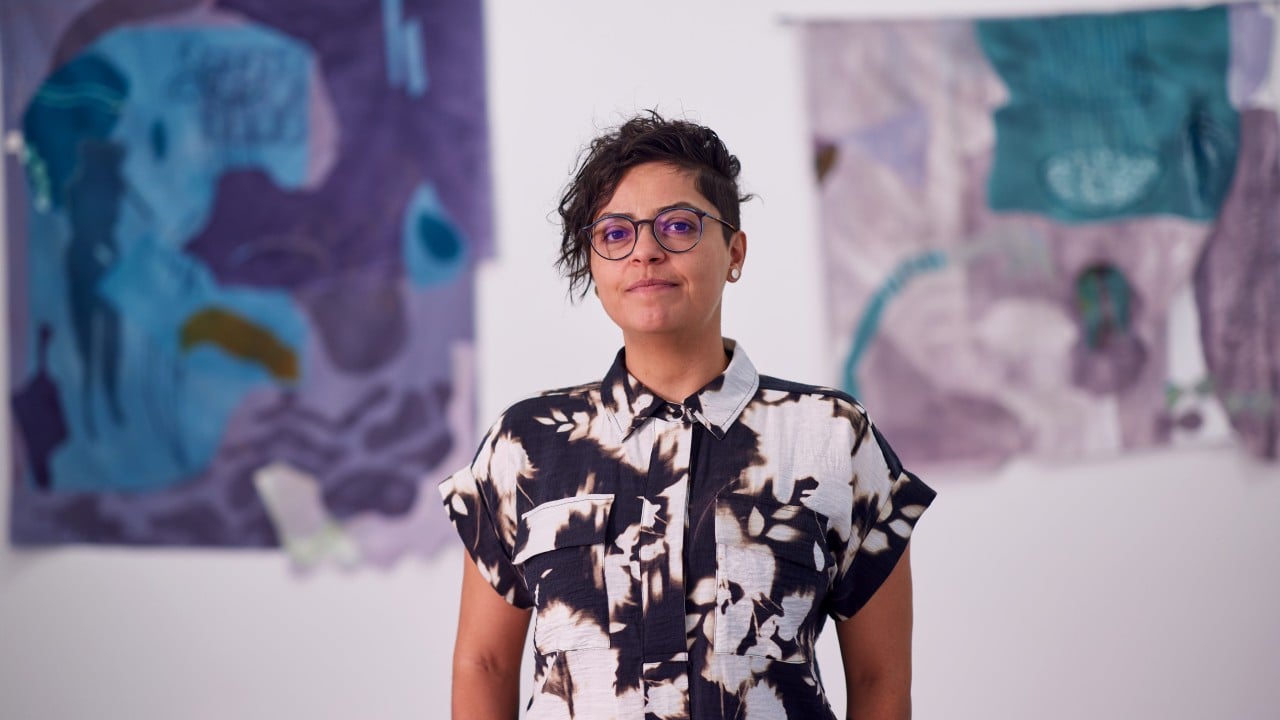
Art Central is humming with the usual suspects. Collectors in expensive linens are nodding solemnly at textiles. They are "connecting" with the "complex fabric of identity." Specifically, they are looking at the works of US-based Iranian artists and mistake their own emotional projection for cultural insight.
We need to stop pretending that every stitch in a piece of cloth is a geopolitical statement.
The industry has a pathological obsession with the "diaspora narrative." It has become a lucrative, repetitive, and ultimately hollow currency. When we frame every Iranian artist through the lens of their "complex identity," we aren't celebrating their work. We are pigeonholing it. We are demanding they perform their trauma for a VIP preview crowd.
The Myth of the "In-Between" Artist
The standard critical consensus regarding artists like those featured at Art Central—often involving layered fabrics or traditional Iranian motifs—is that they occupy a "liminal space." Critics love that word. It sounds deep. It suggests the artist is perpetually caught between Tehran and Los Angeles, unable to fully belong to either.
This is a lazy trope. It’s the "Identity Industrial Complex" at work.
In reality, most of these artists are highly assimilated, elite-educated professionals who have mastered the art of the grant application. I’ve sat in rooms with gallery owners who explicitly coach artists to "lean into the heritage" because abstract minimalism doesn't sell as well as "veiled resistance."
By forcing artists to be ambassadors for their ethnicity, we rob them of the right to be individuals. Why can’t a textile work just be a rigorous exploration of $S_{2}$ symmetry or a study in tensile strength? Why must it always be a "reflection of a fractured home"?
The Fabric Fetish and the Commodification of Memory
Textiles are the go-to medium for this performance because cloth is inherently sentimental. It’s domestic. It’s tactile. It’s "feminine." It carries the literal and figurative scent of the "old country."
But here is the logic the art market ignores: Nostalgia is a terrible basis for serious art.
Nostalgia is static. It’s a closed loop. When an artist uses Persian rugs or traditional embroidery to signal "identity," they are often just recycling aesthetics for a Western audience that wants a safe, digestible version of the Middle East. It’s a velvet cage.
- The Problem: The work becomes a souvenir of a struggle rather than an evolution of a craft.
- The Result: A market saturated with "identity art" that looks remarkably similar regardless of whether the artist is from Iran, Vietnam, or Ethiopia.
If everything is a "complex fabric," then nothing is. We are diluting specific cultural histories into a generic "immigrant experience" that fits neatly into a corporate boardroom or a luxury hotel lobby.
The Art Market’s Diversity Tax
The curators at Art Central and Art Basel will tell you they are "elevating underrepresented voices."
I’ve spent fifteen years watching how these "voices" are selected. It’s rarely about the technical innovation of the fiber art. It’s about the narrative. The artist’s story—the exile, the displacement, the "struggle"—is the real product being sold.
Imagine a scenario where we evaluate an Iranian-American artist purely on their mastery of $1/f$ noise in their patterns. Or their choice of a specific weave that defies traditional loom logic.
We don't do it. We can't. Because the market isn't interested in the art. It’s interested in the story of the artist.
We are taxing these artists. To get the museum solo show, you have to talk about the hijab. To get the Art Central booth, you have to talk about the "fabric of identity." You can’t just be a painter. You have to be a bridge between worlds.
That’s not inclusion. That’s a hostage situation.
Dismantling the Iranian Identity Narrative
Critics in the West love to see these works as "veiled protests."
But the reality is far more cynical. By focusing on the Iranian identity of a US-based artist, we conveniently ignore their American identity. We treat them as an exotic "other" even if they have lived in Brooklyn for twenty years and have an MFA from Yale.
We are obsessed with the "Complex Identity" because it makes us feel sophisticated. It allows us to participate in a "global dialogue" without ever actually leaving the air-conditioned comfort of a Hong Kong art fair.
The Textile Trap: Stop Using Craft as a Crutch
Textiles are a trap for the lazy artist. They provide a built-in emotional weight that the artist hasn't necessarily earned.
- Familiarity: Everyone knows how cloth feels.
- Historicity: Every culture has a weaving tradition.
- Vulnerability: Fabric is fragile.
If you are an artist who isn't sure what to say, you can always fall back on these tropes. You can shred the fabric (trauma), sew it back together (healing), or layer it (complexity). It’s a visual cliché. It’s the "Live, Laugh, Love" of high-end contemporary art.
I’ve seen collectors spend six figures on works that are technically inferior to a well-made quilt from a rural community, simply because the artist wrote a 500-word statement about their "diasporic longing."
The Real Question We Aren’t Asking
The "People Also Ask" questions for this topic are usually:
- How does Iranian art reflect identity?
- Why are textiles popular in contemporary Iranian art?
These are the wrong questions. They assume that identity is something that can be "reflected" like a mirror.
The real question should be: How much is the art market's demand for "authentic identity" stifling actual artistic innovation?
When we force an artist to be "authentic," we are asking them to be a caricature. Authentic identity is messy, boring, and often has nothing to do with where your parents were born. An artist's identity might be "someone who likes industrial brutalism and early 90s techno." But that doesn't sell as well as "someone who missed the pomegranates of Shiraz."
Stop Consuming Trauma as High Art
The obsession with the "complex fabric of identity" at Art Central is just another form of Orientalism. It’s the same old Western gaze, just dressed up in social justice terminology.
If we want to actually respect Iranian artists—or any artists from a diaspora—we need to stop looking for their "identity" in the work.
Start looking at the work itself.
Ignore the wall text. Ignore the artist's statement about their "fractured home." Look at the technique. Look at the formal qualities. If the work can’t stand on its own without the crutch of a "compelling" personal history, then it’s not a masterpiece. It’s a press release with tassels.
We need to give these artists the freedom to be boring. The freedom to be apolitical. The freedom to be obsessed with something other than where they came from.
The art world is a market of souls, and the current price of a "diaspora identity" is at an all-time high. But the bubble will burst. And when it does, the only artists left standing will be the ones who didn't let their "heritage" become their only personality trait.
Stop buying the narrative and start looking at the stitches.