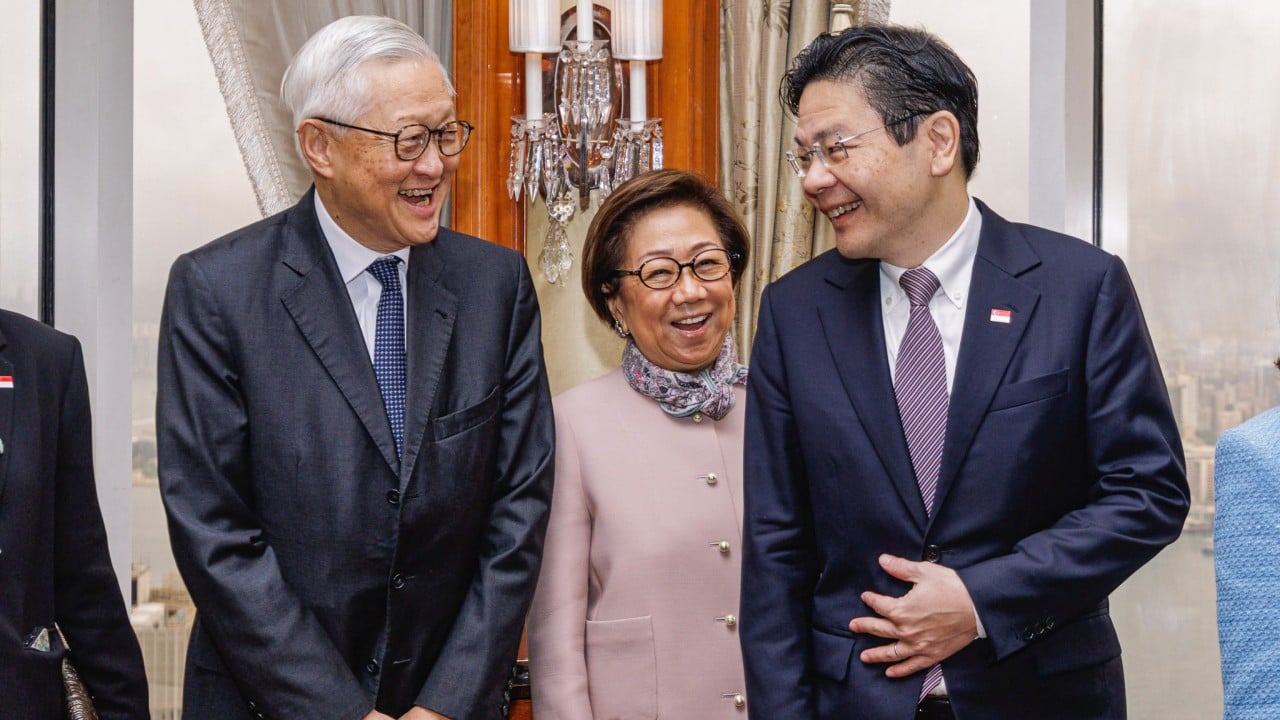
The media loves a "clash of the titans" narrative. When Singapore’s Lawrence Wong spends five days in Hong Kong meeting with John Lee and a roster of billionaires, the press gallery treats it like a diplomatic chess match or a polite scouting mission. They talk about "reaffirming ties" and "strengthening cooperation." They are missing the point.
The comfortable consensus suggests that Singapore and Hong Kong are locked in a fierce, zero-sum battle for the title of Asia’s premier financial hub. This is a fairy tale for people who like simple charts. The reality is far more concerning: both cities are currently leaning into a shared institutional inertia that favors old money and safe bets over the genuine, messy innovation that actually builds futures. Meanwhile, you can read other developments here: Structural Accountability in Utility Governance: The Deconstruction of Southern California Edison Executive Compensation.
Wong’s visit wasn't about competition. It was about mutual validation of a model that is increasingly insulated from the ground-level economic realities of the rest of the world.
The Myth of the Great Rivalry
Stop looking at the capital flight from Hong Kong to Singapore as a "win" for the Lion City. It is a symptom of regional fragility. When family offices move $5 billion from a desk in Central to a desk in Raffles Place, the global economy hasn't gained an ounce of productivity. We’ve just rearranged the deck chairs on a very expensive cruise ship. To understand the full picture, check out the detailed article by The Wall Street Journal.
I have spent two decades watching these two cities trade "Ease of Doing Business" trophies. Here is the secret: they aren't competing for the best ideas; they are competing for the quietest capital.
Singapore has become the world’s most sophisticated "safe room." It is where you put your money when you are afraid of the world. Hong Kong, meanwhile, is pivoting to become the primary gateway for a specific type of mainland liquidity. They are becoming specialized utilities. Utilities are stable, but they aren't where the next industrial revolution happens.
The Tycoon Trap
The headlines touted Wong’s meetings with "tycoons." Since when did meeting with the established elite become a signal of forward-looking leadership?
If you want to know where a city is going in 2026, you don't look at the people who built shopping malls and shipping empires in 1985. You look at the people those tycoons are trying to sue or buy out. By prioritizing these high-level summits with the "old guard," both administrations are signaling a commitment to the status quo.
The real risk isn't that Singapore will "beat" Hong Kong. The risk is that both will become gilded museums of the 20th-century financial model while the actual engines of growth move to Jakarta, Ho Chi Minh City, or even the decentralized cloud.
The Talent Arbitrage Fallacy
Ask any recruiter in the MAS (Monetary Authority of Singapore) ecosystem about the "talent war." They will point to new visa schemes and tax incentives designed to lure "high-net-worth individuals."
This is a fundamental misunderstanding of what makes a city vital. You don't build a world-class economy by attracting people who have already made their money. You build it by being the place where people make their money.
Hong Kong used to be that place. It was gritty, high-risk, and offered massive upside. Singapore was the orderly alternative. Now, both are so prohibitively expensive that the next generation of founders—the ones without a trust fund or a government grant—can’t afford the rent in either city.
We are seeing a "gentrification of ambition." When Wong and Lee talk about "talent," they are often talking about wealth managers and compliance officers. They aren't talking about the engineers and "mad scientists" who break things to build something better.
Cooperation is the New Complacency
The competitor pieces highlight "increased cooperation" between the Greater Bay Area (GBA) and ASEAN. On paper, this looks like a $3 trillion opportunity. In practice, it often results in a layer of bureaucratic sludge.
"Cooperation" in this context usually means more committees, more MOUs, and more photo ops. True economic dynamism doesn't come from government-to-government handshakes; it comes from friction. It comes from Singaporean startups trying to eat the lunch of Hong Kong incumbents. By smoothing over all the edges, these two cities are removing the very competitive pressures that keep an economy sharp.
The "Asia’s World City" and "Passion Made Possible" slogans are starting to feel like the same brochure with different fonts.
The High-Cost Death Spiral
Let’s look at the numbers the official reports ignore. The cost of living in both hubs has reached a point of diminishing returns.
When a mid-level software engineer spends 50% of their take-home pay on a 400-square-foot apartment, that engineer is not thinking about taking a risk on a new venture. They are thinking about survival and their next bonus. This creates a culture of "rent-seeking" rather than "value-creating."
Singapore’s CPI data and Hong Kong’s property index aren't just economic indicators; they are ceilings on innovation. If Lawrence Wong wants to truly disrupt the trajectory, he shouldn't be asking tycoons for investment. He should be asking how to make it possible for a 22-year-old with no connections to live in Singapore and fail three times before succeeding.
The Real Power Shift
The world is decoupling. Supply chains are fracturing. In this environment, being a "neutral hub" or a "bridge" is a dangerous game. It assumes that the two sides actually want to cross that bridge.
The "lazy consensus" says that Singapore benefits from every geopolitical hiccup in North Asia. But history shows that hubs only thrive when the regions they serve are also thriving. If Hong Kong’s role as a financial gateway is diminished, the entire "Asian Century" narrative takes a hit. Singapore isn't an island in an economic sense; it’s an organ in a larger body. If the heart rate slows in the GBA, the pulse weakens in the Lion City.
Instead of "cooperating," these cities should be engaged in a brutal race to see who can deregulate faster, lower costs more aggressively, and pivot away from the "family office" obsession that is currently sucking the oxygen out of the room.
Stop Asking "Which One?"
The "People Also Ask" sections of the internet are filled with queries like "Is Singapore better than Hong Kong for business?"
That is the wrong question. The right question is: "Is either city actually prepared for a world where traditional banking is secondary to sovereign AI and decentralized energy?"
Currently, the answer is a resounding "maybe." Both cities are incredibly good at managing the existing world. They have the best airports, the cleanest streets, and the most efficient tax collectors. But they are increasingly looking like high-end hardware running an outdated operating system.
Wong’s visit to Hong Kong was a display of peak "Managerialism." It was two highly competent CEOs discussing how to maintain their respective market shares. But in a world of disruptive shifts, market share is a lagging indicator.
The Actionable Truth
If you are an investor or a founder, don't be swayed by the optics of these high-level summits.
- Watch the outflow of talent, not the inflow of capital. If the smartest 25-year-olds are leaving for Dubai, Austin, or Bangalore, that’s your lead indicator.
- Ignore the MOUs. A Memorandum of Understanding is where good ideas go to die in a pile of paperwork.
- Bet on the friction. The real money will be made where Singapore and Hong Kong clash, not where they agree. Find the industries where they are genuinely trying to undercut each other—that is where the value is being created.
The tycoons Wong met with are the beneficiaries of the last forty years. They are not the architects of the next forty. If you want to see the future of Asian finance, get out of the meeting rooms in Central and Government House. Go to the workshops in Shenzhen or the cramped co-working spaces in Geylang.
The era of the "Prestige Hub" is ending. The era of the "Functional Hub" is beginning. Singapore and Hong Kong are currently too obsessed with the prestige to notice the function is starting to slip.
The real winner won't be the city that signs the most deals with the old guard. It will be the city that has the guts to make its own billionaires irrelevant.
Singapore and Hong Kong aren't rivals anymore. They are two veterans of a game that is changing faster than they are willing to admit. They don't need to cooperate; they need to wake up.