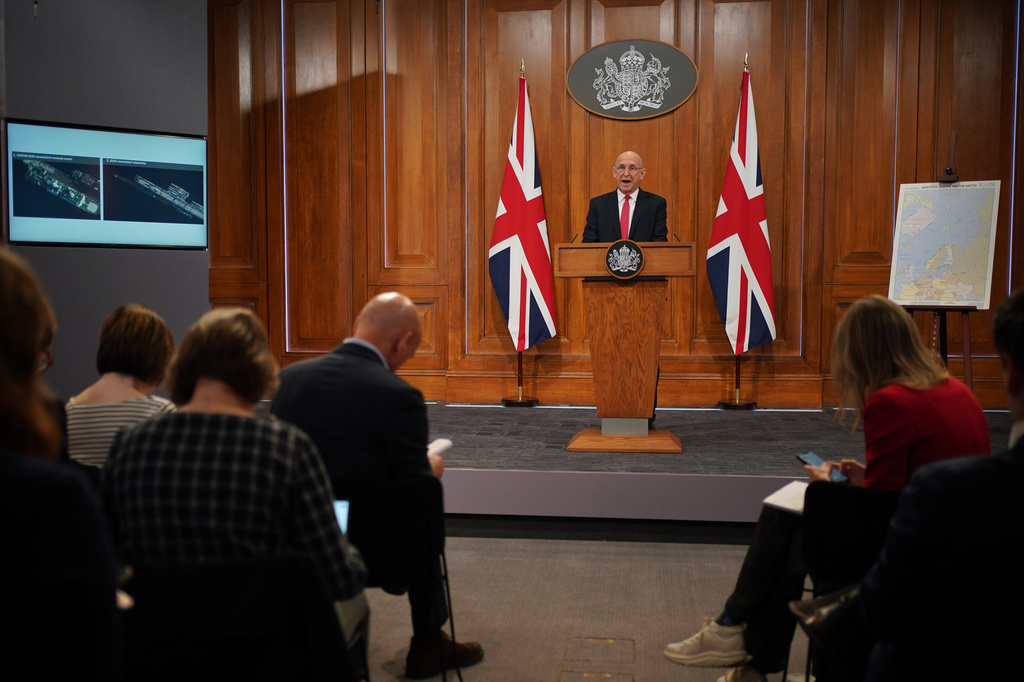
The Royal Navy has shifted from passive monitoring to active deterrence in the High North. This isn't a drill or a routine patrol. For the first time in decades, the United Kingdom is openly signaling its intent to hunt and hold at risk Russian Federation submarines as they attempt to transit the Greenland-Iceland-UK (GIUK) Gap. While the Ministry of Defence frames this as a stabilizing move, the reality is a high-stakes game of acoustic cat-and-mouse that puts British Type 23 frigates and P-8A Poseidon aircraft in direct, daily friction with Moscow’s most advanced nuclear-powered assets.
The North Atlantic is no longer a quiet transit zone. It is a front line.
The GIUK Gap and the Ghost of the Cold War
To understand why the UK is pouring resources into the North Atlantic, you have to look at a map. The GIUK Gap is a naval choke point. It is the only way for the Russian Northern Fleet, based in the Murmansk region, to reach the open Atlantic. If they get through undetected, they can threaten the undersea cables that carry 95% of the world's data and the shipping lanes that feed Europe.
Russia knows this. They have spent the last decade perfecting the Yasen-class submarine. These boats are quiet. They are fast. They carry long-range Kalibr cruise missiles that can hit London from the middle of the ocean. During the Cold War, we knew where the Soviet boats were because they were loud and clunky. Today, the acoustic signature of a Russian sub is often indistinguishable from the background noise of the ocean itself.
The UK’s current operation, centered on "Area of Operations North," is a desperate attempt to regain the acoustic advantage. It involves a "tripwire" strategy. By deploying a constant screen of sonar-heavy frigates and maritime patrol aircraft, the Royal Navy aims to force Russian captains to choose: stay quiet and move at a crawl, or speed up and risk being tagged by a British sonobuoy.
The Hardware of Deterrence
This isn't about traditional naval battles. Nobody is firing torpedoes. The weapons in this war are pings, hydrophones, and data processing algorithms.
The backbone of this operation is the Type 23 frigate, specifically those fitted with the Type 2087 towed array sonar. This isn't your grandfather’s sonar. It is a low-frequency, active and passive system that can detect submarines at ranges that were previously thought impossible. When the frigate "pings," it fills the water column with sound energy. When that energy hits a hull, it bounces back.
The P-8A Poseidon Factor
Above the waves, the RAF’s P-8A Poseidon fleet acts as the eye in the sky. These aircraft are essentially flying supercomputers. They drop "fields" of sonobuoys—disposable sensors that hang in the water and transmit data back to the plane via radio link.
The magic happens in the back of the plane. Acoustic operators sit in front of screens, looking at waterfalls of frequency data. They aren't looking for a picture of a submarine; they are looking for a specific "hum" from a cooling pump or the distinctive "whine" of a gearbox. Once a contact is made, the P-8 can track it for hours, handing over the data to a frigate or an allied US Navy destroyer.
This level of integration is the actual deterrent. The UK is telling Russia: "We see you, we hear you, and we can follow you to the bottom of the world."
The Infrastructure Vulnerability
Why now? Why this sudden surge in transparency regarding military movements? The answer lies at the bottom of the seabed.
The threat to subsea infrastructure has moved from theoretical to imminent. We saw what happened to the Nord Stream pipeline. While the culprit remains a subject of intense geopolitical debate, the tactical lesson was clear: underwater infrastructure is defenseless.
The UK is particularly vulnerable. Our economy relies on a handful of fiber-optic cables and gas pipelines that crisscross the North Sea and the Atlantic. A Russian Special Purpose submarine, like the Belgorod or the Losharik, doesn't need to fire a shot to cripple the UK. They just need to deploy a deep-sea submersible to snip a few wires.
By increasing patrols, the UK is trying to create a "bubble" of surveillance around these critical assets. It is an impossible task to guard every inch of cable, so the strategy is to intercept the mother ships before they even reach the target area.
The Cost of Staying Silent
The Royal Navy is under immense pressure. The fleet is smaller than it has been in centuries. Maintaining a constant presence in the North Atlantic means pulling ships away from other duties. We are seeing a "concentration of force" that leaves other regions, like the Indo-Pacific or the Mediterranean, with a thinner British presence.
There is also the human cost. Anti-submarine warfare (ASW) is a grueling, mind-numbing profession. It involves weeks of staring at static on a screen, waiting for a signal that might never come. The level of focus required is exhausting. When a contact is found, the tension is sky-high. You are effectively stalking a nuclear-armed vessel in pitch-black water.
Russia’s Response
Moscow isn't sitting still. They are using this British surge to test our reaction times. They send "sprint" missions—submarines that move fast and loud just to see how quickly a P-8A arrives on the scene. They are mapping our sonar patterns, looking for the "dead zones" where our sensors fail.
This is a feedback loop. We increase patrols; they increase provocations. They launch a new, quieter boat; we upgrade our software. It is an arms race where the finish line is constantly moving.
The Tech Gap and the Future of the Hunt
The next phase of this operation won't involve more ships. It will involve more robots.
The UK is heavily investing in Uncrewed Underwater Vehicles (UUVs). These are small, autonomous drones that can stay submerged for months. They don't need to eat, sleep, or come up for air. A network of hundreds of these drones could create a permanent "listening fence" across the GIUK Gap.
The problem is the data. Collecting sound is easy. Figuring out which sound belongs to a Russian Akula-class sub and which belongs to a humpback whale is incredibly difficult. This is where the real battle lies—in the development of signal processing that can filter out the noise of a warming, increasingly loud ocean.
The Sovereignty Question
There is a political layer to this military operation that often goes unmentioned. The UK is positioning itself as the "European lead" for North Atlantic security. Since Brexit, the government has been keen to prove that British military power is still the glue that holds the northern flank of NATO together.
By taking the lead in deterring Russian subs, the UK secures its seat at the top table of global intelligence sharing. The Americans have the most hulls, but the British have the "local knowledge" and the specialized ASW training that dates back to the Battle of the Atlantic. This operation is as much about maintaining the "Special Relationship" with Washington as it is about stopping Vladimir Putin.
The Inherent Risks of Proximity
When you put two high-powered military forces in close proximity in a high-stress environment, things can go wrong.
In the air, we have seen "unprofessional" intercepts between Russian jets and NATO planes. Underwater, the stakes are higher. A collision between a British frigate’s towed array and a Russian submarine could be interpreted as an act of aggression. If a Russian boat feels cornered or "pinged" too aggressively, the commander has to make a split-second decision.
The Royal Navy's new stance is a calculated gamble. They are betting that transparency and a show of force will lead to Russian caution. But history suggests that when you push a rival’s navy back toward its home ports, they eventually push back.
The North Atlantic has become a stadium for a game where the rules are unwritten and the spectators are oblivious. We are currently watching the opening moves of a multi-decade struggle for the depths.
Modern naval power is no longer about the size of the deck or the caliber of the gun. It is about who owns the silence. The UK has decided that it can no longer afford to be quiet. It has chosen to be heard, loudly and clearly, across the canyons of the Atlantic floor.