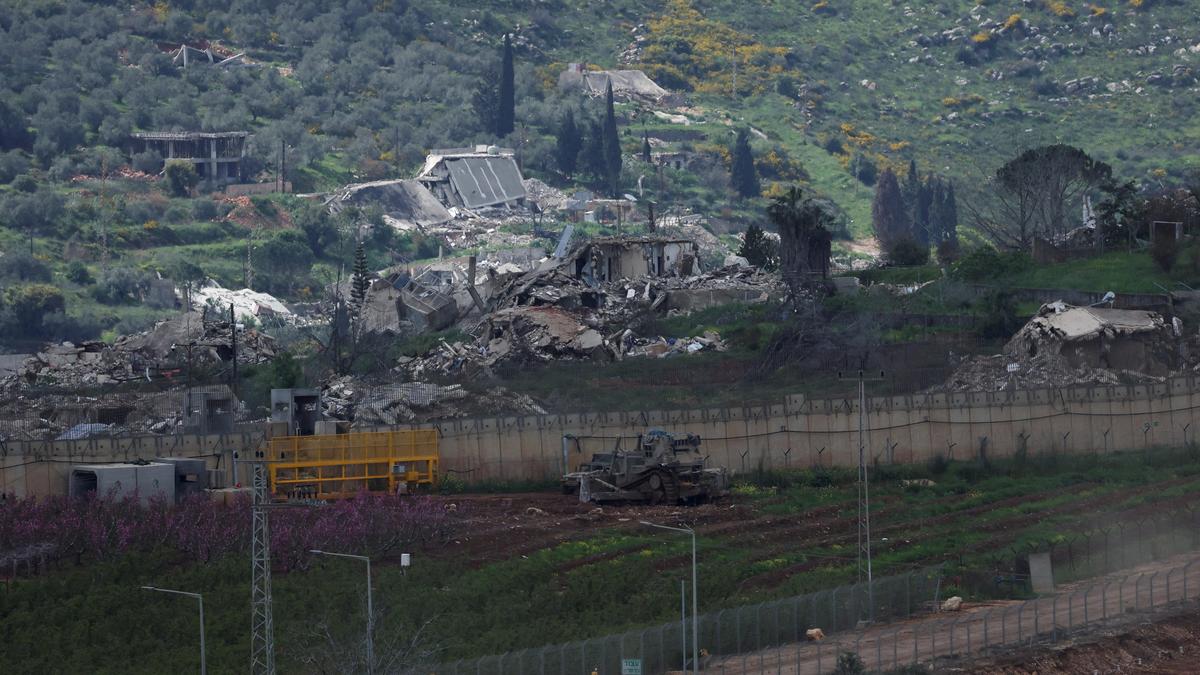
The ink on a diplomatic cable is rarely wet when it reaches the public eye, but the heat radiating from it can be felt across a thousand miles of scarred hillside. In Jerusalem, a pen moved. It was a signature that didn't just authorize a meeting; it authorized a breath. Benjamin Netanyahu has greenlit direct talks with Lebanon. The goal is a ceasefire. The timeline is "as soon as possible."
But to understand the weight of that phrase, you have to look past the mahogany tables of the Kirya and the high-walled offices in Beirut. You have to look at the olive groves.
Imagine a man named Elias. He is hypothetical, but he represents a million realities currently vibrating with tension along the Blue Line. Elias hasn’t slept in a room with a window for weeks. Every time a jet breaks the sound barrier, his coffee trembles. He doesn’t care about the intricacies of Resolution 1701 or the specific wording of a maritime border agreement. He cares about whether he can walk to his mailbox without becoming a statistic.
For people like Elias, this news isn't a policy shift. It is a flickering candle in a very dark, very long tunnel.
The Geography of Desperation
Diplomacy is often treated like a game of chess, but in the Middle East, it’s more like a game of nerves played on a crumbling cliffside. The border between Israel and Lebanon is a jagged line of history, resentment, and shared air. For months, that air has been filled with the whine of drones and the thunder of artillery.
The decision to move toward direct talks is an admission. It’s an admission that the current trajectory has reached a point of diminishing returns. When a leader says "as soon as possible," they aren't just expressing a desire for speed. They are acknowledging a pressure cookers' whistle.
The pressure isn't just military. It’s internal. It’s the families in Northern Israel who have been living in hotels for a year, their lives packed into suitcases, their children attending makeshift schools in lobbies. It’s the villages in Southern Lebanon where the infrastructure is a memory and the future is a question mark written in smoke.
Consider the logistics of a ceasefire in a place where trust has been buried under layers of concrete and grief. You cannot simply tell two sides to stop. You have to give them a reason to stay stopped. That requires a mediator, a map, and a massive amount of political capital that neither side is particularly eager to spend.
The Invisible Table
Behind every direct talk is a ghost. In this case, the ghost is the United States, hovering with a pen and a promise. The framework currently being discussed involves a phased withdrawal and a buffer zone—a "No Man's Land" that everyone hopes will eventually belong to the men and women who just want to farm their land.
But the real struggle isn't about where the tanks go. It’s about the language.
When diplomats sit down, they fight over commas. They argue over the difference between "withdrawal" and "repositioning." To an outsider, it looks like pedantry. To a soldier in a trench, it’s the difference between going home and staying in the mud.
We often think of peace as a grand, sweeping gesture. A handshake on a lawn. A signed treaty with a fancy seal. In reality, peace is a series of small, agonizing concessions. It is the act of looking at an enemy and deciding that their survival is more convenient than their destruction.
It’s messy. It’s ugly. It’s necessary.
The Cost of the Status Quo
If these talks fail, the alternative isn't just "more of the same." The alternative is a deepening of the scars.
Every day that the direct talks are delayed, the psychological toll mounts. We talk about the "stakes" as if they are abstract, but the stakes are the grocery bills of the displaced. The stakes are the heart rates of the elderly who can't reach a shelter in time. The stakes are a generation of children who will grow up thinking that the sound of a whistling wind is a reason to dive under a desk.
There is a profound exhaustion settling over the region. It’s a bone-deep weariness that transcends religion or political affiliation. People are tired of being brave. They are tired of being resilient. They just want to be bored.
The authorization for direct talks is a recognition of this exhaustion. It is a crack in the door.
The Architecture of a Deal
What does a "successful" talk look like? It doesn't look like a friendship. It looks like a cold, functional arrangement.
- The Separation: Moving armed groups away from the fence. This is the physical requirement, the breathing room.
- The Monitoring: Someone has to watch the watchers. This usually involves international forces who are often criticized but are the only thing standing between a misunderstanding and a massacre.
- The Sovereignty: The Lebanese state must actually hold the reins in its own south. Without this, any deal is a house of cards built on a windy beach.
None of these points are easy. Each one requires someone to give up something they feel they earned with blood.
I remember talking to a veteran of a different conflict years ago. He told me that the hardest part of peace isn't the ceasefire. It’s the first day you don't look at the sky. It takes years to train the eyes to look at the horizon instead of searching for a trail of fire.
The Timing of the Pivot
Why now?
The timing of Netanyahu’s authorization isn't accidental. It’s a convergence of geopolitical winds. The American election cycle, the shifting alliances in the Gulf, and the sheer logistical strain of a multi-front conflict have created a narrow window.
Windows like this don't stay open. They get slammed shut by a single rogue rocket or a miscalculated airstrike.
There is a certain irony in the fact that it takes so much violence to bring people to a table. We spend billions on the machinery of war only to realize that the most powerful weapon in the arsenal is a conversation.
The talks won't be easy. They will likely be filled with walkouts, posturing, and "red lines" that turn out to be pink. There will be moments where it seems like the whole thing will collapse.
But the alternative is the silence of the graveyard, and even the most hardened hawk knows that you can't build a future on top of a tomb.
The Human Weight of the Word
When the news broke, I thought about the families who have been living in limbo.
There is a specific kind of cruelty to uncertainty. It’s the "maybe" that kills you. Maybe we can go home next month. Maybe the roof is still there. Maybe the school will open in the fall.
Direct talks turn that "maybe" into a "how."
It’s a fragile thing, this authorization. It’s a piece of paper in a world of iron. But for the person waiting in a hotel room in Haifa or a basement in Tyre, it is the most important piece of paper in the world.
The diplomats will argue over the details. They will trade barbs and demand guarantees. They will speak in the language of security and sovereignty.
But the real story is simpler.
It is the story of a mother who might finally be able to put her child to bed without wondering if the ceiling will hold. It is the story of a farmer looking at a blackened field and wondering if he should buy seeds for the spring.
The talks are the first step toward a world where the most significant thing that happens in a day is the weather.
It is a long road from an authorization to a lasting quiet. The path is littered with the wreckage of previous attempts. But for the first time in a long time, the engine has been started.
Now, we wait to see if anyone is brave enough to drive.
The sun sets over the Mediterranean, casting a long, golden light over the very waters these negotiators will discuss. The waves don't care about borders. They just keep coming, indifferent to the signatures and the speeches. Underneath that golden light, millions of people are holding their breath, waiting to see if the words will finally be stronger than the weapons.
A man stands on a balcony in the north, looking toward the hills. He hears a sound. He pauses, his muscles tensing by reflex.
It was only the wind.
He stays there for a moment, letting the silence settle into his bones, hoping that this time, the silence is here to stay.


