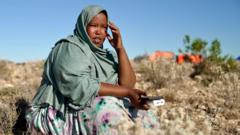
The heat in the Bari region of northern Somalia does more than burn. It vibrates. It creates a shimmering veil over the jagged limestone peaks of the Golis Mountains, a landscape so vertical and unforgiving that it feels less like geography and more like a fortress designed by nature to hide the world’s most dangerous secrets.
Down in the coastal towns, the air smells of salt and dried fish. But up here, the air tastes of dust and old gunpowder. This is the frontier of a ghost war. For years, the Islamic State in Somalia (ISS) has used these caves and ravines as a laboratory for terror, a place where they can disappear into the rock and wait. They aren't just hiding. They are breathing. They are planning.
The strategy used to be simple: find them, strike them, move on. But you cannot kill a shadow with a hammer. To root out an insurgency that has burrowed into the very marrow of the mountains, the approach had to change from brute force to a surgical, psychological, and technological hunt.
The Ghost in the Machine
Imagine a young man named Abdi. He is a hypothetical composite of the many who live in the orbit of the Golis. Abdi doesn't care about global caliphates. He cares about the fact that his goats are thirsty and the local "administrators"—the men with the black flags—are the ones who control the deep wells. When the Islamic State moved into the caves above his village, they didn't just bring rifles. They brought a parallel economy.
They extorted local businesses. They taxed the frankincense trade. They created a reality where survival was tied to silence.
This is the human gravity that keeps the Islamic State anchored in Somalia. It isn't just about ideology; it's about the terrifyingly mundane logistics of power. For the Somali security forces and their international partners, the challenge isn't just finding a cave entrance on a satellite map. It’s breaking the grip of fear that prevents a villager from pointing at that map.
The technology of the hunt has become breathtakingly intimate. Drones now loiter in the thin air, their sensors capable of detecting the heat signature of a single cooking fire hidden deep within a crevice. These aren't just weapons; they are unblinking eyes that have turned the rugged terrain against those who hide in it. When a strike happens, it is often the result of weeks of "pattern of life" analysis—watching how a specific group moves, how they fetch water, and who they meet under the cover of the acacia trees.
The Invisible Stakes of a Remote Province
Why does a desolate mountain range in Puntland matter to the rest of the world?
If you look at a map, Somalia is the gateway to the Gulf of Aden. Millions of barrels of oil and billions of dollars in cargo pass through those waters every day. The Islamic State knows this. They aren't just a ragtag group of mountain dwellers; they are a franchise of a global brand that views the Horn of Africa as a strategic pivot point. If they can consolidate power in the Golis, they can project chaos into the shipping lanes.
The conflict is a chess match played with high-altitude surveillance and ground-level betrayal. Recently, the pressure has moved from the air to the earth. Somali commando units, trained for the specific nightmare of mountain warfare, have begun the slow, bloody process of clearing the peaks.
This is not a "seamless" operation. It is gritty. It is loud. It is often confusing.
The soldiers move in the pre-dawn cold, their boots slipping on loose shale. They know that every bend in the trail could be an ambush. The Islamic State fighters here are known for their use of Improvised Explosive Devices (IEDs) made from remnants of old wars, buried under an inch of orange sand. One wrong step doesn't just end a life; it halts an entire operation, forcing a retreat and giving the enemy another week to relocate.
The Anatomy of the Hunt
The intelligence gathering is where the true war is won or lost. It’s a messy mix of high-tech SIGINT (signals intelligence) and old-school HUMINT (human intelligence).
- Signals Intercepts: Even in the mountains, leaders need to talk. A brief burst of a satellite phone or a radio transmission is a flare in the dark. Specialists miles away filter through the static, looking for the specific frequency of a commander.
- Biometric Tracking: When a hideout is over-run, the hunt shifts to what was left behind. Fingerprints on a discarded tea cup or DNA on a blanket are fed into global databases. The goal is to turn "insurgents" into "individuals" with names, faces, and histories.
- The Financial Noose: You cannot run a war without cash. By tracking the mobile money transfers—the lifelines of the Somali economy—investigators can see the pulse of the organization. They watch the money move from a shop in Bosaso to a middleman in the hills. When the money stops, the movement starves.
But there is a catch. Every time a strike is successful, it risks creating a vacuum that is filled by something even more desperate.
The Price of Silence
The most difficult part of this narrative isn't the combat. It’s the aftermath.
When the dust settles after a raid, the village at the base of the mountain is still there. The people who live there have to look at the soldiers who just arrived and then look back at the peaks where the survivors of the Islamic State are still watching. For the locals, the war isn't a headline or a policy objective. It is a permanent neighbor.
Trust is the scarcest resource in Somalia. The government in Mogadishu and the regional authorities in Puntland often struggle to provide the basic services that would make the Islamic State’s "administration" irrelevant. If the state cannot provide a school or a clinic, the man with the gun and the black flag becomes the only source of "order," however brutal that order may be.
The hunt for the Islamic State in the Golis is a race against time. The longer they stay in the mountains, the more they become part of the ecology. They marry into local clans. They trade for supplies. They become invisible because they become familiar.
A War of Incremental Gains
There will be no grand surrender on a battleship. There is no capital city to capture in the Golis. Instead, there are only small, quiet victories.
A shipment of detonators intercepted at a checkpoint. A mid-level financier arrested in a marketplace. A group of three fighters who, tired of the cold and the hunger, decide to walk down the mountain and hand over their rifles in exchange for a chance at a normal life.
These moments don't make the evening news in London or Washington, but they are the only way the war actually ends. It ends when the cost of hiding becomes higher than the cost of coming home.
The strategy has shifted toward "degrade and disrupt." The goal isn't necessarily to kill every single person associated with the group—an impossible task in such terrain—but to make it impossible for them to function as a cohesive unit. If they are constantly moving, constantly looking at the sky for the hum of a drone, and constantly wondering if their courier has been flipped by the police, they cannot plan attacks.
They become prisoners of the very mountains they thought would protect them.
The sun sets over the Bari region, turning the limestone cliffs a deep, bruised purple. Somewhere up there, a man is sitting by a small fire, shielded by a rock overhang. He is listening to the wind and the faint, rhythmic pulse of a distant engine in the sky. He knows that the world hasn't forgotten about this patch of dirt. He knows that the hunt is patient.
In the valley below, a light flickers on in a small house. A family sits down to eat. For tonight, the mountains are quiet, and the shadows are just shadows.