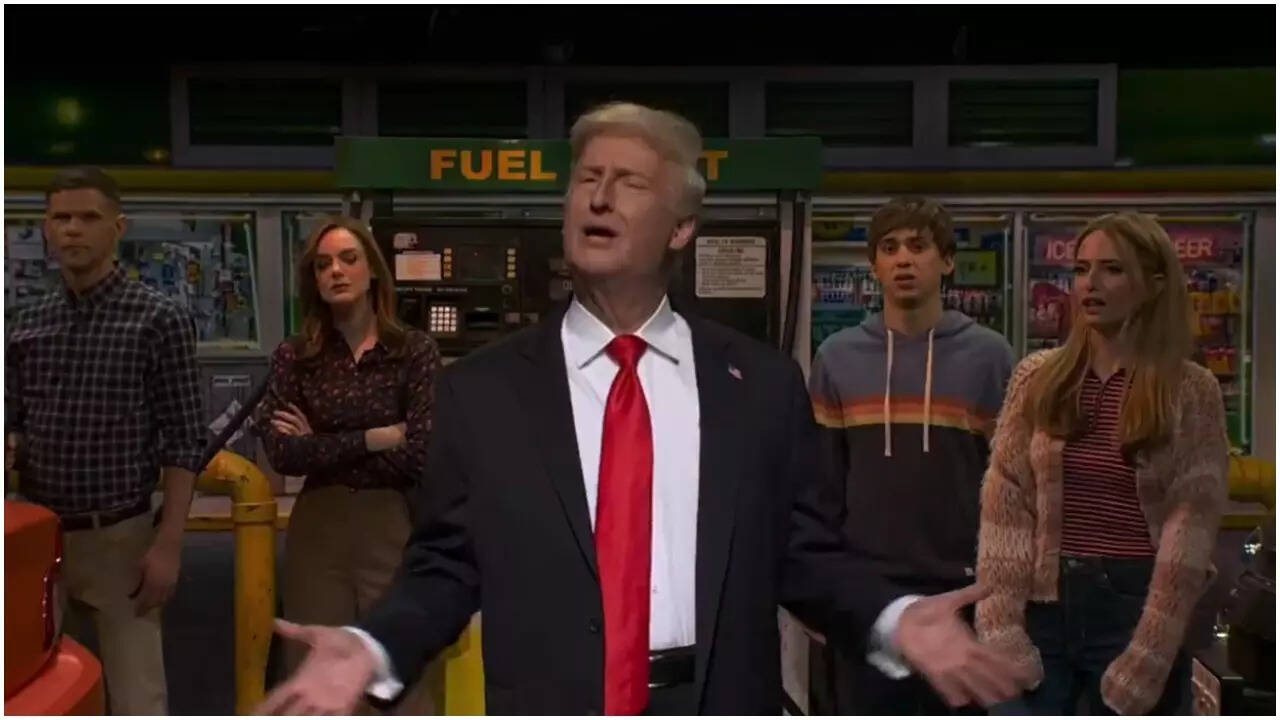
Late-night television has stopped trying to speak truth to power. Instead, it has settled for a comfortable, repetitive pantomime that serves neither the art of comedy nor the necessity of political critique. The recent Saturday Night Live sketch featuring a Timothée Chalamet-inspired take on the Trump administration’s geopolitical rhetoric—specifically the baffling comparison of Iran to "ballet and opera"—is more than just a weak punchline. It is a symptom of a creative engine that has stalled out, relying on celebrity impressions to mask a profound lack of insight.
When SNL drags a figure like Chalamet into a parody of the White House, it isn't doing so to sharpen the edge of its political commentary. It does so because the show has become addicted to the "cameo economy." This is the practice of substituting structural wit with the sheer dopamine hit of seeing a familiar, high-profile face in a wig. The audience cheers for the recognition, not the joke. In the process, the actual absurdity of modern governance is left largely unexamined.
The Spectacle of the Superficial
Satire requires a baseline of reality to subvert. Without it, you are just making noise in a costume shop. The "ballet and opera" bit highlights a specific failure in contemporary writing: the inability to compete with the inherent strangeness of the source material. When the real-world political discourse already sounds like a fever dream, a sketch comedy show cannot simply repeat those words with a funny accent and call it a day.
The Chalamet caricature serves as a distraction. By focusing on the aesthetics of the "cool youth" versus the "crusty establishment," the show ignores the actual mechanics of the policy being discussed. We are left with a series of sketches that feel like high school theater projects with million-dollar budgets. They are pleasant, they are safe, and they are entirely forgettable the moment the credits roll.
The Cameo Trap
The reliance on A-list stars to play political figures has fundamentally broken the show's internal logic. In the past, SNL cast members built careers by inhabiting these roles for years, developing a specific, satirical language for each politician. Think of Dana Carvey’s Bush or Will Ferrell’s version of the same man. These weren't just impressions; they were characters.
Now, we get a revolving door of guest stars who drop in for a single week. They haven't lived with the character. They are reading off cue cards, often for the first time in front of a live audience. The result is a performance that feels tentative and thin. When the audience sees Timothée Chalamet, they don't see a biting critique of a press secretary or a diplomat; they see a movie star playing dress-up. This "stunt casting" creates a barrier between the satire and the subject. It turns the news into a variety show, which is exactly what the people being satirized want. They want to be seen as celebrities, not as public servants accountable to the citizenry.
Why the Bite is Gone
The "ballet and opera" line is a perfect example of a joke that stops halfway. The premise—that a hardline administration would use high-culture metaphors to describe a geopolitical adversary—is ripe for deconstruction. It suggests a disconnect between the reality of war and the language used to sell it to the public. But SNL doesn't go there. It stays on the surface, laughing at the oddity of the words rather than the danger of the sentiment.
The Echo Chamber Problem
Writer’s rooms in New York and Los Angeles are increasingly disconnected from the anxieties of the broader public. This results in comedy that feels like it’s written for a specific ZIP code. The humor is insular. It relies on "clapter"—the phenomenon where an audience applauds a joke not because it is funny, but because they agree with the political stance of the comedian.
- Recognition over Revelation: The jokes focus on what we already know.
- Safety over Subversion: No one is truly offended, and no one is truly challenged.
- The Viral Hunt: Sketches are designed to be clipped for social media, leading to a "greatest hits" style of writing that lacks narrative flow.
This approach has turned SNL into a defensive wall for the status quo. By making the opposition look like buffoons in a predictable, non-threatening way, the show actually helps to normalize the very behavior it claims to be mocking. If the worst thing about a political crisis is that it’s "weird" or "like an opera," then the stakes are effectively lowered.
The High Cost of Easy Laughs
We are living through a period of extreme institutional distrust. In such a climate, the role of the satirist is to act as a pressure valve, sure, but also as a mirror. If the mirror is distorted by a need for celebrity approval and easy ratings, it provides a false image of the world.
The "ballet and opera" sketch didn't just fail to be funny; it failed to be relevant. It treated a complex international standoff as a backdrop for a "cool kid" bit. This is the "Jimmy Fallon-ization" of political discourse—tousling the hair of the monster and laughing while the house burns down. It’s an aesthetic of passivity.
The Satire Gap
While SNL plays it safe with Chalamet cameos, independent creators and smaller platforms are finding ways to be genuinely subversive. They don't have the baggage of a legacy network or the need to please a massive slate of corporate sponsors. They can afford to be mean. They can afford to be wrong. Most importantly, they can afford to be uncomfortable.
Television satire is currently stuck in a loop. It mimics the cadence of a joke without the substance of a point. To fix this, the show needs to stop looking at the guest list and start looking at the ledger. It needs to stop asking "Who can we get to play this person?" and start asking "What are we actually trying to say about this person?"
Beyond the Impression
An impression is a mimicry of form. Satire is a critique of function. If SNL wants to regain its position as a cultural heavyweight, it has to move beyond the wardrobe department. The show has an incredibly talented cast that is frequently sidelined in favor of the celebrity of the week. This isn't just a waste of talent; it’s a waste of the medium’s potential.
The Chalamet sketch was a hit in terms of clicks. It trended. It was shared. But did it change anyone's mind? Did it offer a new perspective on the administration's rhetoric? Did it even provide a laugh that lasted longer than the five minutes of the segment? The answer is a resounding no. It was cultural candy—sweet, airy, and entirely devoid of nutrition.
If the goal is simply to survive as a brand, then SNL is doing just fine. But if the goal is to be a vital part of the national conversation, it is failing. The "ballet and opera" of the Trump era deserves better than a three-minute sketch that prioritizes a movie star's cheekbones over the gravity of the situation.
Stop watching the actors and start watching the scripts. The real comedy—and the real tragedy—isn't in the impression; it's in the reality that the impression is too afraid to touch.