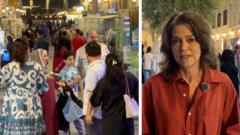
The cameras are back in the Souq Waqif, and they are telling you a lie.
You’ve seen the footage. Steam rising from coffee cups, shoppers haggling over spices, and the rhythmic clatter of construction resuming in the Msheireb district. The narrative being fed to the global public is one of "resilience." It is the classic wartime trope: two weeks into a regional conflagration involving Iran, the markets are filling up, the "new norm" has arrived, and life goes on. Meanwhile, you can read similar stories here: The Calculated Silence Behind the June Strikes on Iran.
It is a comforting story. It is also a dangerous misunderstanding of how capital and power actually function in the Gulf.
What the BBC and every other major outlet misses when they profile a "busy market" is the difference between biological survival and economic solvency. A crowded market in Doha during a hot war isn't a sign of recovery. It is a sign of local paralysis. People are buying bread and gold because they have nowhere else to go and nothing else to do with their local currency. To understand the complete picture, check out the excellent report by BBC News.
If you want to understand the health of a Petrostate during a conflict, stop looking at the vegetable stalls. Look at the bond spreads. Look at the insurance premiums for LNG tankers. Look at the silent, frantic exit of the "invisible" expat workforce that actually keeps the lights on.
The Myth of the New Norm
The term "new norm" is a linguistic sedative. It suggests that a state of war can be baked into a business model without destroying the underlying value. It cannot.
In my fifteen years advising private equity firms on Middle Eastern risk, I’ve seen this play out from Kuwait to Erbil. There is an initial shock, a brief period of "spirit of the Blitz" bravado where everyone goes back to the cafes to prove they aren’t afraid, and then the structural rot begins.
When a war involving a neighbor like Iran breaks out, the "new norm" isn’t a return to shopping. It is the permanent elevation of the "Risk Premium."
International investors do not care if the Souq is crowded. They care about the Probability of Default (PD) and the Loss Given Default (LGD). When the Straits of Hormuz become a literal shooting gallery, the fundamental value proposition of Qatar—a safe, stable bridge between East and West—evaporates.
You aren't seeing a recovery; you are seeing the ghost of a city-state trying to convince itself it still has a future as a global hub.
Why the Market Data is Screaming
Let’s talk about what the fluff pieces won’t. While tourists or residents might be buying more saffron, the institutional money is looking at the CDS (Credit Default Swap) prices.
In any conflict involving Iran, the cost to insure Qatari sovereign debt doesn't just "tick up." It undergoes a structural shift. If you are an institutional treasurer, you aren't looking at "resilient shoppers." You are looking at:
- Supply Chain Decoupling: Qatar imports nearly 90% of its food. When the primary shipping lanes are contested, the "filling markets" are often just people panic-buying before the next price hike.
- Labor Flight: The professional class—the engineers, the surgeons, the fintech developers—don't wait for the missiles to hit. They leave when the insurance on their villas triples.
- Liquidity Traps: Domestic spending might look high because people are liquidating assets into cash. High velocity of money in a war zone isn't growth; it's an exit strategy.
Stop Asking if People are Afraid
The "People Also Ask" sections of the internet are currently obsessed with "Is it safe to travel to Doha?" or "Is the Qatar economy stable?"
These are the wrong questions. You are asking about the symptoms while the patient has stage four cancer.
The real question is: "Can a rentier state survive the permanent loss of its neutrality?"
Qatar’s entire 21st-century strategy was based on being the "Switzerland of the Sand." It hosted everyone from the Taliban to the U.S. military. It used its gas wealth to buy silence and influence. But war with Iran forces a binary choice. You are either a target or an ally, and both are expensive.
When the BBC shows you a crowded market, they are showing you the 1% of the economy that is visible. They are ignoring the 99%—the sovereign wealth fund allocations, the massive infrastructure debt, and the drying up of Foreign Direct Investment (FDI).
I have watched companies burn through a decade’s worth of reserves in six months trying to maintain the "illusion of normalcy." They keep the malls open. They keep the fountains running. They do this because if they stop, the credit ratings drop. It is a theater of stability performed for an audience of banks that have already stopped clapped.
The Contradiction of Energy Security
The great irony of the current conflict is that while the world screams for Qatari gas to replace lost volumes elsewhere, the physical ability to export that gas becomes a liability.
Imagine a scenario where the North Field—the world’s largest gas field—is within the "cone of uncertainty" for every drone swarm launched in the region. The "market filling up" doesn't matter if the LNG terminals are idling.
The media focuses on the "resilience" of the people. But people are resilient by necessity. Capital is a coward. Capital runs at the first sign of a kinetic threat.
If you are looking for the truth, ignore the smiling merchant in the article. Look at the flight manifests of private jets leaving Hamad International Airport. Look at the vacancy rates in the high-end towers of West Bay. That is where the war is being won or lost.
The Brutal Reality of the Post-War Pivot
The "status quo" thinkers believe that once the dust settles, things go back to 2022 levels. They won't.
Once a region is flagged as a high-intensity conflict zone, the "Safe Haven" status takes decades to earn back. You don't just "reset" a global logistics hub. Every day the war continues is a year added to the recovery time of the "Doha Brand."
The "New Norm" isn't a return to the market. It is the realization that the market was built on a foundation of peace that no longer exists.
Stop looking at the shoppers. Look at the exit signs.
If you are an investor, a business owner, or a policy maker, the biggest mistake you can make is believing your own PR. The market isn't filling up because things are getting better. It's filling up because the walls are closing in, and there is nowhere else to go.
Buy your spices while you can. The ships aren't coming back anytime soon.