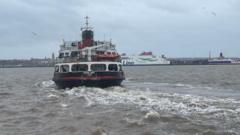
Stop mourning the scrap metal.
The collective weeping over the Snowdrop or any of its aging siblings embarking on a "final voyage" after six decades is the kind of industrial Stockholm Syndrome that keeps British infrastructure stuck in a 1950s time warp. We love a good eulogy for a boat. We adore the grainy photos and the Gerry and the Pacemakers soundtrack. But if you actually care about the Mersey, you should be cheering for the torch.
The competitor narrative is predictable: "End of an era," "Sixty-six years of service," and "A beloved icon retires." It’s lazy. It treats a public transport asset like a family pet. In reality, keeping a 66-year-old vessel in active service isn't a feat of heritage—it’s a failure of imagination and a drain on the taxpayer.
The High Cost of Nostalgia
Let’s talk about the math of maintenance. Every extra year a vessel like this stays on the water, its operational costs don't just climb; they hockey-stick.
The Maintenance Debt
When a ferry hits the 60-year mark, you aren't just "fixing" it anymore. You are fighting physics. You are chasing corrosion through hulls that have seen more saltwater than some islands.
- Propulsion inefficiency: Older engines are fuel-guzzling monsters.
- Compliance creep: Retrofitting ancient vessels to meet modern safety and environmental standards is a financial black hole.
- Spare part scarcity: When parts aren't made anymore, you’re either cannibalizing other old boats or paying a fortune for custom fabrication.
I have seen city councils and transport authorities bleed millions of pounds trying to keep "icons" afloat. They do it because they are terrified of the PR fallout from "destroying history." But history belongs in a museum, not on a daily commuter route.
The Myth of the "Iconic" Experience
The competitor's piece thrives on the idea that the ferry is Liverpool. It’s an easy trope. But if you’ve actually been on one of these "final voyages," the reality is often less about the romance of the river and more about vibrating deck plates and the smell of diesel.
The real tragedy isn't the ferry going to the breaker's yard. The real tragedy is that we’ve convinced ourselves that a 1950s boat is the best way to cross the Mersey in 2026. This isn't just about nostalgia; it’s about a lack of ambition.
What People Also Ask (and Why They’re Wrong)
- "Can’t we just renovate it?"
No. You can't "renovate" a ship’s structural integrity indefinitely. Eventually, the steel is more patch than plate. It becomes a Ship of Theseus problem, except the new parts are prohibitively expensive and the old parts are dangerous. - "Won't we lose tourists?"
Tourists don't come for the specific hull. They come for the view and the song. You can give them a 21st-century experience—electric, silent, zero-emission—and they will still take the selfie. They’ll probably take a better one if the boat isn't vibrating their teeth out. - "Isn't it part of our identity?"
If your city’s identity is tied to a 1959 propulsion system, your city is in trouble.
The Zero-Emission Reality Check
The maritime industry is currently undergoing a massive shift toward electrification and hydrogen fuels. While the world is moving toward silent, clean, high-speed water transit, we are still writing poems for boats that require a crew to manually monitor analog dials.
The Opportunity Cost of Sentimentalism
Every pound spent prolonging the life of a relic is a pound not spent on:
- Fully electric fleets: Zero noise, zero fumes, and lower long-term operating costs.
- Integrated transit hubs: Making the ferry more than a tourist novelty.
- Frequency of service: Modern boats are more reliable and require less downtime.
If we keep these old vessels on the water, we are essentially subsidizing a floating museum with money meant for transit. I have watched transit authorities in other parts of the world—places like Oslo or even parts of New York—pivot toward modern fleets and see ridership numbers skyrocket. They didn't wait 66 years. They understood that a boat is a tool, not a monument.
The Engineering Truth
Let's look at the actual physics. $F = ma$ doesn't care about your memories of school trips. The mass of these older vessels is often much higher than modern composite hulls. This means more energy is required to move them, which translates to more fuel and higher emissions.
If we calculate the carbon footprint per passenger mile on a 60-year-old diesel ferry versus a modern electric catamaran, the results are damning. It’s not just "less efficient." It’s a different league of environmental impact.
"But it’s a classic design!"
So is a 1959 Ford Anglia, but you wouldn't use it to run a city bus route.
The Hard Truth About Heritage
Heritage is a trap. It’s a comfortable blanket that smothers progress. By framing every decommissioned ferry as a "sad loss," we are telling the people of the Liverpool City Region that they don't deserve better. We are telling them that "old and creaky" is the best they can hope for because it’s "tradition."
I have spent years consulting on infrastructure projects. I know exactly how these conversations go behind closed doors. The engineers want the new stuff. The bean counters want the new stuff because the old stuff is a liability nightmare. It’s the politicians and the "sentimentalists" who hold things back, terrified of a headline in the local paper.
Stop the Eulogies
The retirement of a ferry after 66 years shouldn't be a somber occasion. It should be an admission that we waited at least twenty years too long to replace it.
If we want to honor the maritime history of the Mersey, we do it by building the most advanced, efficient, and forward-thinking river transit system in the world. We don't do it by clinging to the rusted hulls of the past.
The Snowdrop had its run. It did its job. Now, let it die so something better can take its place.
Put the song on if you must. But once the music stops, look at the river and demand a 21st-century fleet that actually serves the city, instead of just reminding it of what things looked like when your grandfather was a teenager.
The only "final voyage" we should be talking about is the one where we finally leave this obsession with industrial stagnation behind.
Pick up the welding torch and get on with it.