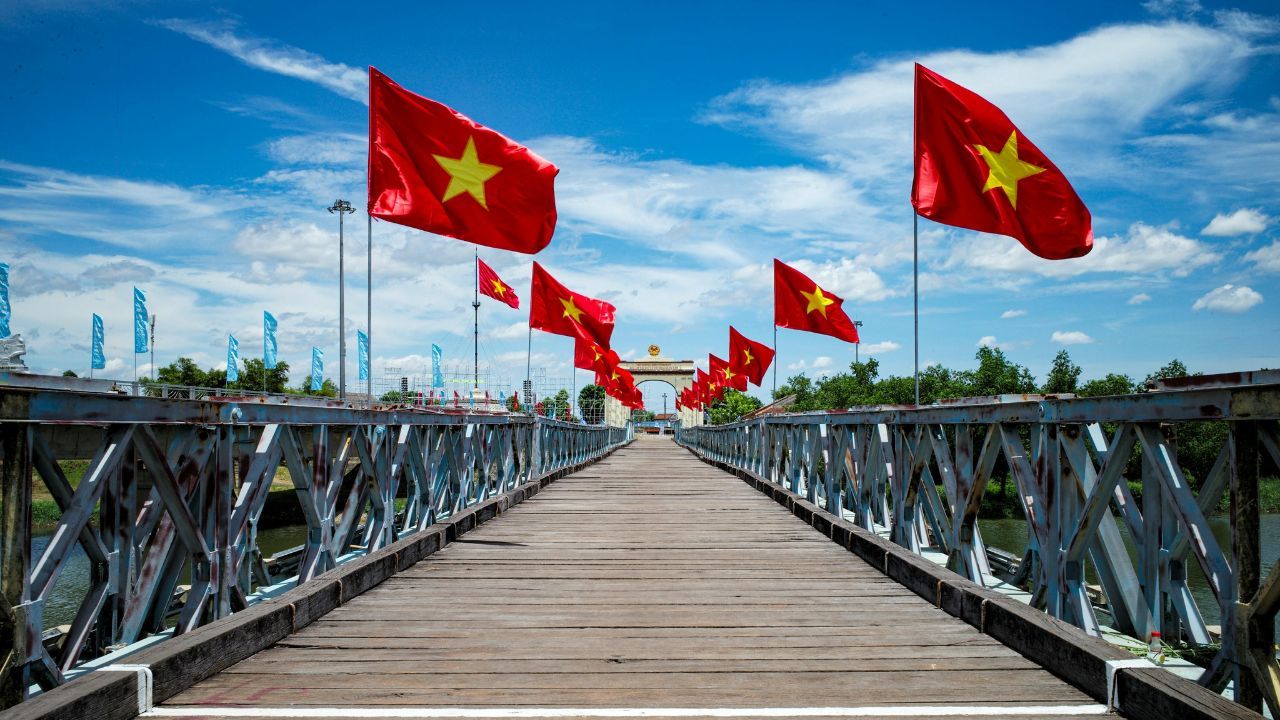
The scent of Phở Gà and exhaust fumes usually defines a Sunday morning in Hanoi. But today, there is something else in the humid air. It is the smell of fresh paper and the sound of loudspeakers, crackling with a rhythmic, patriotic urgency that feels like a heartbeat for a nation of nearly 100 million people.
Across the S-shaped curve of Vietnam, from the mist-shrouded peaks of Ha Giang to the muddy, life-giving veins of the Mekong Delta, a silent machinery has groaned into life. It is election day. If you liked this piece, you might want to look at: this related article.
To a casual observer from the West, the process might look like a foregone conclusion. The Communist Party of Vietnam (CPV) remains the sole pilot of this rapidly ascending ship. Yet, to dismiss this as a mere bureaucratic ritual is to miss the subtle, internal tectonic shifts of a country trying to balance iron-clad stability with a blistering, modern economic hunger.
The Weight of a Single Slip
Consider Nguyen. He is a hypothetical but representative shopkeeper in the Old Quarter. He is 62 years old. His skin is mapped with the lines of a man who remembers when bicycles were a luxury and white rice was a dream. For Nguyen, the act of walking to the local polling station—decorated with the bright crimson banners and gold stars that define the national aesthetic—is not about overturning a system. It is about the social contract. For another perspective on this event, check out the recent coverage from Al Jazeera.
He stands in line with his neighbors. They are not shouting slogans. They are talking about the price of pork and the quality of the new metro line. When Nguyen receives his ballot, he is looking for names he recognizes—local leaders who might actually fix the drainage on his street or push back against the local developers.
In this election, over 69 million voters are eligible to choose 500 members of the National Assembly. While the overarching power structure is firm, these 500 individuals represent the friction point between the high-level policy of the Politburo and the messy, daily reality of the Vietnamese people.
The stakes are invisible but heavy.
The Filtered Choice
The "Vetting" is the word that outsiders often stumble upon. Before a name ever reaches a ballot like the one Nguyen holds, it must pass through the Vietnam Fatherland Front. This is a rigorous screening process designed to ensure that candidates align with the national direction.
In the most recent cycles, there has been a push for more "self-nominated" candidates—individuals not formally put forward by the Party. While their numbers remain small, their presence is a pressure valve. It represents a growing awareness that as Vietnam’s middle class explodes, so too does the demand for professionalized governance.
The government needs the National Assembly to be more than a rubber stamp. They need it to be a laboratory. They need legislators who can navigate the complexities of international trade deals like the CPTPP and the EVFTA. They need people who can handle the delicate diplomacy of being a primary manufacturing alternative to China while maintaining a peaceful border.
A Nation in a Hurry
Vietnam is not a country content to wait. The energy in Saigon—officially Ho Chi Minh City, but still "Saigon" to the pulse of its streets—is frantic. Young entrepreneurs in high-rise co-working spaces don't talk about Marx; they talk about Series A funding and supply chain logistics.
Yet, the election serves as a grounding wire. It reminds the high-flyers that the state remains the architect of the infrastructure they use. The roads, the fiber-optic cables, and the very stability that attracts foreign investment are tied to the hands that count these red ballots.
During this election, the "Blazing Furnace" anti-corruption campaign led by General Secretary Nguyen Phu Trong looms over every polling station. It is a campaign that has seen high-ranking officials, including former ministers and business moguls, stripped of power and imprisoned.
For the average voter, the election is a chance to see which way the wind is blowing. Are the new candidates "clean"? Do they represent a break from the graft that has historically slowed down local projects?
The Mechanics of the Day
Logistically, the day is a marvel of mobilization.
- The Local Units: Every neighborhood is divided into small voting groups.
- The Red Boxes: The ballot boxes are moved with a level of security usually reserved for gold bullion.
- The Fingerprint: In many areas, the indelible ink on a finger is a badge of participation, a quiet signal to the community that you have fulfilled your duty.
There is a specific silence that falls over a Vietnamese city during the peak voting hours. The usual roar of motorbikes fades to a hum. The parks are empty. The focus is inward.
The Paradox of Stability
The struggle for many observers is understanding how a country can be so vibrant, so capitalist in its daily hustle, yet so rigid in its political architecture.
The answer lies in the memory of chaos.
Vietnam’s history is a long, often agonizing lesson in the cost of instability. From the colonial era to the "American War" and the lean, hungry years of the post-war era, the collective psyche prizes order. The election is the annual renewal of that order. It is the ritual that says: We are moving forward, but we are moving together.
Consider the youth. More than half of the population is under the age of 35. They have no memory of the subsidy period. They are digital natives. For them, the election is less about the grand narrative of revolution and more about the practical narrative of the future. They want environmental protections for their coastlines. They want an education system that competes with Singapore. They want a government that moves as fast as their internet connection.
The Invisible Stakes
If the election fails to engage this younger generation, the Party faces a slow-motion crisis of legitimacy. That is why this particular cycle has seen an increased use of social media and Zalo—the national messaging app—to drive turnout and explain candidate biographies.
It is a digital-age charm offensive.
By the time the sun begins to set over the Long Bien Bridge, the counting has already begun. There will be no surprises in the sense of a new party taking power. There will be no "upset" in the traditional parliamentary sense.
But the victory is measured differently here.
Success is measured in the percentage of turnout. A 95% or 98% turnout is not just a statistic; it is a claim of mandate. It is the government saying to the world—and to its own people—that the mandate of heaven is still intact.
The Last Ballot
Back in the Old Quarter, Nguyen finishes his bowl of noodles. He has cast his vote. He has done his part. He walks back to his shop, pulls up the metal rolling door, and prepares for the afternoon rush.
The red banners will stay up for a few more days, fluttering against the grey Hanoi sky. The loudspeakers will eventually go silent, replaced by the chaotic music of commerce and construction.
The world will continue to look at Vietnam and see a factory, a tourist destination, or a strategic pawn on a geopolitical chessboard. But today, Vietnam looked at itself in the mirror of a ballot box.
It saw a nation that is no longer just surviving, but calculating its next move with a cold, focused precision. The revolution hasn't ended; it has simply changed its medium from gunpowder to paper, from the battlefield to the boardroom, and from the jungle to the quiet, determined hand of a shopkeeper marking a red slip in the morning light.
The ink on Nguyen’s finger will fade in a week, but the machinery he helped turn today will keep humming, driving a nation toward a future that is as certain as the sunrise over the East Sea and as complex as the streets of the city he calls home.
The ballots are counted, the names are recorded, and the ship sails on, its course set by a single hand on the tiller and millions of hands holding the oars.