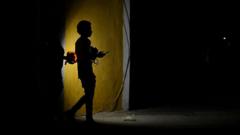
The collapse of Cuba’s national power grid on Monday was not an accident of nature or a simple mechanical hiccup. It was a mathematical certainty. When the Antonio Guiteras thermal power plant—the island’s largest and most temperamental energy workhorse—shuddered to a halt at approximately 11:00 a.m., it didn’t just leave 10 million people in the dark. It exposed the terminal phase of a decades-long infrastructure decay that has now collided with a brutal, renewed geopolitical strangulation.
The lights went out because the margin for error has reached zero. For years, the Cuban electrical system has functioned on the "magical" ingenuity of technicians cannibalizing parts from Soviet-era relics to keep turbines spinning long past their expiration dates. On Monday, the math simply stopped working. Demand, hovering around 2,347 megawatts, met an available supply of barely 1,140 megawatts. You cannot run a country on a 50% deficit. The system did what any overloaded circuit does to save itself from melting down: it disconnected. In related developments, take a look at: The Sabotage of the Sultans.
The Venezuelan Arteries Have Been Cut
To understand why the grid collapsed today, you have to look at what happened in Caracas in January. The capture of Nicolás Maduro and the subsequent U.S. intervention in Venezuela ended the subsidized oil shipments that have served as Cuba’s lifeblood since the turn of the century. Historically, Cuba required roughly 120,000 barrels of oil per day to keep the lights on and the economy moving. Domestic production covers barely 40,000 barrels, and even that is a heavy, sulfur-rich "sour" crude that corrodes the very boilers it is meant to fire.
With Venezuelan shipments halted and the Trump administration threatening massive tariffs on any third-party nation—including former allies like Mexico—that dares to dock a tanker in Havana, the island is effectively under an energy blockade. In 2026, the fuel reserves have been drained to the "bottom of the tank." Without the "smokestack of a tanker on the horizon," as maritime analysts have warned, the Cuban state is entering "zero hour." USA Today has provided coverage on this critical issue in great detail.
A Grid Held Together by Duct Tape and Prayer
Even if oil were abundant, the hardware is failing. The backbone of the Cuban grid consists of eight aging thermoelectric plants. Most are over 40 years old. In the world of power generation, that is geriatric.
The Antonio Guiteras plant in Matanzas is the perfect example of this structural fragility. It is a single-unit plant, meaning when it fails, the shock to the national frequency is so violent that it triggers a cascading "tripping" of smaller plants across the island.
- Thermal Fatigue: Constant cycling of plants—turning them off and on to manage fuel—causes metal fatigue in high-pressure steam lines.
- Maintenance Backlog: Due to a lack of foreign currency, Cuba hasn't performed a "deep" capital maintenance cycle on its major plants in over a decade.
- The Powership Problem: In a desperate move, Havana leased floating power plants from the Turkish company Karpowership. However, by February 2025, five of these vessels reportedly weighed anchor and left because the Cuban government couldn't meet its payment obligations.
The Social Breaking Point
This isn't just a technical crisis; it’s a humanitarian one. When the power goes, the water stops. Cuba’s municipal water systems rely on electric pumps to move water through aging pipes. Without them, millions lose access to running water within hours. In the tropical heat of March, food—already scarce and exorbitantly expensive—spoils in darkened refrigerators.
We are seeing the return of the "cacerolazo," the rhythmic banging of pots in the streets of Havana and Santiago. The government's response has been a predictable blend of military mobilization and internet blackouts to prevent the coordination of dissent. President Miguel Díaz-Canel has traded his civilian suits for military fatigues in televised addresses, blaming "energy persecution" from Washington while warning that protests will not be tolerated.
The Renewable Mirage
Havana has spent the last year touting a pivot to solar energy, promising that 37% of the nation's power will come from renewables by 2030. It is a noble goal that is currently irrelevant to the 10 million people sitting in the dark. Solar production peaked at 732 megawatts last week, but without massive battery storage systems—which Cuba cannot afford—that power vanishes the moment the sun sets, precisely when peak demand hits.
Russia and China have stepped in with "humanitarian" shipments of fuel and rice, but these are band-aids on a severed artery. A single Russian tanker carrying 200,000 barrels of diesel buys the island maybe three or four days of breathing room. It does not fix the cracked boilers or the rusted transmission lines.
The crisis in Cuba is no longer about "managing" a shortage. It is about a system that has finally run out of time, fuel, and luck. The total collapse of the grid is the physical manifestation of a state that has lost its ability to provide the most basic requirement of modern life. Until there is a fundamental shift in either the geopolitical landscape or the internal economic model, the intervals between these blackouts will only get shorter.
Cuba isn't just waiting for the lights to come back on. It is waiting to see if they ever will stay on again.