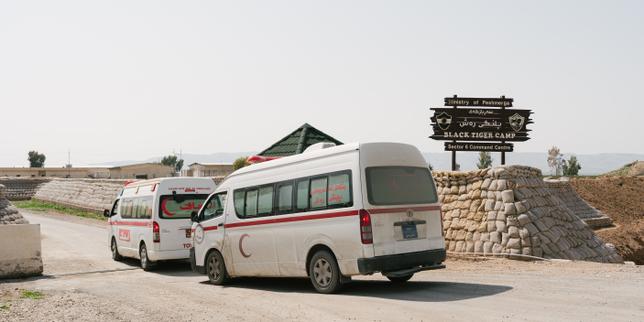
The dust in Iraqi Kurdistan has a way of clinging to everything—your boots, your lungs, and eventually, your conscience. It is a fine, ochre powder that blurs the line between the earth and the sky, much like the conflict itself blurs the line between a training mission and a front-line war. In August 2023, that dust settled on the coffin of Nicolas Mazier.
He was a member of the elite Commando Parachutiste de l'Air n° 10. He wasn't there to conquer territory. He was there to advise, to assist, and to ensure that the remnants of a shattered caliphate didn't find the breath to rise again. But when a routine reconnaissance mission in the Kirkuk region spiraled into a four-hour firefight against entrenched insurgents, the abstraction of "foreign policy" evaporated. It was replaced by the staccato rhythm of assault rifles and the heavy silence of a life extinguished.
France found itself staring at a map of the Middle East that suddenly looked much more jagged.
The Fiction of the Perimeter
We often talk about military involvement as if it were a game of chess played on a clean board. We draw circles around regions and label them "stabilized" or "under control." It is a comforting lie. In reality, the Iraqi theater is a porous mess of shifting loyalties and ancient grievances.
When a French soldier dies in the mountains of the Levant, it isn't just a tragedy for a family in France; it is a mechanical failure in a very delicate machine. Paris has spent years trying to maintain a "third way" in the Middle East. They want to be the Western power that speaks to everyone—the Americans, the Iraqis, the Kurds, and even, through clenched teeth, the Iranians.
Mazier’s death ripped the veil off this balancing act.
Consider the geography of the strike. Kirkuk is a tinderbox. It is where the aspirations of the Kurdish regional government collide with the central authority of Baghdad, all while ISIS cells wait in the limestone caves like a dormant virus. By losing a soldier here, France was forced to acknowledge that its "light footprint" was stepping on very hot coals. The mission, officially dubbed Operation Chammal, was supposed to be the tail end of a finished war. Instead, it felt like the prologue to a new, more chaotic chapter.
The Invisible Architect in Tehran
You cannot speak of the dirt in Iraq without speaking of the shadow cast from Iran. While the specific insurgents who pulled the trigger may have been local fanatics, the environment that allowed them to thrive is a product of a much larger struggle.
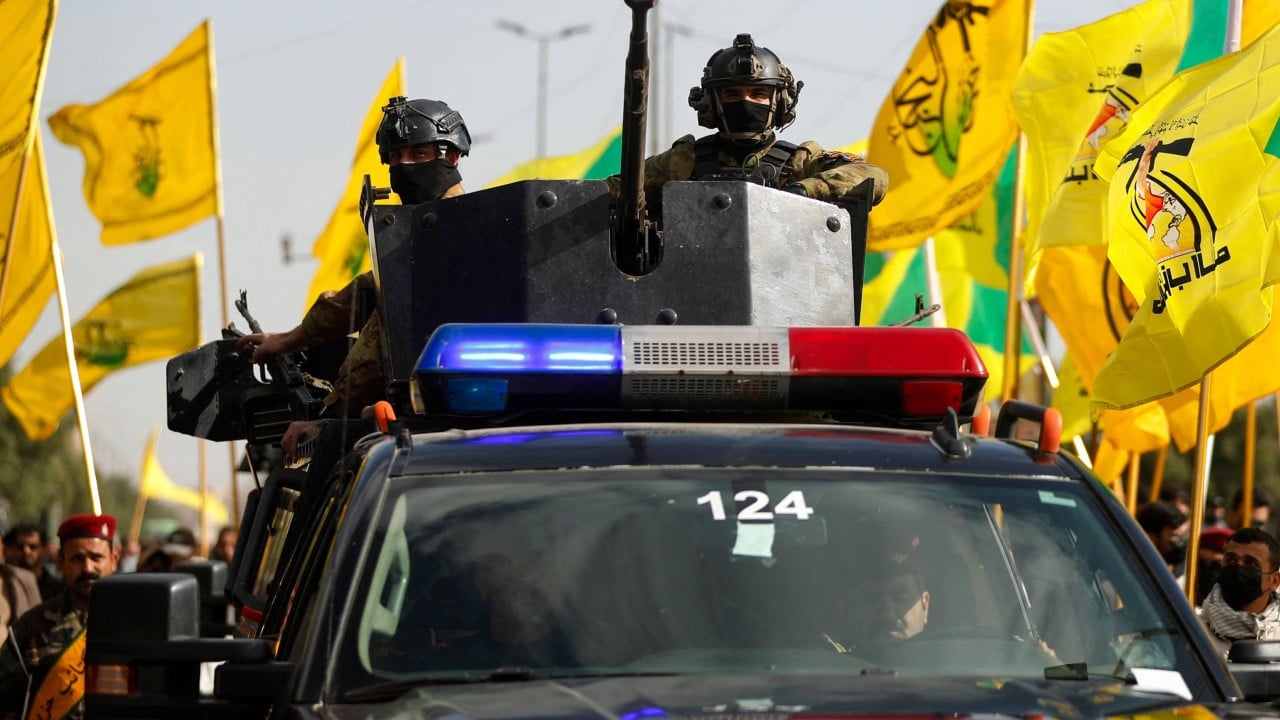
Iran views the presence of any Western boot on Iraqi soil as an existential insult. For years, Tehran has cultivated a network of militias—the Popular Mobilization Forces—that often hold more sway than the actual Iraqi army. France knows this. President Emmanuel Macron has tried to play the role of the grand mediator, attempting to de-escalate tensions between Washington and Tehran to keep the region from melting down.
But mediation requires leverage. And leverage is hard to maintain when your soldiers are being shipped home in flag-sleeved boxes.
Every time a French operative is killed or a French diplomat is sidelined, the Iranian influence grows an inch taller. They are playing a long game of attrition. They want the cost of staying to eventually outweigh the pride of the mission. They want the French public to ask: "Why are we there?"
The Anatomy of a Dilemma
The French government faces a choice that has no "right" answer.
If they withdraw, they leave a vacuum. We know what happens in Middle Eastern vacuums. They aren't filled by democracy or peace; they are filled by the loudest, most violent actors available. A French exit would signal to the Kurds—long-time allies who feel increasingly abandoned by the West—that Paris is no longer a reliable shield. It would also hand a symbolic victory to the very insurgents who killed Mazier.
If they stay, they remain a target.
The death of a soldier in a "non-combat" role is a political nightmare. It creates a friction point in the National Assembly. It forces the government to justify a budget and a blood price for a conflict that many citizens thought was over in 2017.
The reality is that France is trapped in a paradox of presence. They are too small to dictate the outcome of the region, but too large to leave without triggering a collapse. They are the glue in a vase that has already been shattered.
The Human Toll of Strategy
Let’s step away from the maps and the ministers for a moment.
Think of the "adviser." In military parlance, an adviser is someone who stands behind the line. They teach tactics. They coordinate air strikes. They provide the intellectual backbone of a local force. But in the jagged hills of the Zagros mountains, there is no "behind the line."
When the bullets start flying, the distinction between a trainer and a combatant disappears in a heartbeat. The risk isn't a statistic. It’s a 30-year-old man with a family back in a quiet French village, crouching behind a rock, wondering if the drone overhead belongs to his friends or his enemies.
This is the "invisible stake." We measure the success of these missions in "territory cleared" or "units trained." We rarely measure it in the psychological erosion of the men and women sent to hold back the tide with a handful of sand.
A Position Complicated
The headline in the competitor's piece spoke of a "complicated position." That is an understatement of Victorian proportions.
France's position isn't just complicated; it’s precarious. They are trying to support an Iraqi state that is increasingly infiltrated by Iranian interests. They are trying to protect a Kurdish minority that is being squeezed by both Baghdad and Turkey. And they are trying to do all of this while the United States is visibly looking for the exit door, refocusing its eyes on the Pacific.
When Nicolas Mazier died, he didn't just leave a hole in his unit. He left a hole in the narrative that France could manage this conflict from a safe distance.
The death of a soldier is a moment of brutal clarity. It strips away the diplomatic jargon. It reminds the world that "influence" is bought with lives. As Paris navigates the fallout, they aren't just looking for a military strategy; they are looking for a reason to tell the next soldier’s mother that the mission is still worth the price.
The sun sets over the ruins of a thousand years of empire in Iraq, and the wind carries the smell of cordite and ancient dust. The mission continues, not because the goal is clear, but because the alternative is a darkness no one is ready to face.
Somewhere in a barracks in France, another commando is packing his gear. He knows the name of the man who went before him. He knows the dust is waiting. He goes anyway, a single human thread in a tapestry that is being pulled apart by forces far larger than himself.