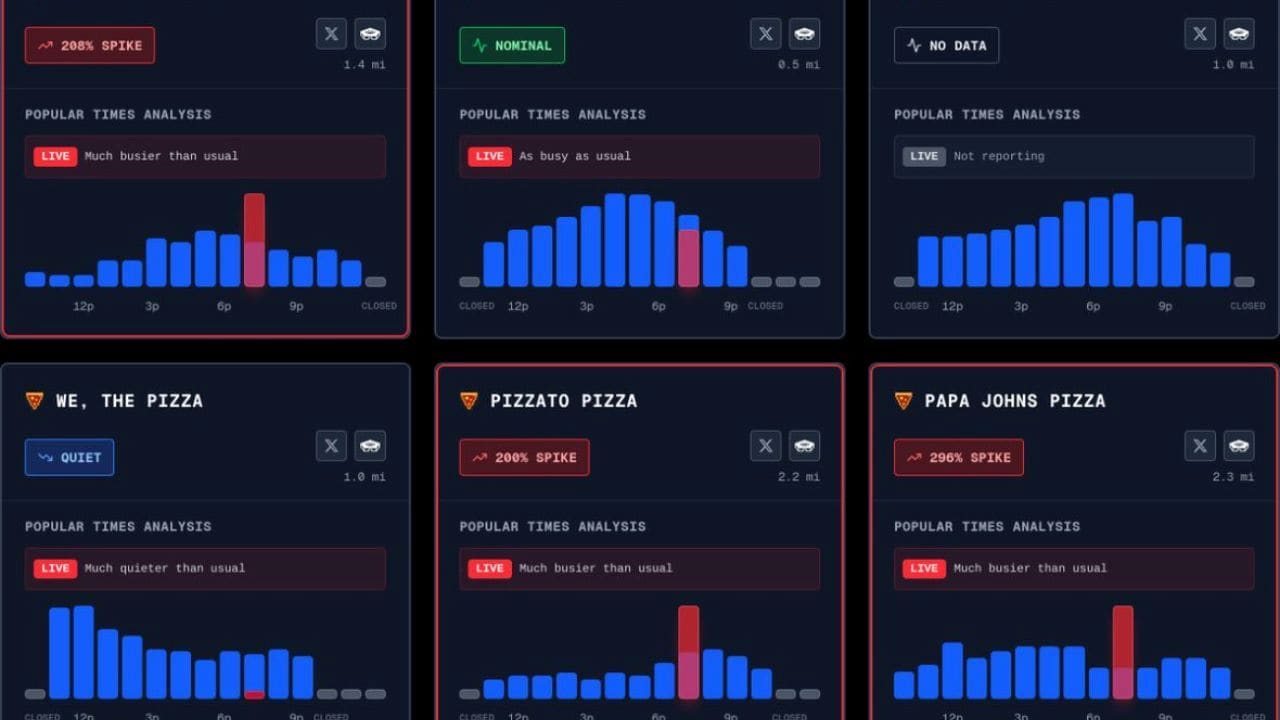
The internet loves a good spy novel trope, especially when it involves pepperoni and national security. Every time tensions flare in the Middle East, social media ghouls start monitoring Papa John’s delivery heat maps around the Pentagon. They call it the Pizza Meter. They claim it’s a foolproof leading indicator of an imminent strike on Iran.
It’s not. It’s a relic of 1990s logic being applied to a 2026 decentralized workforce. If you’re waiting for a surge in cheese-laden cardboard to predict the next move in the Persian Gulf, you aren't just late to the party—you’re reading a map of a city that was demolished a decade ago.
The "Pizza Meter" (originally dubbed the Frank Meeks Factor after a Domino’s franchise owner noticed spikes before the Gulf War) relied on a very specific set of variables: a centralized workforce, a lack of on-site high-end catering, and the absence of mobile delivery apps. None of those variables exist today.
The Death of Centralized Intelligence
The "lazy consensus" suggests that when a crisis hits, every analyst, general, and code-breaker rushes to the E-Ring of the Pentagon and stays there until 4:00 AM. This assumes the Department of Defense (DoD) operates like a 1950s newsroom.
It doesn’t.
The most critical data processing for a potential strike on Iranian infrastructure isn’t happening exclusively in Arlington. It’s happening at USCENTCOM in Tampa. It’s happening at NSA Georgia. It’s happening in windowless rooms in Aurora, Colorado. Most importantly, it's happening via SCIF-to-SCIF (Sensitive Compartmented Information Facility) encrypted video uplinks.
When the President extends a deadline, he isn't just "buying time." He is allowing the logistical machine to reset. The idea that a strike is "imminent" because a delivery driver dropped off twenty pies at the Pentagon’s Mall Entrance ignores the fact that modern warfare is managed through distributed nodes.
If you want to track a surge in activity, stop looking at pizza. Start looking at the private jet flight paths from defense contractors in Northern Virginia to Offutt Air Force Base. Look at the "burst" patterns in satellite downlink bandwidth. Pizza is for the entry-level analysts who don't have the clearance to go home. The people actually calling the shots are eating catered salads behind biometric locks or, more likely, working from a distributed command center that you’ve never heard of.
Why the "Deadline Extension" is a Kinetic Tactic, Not Diplomacy
Mainstream media outlets treat a deadline extension as a sign of weakness or a "thaw" in relations. This is a fundamental misunderstanding of Escalation Dominance.
In the world of high-stakes brinkmanship, a deadline is a psychological anchor. When Donald Trump or any Commander-in-Chief "extends" a deadline, they are performing a specific type of sensory deprivation on the adversary.
Imagine you are an IRGC commander in Tehran. You’ve been told the strike comes at midnight. You move your assets. You burn your fuel. You keep your crews at 100% readiness. Then, the deadline moves. Then it moves again.
- Combat Fatigue: You cannot keep a surface-to-air missile battery at peak readiness for 72 hours straight without performance degradation.
- Asset Exposure: To prepare for a strike, Iran must "unhide" its mobile launchers. Every hour the deadline is extended is another hour of high-resolution synthetic aperture radar (SAR) imagery the US collects on those positions.
- Intelligence Leakage: In the frantic scramble of a "near-strike," communications volume spikes. The US isn't waiting for the deadline to expire; they are recording the frantic radio traffic generated by the extension itself.
The deadline isn't a promise to the public. It’s a hook in the jaw of the enemy. By moving it, you force the enemy to keep their hand on the stove until their skin blisters.
The Logistics of the "Just-in-Time" Strike
We have been conditioned by movies to think of war as a "Go/No-Go" switch. In reality, modern kinetic action against a peer or near-peer adversary like Iran is a Just-in-Time (JIT) manufacturing process.
The Pentagon doesn't "order a strike" and then wait for the pizza to arrive. The strike is a rolling sequence of electronic warfare, cyber-intrusions, and carrier-group positioning that happens weeks in advance.
If you are seeing "signs" of a strike on the news, the strike has already failed or succeeded in the digital realm. The physical bombs are often just the cleanup crew.
The Misconception of "Total War"
People ask: "Is this the start of World War III?"
This question is flawed because it assumes war still looks like 1944. We are currently in a state of Permanent Low-Intensity Conflict (PLIC).
The US and Iran have been "at war" in the gray zone for years. Cyberattacks on Iranian centrifuges (Stuxnet, etc.) and Iranian-backed proxy attacks on shipping lanes are the actual "strike." The "Pizza Meter" is a distraction for the masses while the real war is fought in the electromagnetic spectrum.
The "Expert" Trap: Why General Officers are Often Wrong on TV
You’ll see retired three-stars on cable news talking about "red lines." Take it from someone who has sat in the rooms where these briefings are built: the people on TV are paid for their certainty, not their accuracy.
They use terms like "proportionality" because it sounds legal and comforting. But in a tactical environment, proportionality is a myth. You don't want a proportional response; you want an asymmetric overmatch.
If the Pentagon is actually preparing a massive kinetic shift, the last thing they are doing is letting a 19-year-old delivery driver see the hustle in the hallways. The most secure operations I’ve ever seen were characterized by an eerie, haunting silence. No pizza. No crowds. No frantic energy. Just a skeleton crew and a lot of empty desks because everyone else was already at their "alternate site."
Stop Looking at the Crust, Start Looking at the Capital
If you want to know if a strike on Iran is actually happening, ignore the Pentagon’s food court. Watch the options market.
Defense contractors like Lockheed Martin, Northrop Grumman, and Raytheon have "insider" gravity. While the SEC hates it, the reality is that major shifts in military posture reflect in the dark pools of the stock market 48 hours before the first Tomahawk is launched.
- Check the Crude Oil Volatility Index (OVX): If the "Pizza Meter" is high but oil volatility is flat, the pizza is just for a budget meeting or a standard training exercise.
- Watch the CDS (Credit Default Swaps): Specifically on regional debt in the Middle East. Big money doesn't wait for a CNN "Breaking News" banner.
The "Pizza Meter" is a comfort food for the conspiratorial mind. it provides an illusion of "seeing behind the curtain" without requiring the hard work of understanding signal intelligence or regional logistics. It’s the geopolitical equivalent of reading tea leaves in a Starbucks cup.
The Pentagon hasn't been a reliable source of "open-source intelligence" through its cafeteria habits since the advent of Uber Eats and the proliferation of off-site "cloud" intelligence centers.
If the lights are on at the Pentagon, they might just be doing paperwork. It’s when the lights go out, and the parking lot is empty, that you should start worrying.
The deadline extension isn't a reprieve. It’s a calibration.
Stop checking the delivery apps. The most important movements in modern warfare are silent, digital, and completely indifferent to whether or not a colonel has had his dinner.