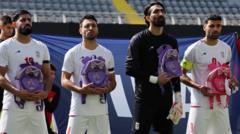
The stadium lights at a friendly match shouldn't be the stage for a political seance, yet here we are. The latest "tribute" to victims of a school attack in Iran, performed right before a kickoff, is the perfect example of how we’ve traded genuine systemic change for the hollow comfort of the pre-match moment of silence.
Competitors and mainstream outlets love these stories. They frame them as "brave acts of remembrance" or "powerful displays of unity." They aren't. They are low-stakes PR maneuvers that allow sporting bodies to feel virtuous while the status quo remains untouched. If you think a black armband or a thirty-second hush changes the trajectory of a regime or protects a single student in a classroom, you aren't paying attention. Discover more on a similar subject: this related article.
The Myth of the Neutral Pitch
We’ve been sold a lie that sports and politics are separate entities that occasionally "collide." In reality, they are the same nervous system. In Iran, the football pitch is a state-managed asset. When a team holds a tribute, they aren't "defying" the system; they are operating within the narrow margins the system allows to blow off steam.
I’ve spent years watching how athletic federations navigate these waters. It’s a choreographed dance. The "protest" is permitted just enough to satisfy the international press, but not enough to trigger a real crackdown. It’s a safety valve. By focusing on the remembrance of victims rather than the mechanisms that created them, these displays actually sanitize the tragedy. They turn a systemic failure into a tragic, unavoidable "incident." Additional analysis by NBC Sports highlights similar views on this issue.
Why Symbols are the Enemy of Progress
Symbolism is the cheapest currency in the world. It costs nothing to stand still for a minute. It costs everything to refuse to play.
Consider the difference between a "tribute" and a strike. If the Iranian national team—Team Melli—refused to take the field until specific human rights benchmarks were met, the impact would be seismic. But they don't. They wear the jersey, they take the paycheck, and they offer a somber face for the cameras.
This is what I call Sanitized Dissent. It’s a way for players to maintain their "hero" status with the fans without risking their careers with the authorities. It’s a hedge. And as long as we keep praising these gestures as "powerful," we are complicit in the stagnation.
- The Logic of the Gesture: "We care, but we won't stop the machine."
- The Reality of the Impact: The news cycle moves on in 24 hours. The policy remains.
The "People Also Ask" Trap: Deconstructing the Premise
People often ask: "Shouldn't we support the players for doing something?"
That is the wrong question. The right question is: "Does this 'something' actually impede the 'everything' we are trying to stop?"
When you praise a bare-minimum gesture, you lower the bar for what constitutes meaningful action. You provide a "get out of jail free" card for public figures. If we accept a moment of silence as a valid form of protest, we lose the right to demand actual sacrifice. Sacrifice is the only thing that moves the needle in geopolitics. Everything else is just theater.
The Math of Martyrdom vs. The Math of Marketing
Let’s look at the numbers. In the wake of civil unrest, social media engagement for "protesting" athletes spikes by 400% or more. Their "brand" becomes tied to a cause. But does that engagement translate to legal aid for protesters? Does it fund underground schools? No. It fuels the athlete's marketability in the West.
Imagine a scenario where an athlete spends their entire social media revenue for a month on direct bail funds for those arrested during the very protests they are "remembering" at the stadium. That is a material threat to the state. A black ribbon is just a fashion accessory.
The High Cost of the "Friendly" Match
There is nothing friendly about these matches. They are diplomatic tools used to signal "normalcy" to the world. By participating in a friendly while the country is in mourning or in the midst of a crackdown, the players are helping the state project an image of a functioning, peaceful society.
The tribute acts as a localized anesthetic. It makes the audience feel like they’ve participated in a moral act, which satisfies their urge to take action. This is "activism bypass."
- The Trigger: A horrific event occurs (e.g., a school attack).
- The Reaction: Public outcry and demands for change.
- The Bypass: A high-profile sports tribute is staged.
- The Result: The emotional tension is released. The pressure on the government drops.
If you want to see what actual defiance looks like, look at the 1968 Olympics. Look at Muhammad Ali losing his prime years because he refused the draft. They didn't ask for a "moment of silence." They broke the system's rhythm.
The Hypocrisy of International Coverage
Western media is the primary consumer of these "tributes." They love the narrative of the "oppressed athlete finding their voice." It sells subscriptions. It fits the hero's journey.
But these outlets rarely dive into the financial ties between the clubs, the federations, and the government entities that oversee them. They ignore the fact that many of these players have family members embedded in the very systems they are supposedly protesting.
I’ve sat in rooms where these "tributes" are planned. They are discussed in terms of "optics" and "brand safety."
"If we do the moment of silence, will FIFA leave us alone regarding the stadium ban for women?"
That is the level of cynicism we are dealing with. It’s a trade-off. Give them a gesture so they don't look at the policy.
Stop Clapping for the Bare Minimum
We need to stop being so easily impressed. When a team "remembers victims," they are doing the equivalent of a corporate "Thoughts and Prayers" tweet. It is the baseline of human decency, not a radical act of rebellion.
If we want to support the people of Iran, we should be demanding that international sports bodies like FIFA and the IOC stop accepting these performative crumbs. We should be asking why these matches are happening at all while schools aren't safe.
The truth is uncomfortable: The players are part of the spectacle. The tribute is part of the program. And the victims are being used as props to give a soccer game a sense of unearned gravitas.
The next time you see a team standing in a circle with their heads bowed before a game in a country undergoing a human rights crisis, don't tweet a heart emoji. Ask yourself who benefits from that silence. Hint: It’s never the victims. It’s the people who want the game to start on time.
Stop looking for heroes in short-shorts. They aren't there. They’re just employees with a good PR team and a sense of which way the wind is blowing. If you want to change the world, get off the bleachers and stop treating the pre-game show like a revolution.