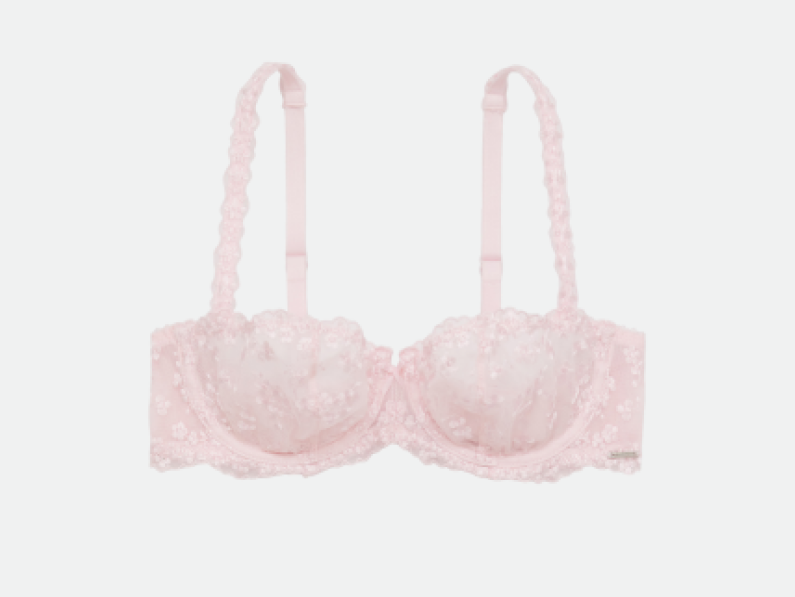
You’re probably wearing the wrong bra. It sounds like a bold claim, but data from professional fitters and lingerie brands suggests that roughly 80% of women are walking around in a size that doesn't actually fit. That’s a massive number. It means millions of people are dealing with digging straps, slipping bands, or the dreaded "quad-boob" effect every single day. We’ve been taught that bra fitting is a dark art or something you only do once in your teens. That’s a mistake. Your body changes. Your bra should too.
Finding your bra size isn't just about a tape measure and a math equation. It’s about understanding how a garment is supposed to support your anatomy. Most of the support—about 80% of it—should come from the band, not the straps. If your shoulders are sore at the end of the day, your band is too loose. It’s that simple.
The Great Band Myth
The most common error I see is a band that’s too big and cups that are too small. We gravitate toward a larger band because it feels "less tight." But a loose band slides up your back. When the back goes up, the front goes down. Gravity takes over. You then tighten the straps to pull everything back up, which puts all the weight on your trapezius muscles. Hello, neck pain.
A proper band should be level all the way around your ribcage. It should feel firm. You should only be able to fit two fingers under the band at the back. If you can pull it out several inches from your skin, it’s useless. It isn't providing the "shelf" your breasts need to sit on.
When you buy a new bra, always fit it on the loosest hook. Bras are made of elastic. They stretch over time. You want to be able to tighten the band as the fabric loses its snap. If you start on the tightest hook, you’ve got nowhere to go once the bra starts to age. It's a waste of money.
Why Cup Letters are Meaningless Without Context
The letter "D" doesn't mean "big." This is the hardest concept for people to wrap their heads around. Volume is relative to the band size. A 32D has a much smaller cup volume than a 38D. This is called sister sizing.
If you try on a 34C and the band fits perfectly but your breasts are spilling out the top, you don't just need a bigger bra. You need a bigger cup. You'd move to a 34D. If the band feels too tight but the cups look okay, you might try a 36B.
I’ve seen people refuse to try a larger cup size because of the stigma attached to certain letters. Forget the labels. If the underwire is poking your breast tissue instead of sitting flat against your ribcage behind the tissue, the cup is too small. That wire should follow the natural crease of your breast and go all the way back toward your armpit. If it’s sitting on the soft tissue, it’s going to hurt, and it might even cause long-term damage to the delicate glands.
The Scoop and Swoop Technique
You can’t just hook your bra and walk out the door. You have to physically move your breast tissue into the cup. This is known in the industry as the "scoop and swoop."
Leaning forward slightly, reach into the cup with the opposite hand and gently pull your breast tissue forward and up from the underarm area. This ensures that the underwire is sitting in the "inframammary fold"—the spot where your breast meets your chest wall.
It’s shocking how much "side-boob" is actually just breast tissue that hasn’t been properly seated in the cup. Once you do this, you might realize the cups you thought fit are actually too small. That’s good. It means you’re finally seeing your true shape.
Signs Your Current Bra is Failing You
Check yourself in the mirror. Be honest. If you see any of these, your bra is a liar:
- The Floating Gore: The "gore" is the center part of the bra between the cups. It should sit flat against your sternum. If it’s hovering or pushing away from your chest, your cups are too small.
- The Back Bulge: While some "skin displacement" is normal because the band needs to be firm, a massive bulge often means the band is too narrow or the cups are too small, forcing tissue out and back.
- Wrinkling Cups: If the fabric is gapping or wrinkling at the top, the cup is too big or the shape is wrong for your breast type.
- Slipping Straps: Often a sign the band is too large. If the band is too big, the straps sit too wide on the shoulders and slide off.
Shape Matters More Than Size
Two people can have the exact same measurements but require completely different bras. This comes down to shape. Some people are "full on bottom," while others are "full on top." Some have "shallow" tissue spread over a wide area, while others have "projected" tissue.
If you have shallow tissue, a full-coverage bra will likely gap at the top, even if the size is technically correct. You might do better with a balcony or demi-cup. If you’re full on top, a plunge bra might cause you to spill out the center. Understanding your "root" (where the breast attaches to the chest) and your "projection" is the secret to comfort that lasts more than an hour.
The Life Cycle of a Bra
Don't wear the same bra two days in a row. It sounds like a marketing ploy, but it’s science. The elastic fibers need time to recover their shape. If you wear it every day, you’ll kill the elasticity in months. Rotate between three or four bras to give them a "rest day."
Wash them by hand. Or, if you’re lazy like most of us, use a mesh bag and the delicate cycle. Never, ever put them in the dryer. Heat is the enemy of spandex and Lycra. It makes the fibers brittle. A bra that could have lasted a year will be dead in three months if you toss it in the dryer.
Taking Your Measurements at Home
While a professional fitting is great, you can get a solid starting point yourself. You’ll need a soft measuring tape.
- Underbust: Measure around your ribcage, directly under your breasts. Pull it snug—the way you’d want a bra band to feel. If you get an odd number, round up or down depending on how much "squish" you have on your ribs. This is your band size. (Note: The old "+4" rule where you add four inches to your measurement is outdated and usually results in a band that’s way too big. Ignore it.)
- Bust: Measure around the fullest part of your chest. Keep the tape level. Don't pull it tight; just let it rest on the surface.
- The Math: Subtract the underbust measurement from the bust measurement. Each inch of difference usually represents one cup size. 1 inch is an A, 2 inches is a B, 3 inches is a C, and so on.
This is a starting point, not a law. Brands vary. A French brand fits differently than an American brand or a UK brand. UK brands are generally more consistent with larger cup sizes (using double letters like GG or HH), so if you have a larger bust, look for UK sizing.
Next Steps for a Better Fit
Stop settling for "good enough." Go to your top drawer right now and put on your favorite bra. Look at the gore—is it touching your skin? Look at the band in the mirror—is it horizontal or is it arching toward your neck?
If it’s not right, go to a store that carries a wide range of sizes beyond the standard 32A-38DD. Try on a "sister size" if your usual isn't working. Focus on the band first, then the cups. Once you find a brand and style that works, buy it in two colors and treat them well. Your back, your posture, and your clothes will thank you.