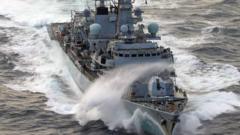
Russia just tried to blindside the UK under the cover of the Middle East crisis, and most people didn't even notice until the Ministry of Defence went public. While global headlines were fixed on the Mediterranean, a high-stakes game of cat and mouse was playing out in the freezing depths of the North Atlantic. This wasn't just a routine patrol. It was a calculated, multi-layered operation designed to test whether the Royal Navy could still walk and chew gum at the same time.
Here's the reality: the UK just exposed a massive Russian "bluff" that involved an Akula-class nuclear attack submarine acting as a flashy distraction for much more dangerous, specialist vessels loitering over our internet cables.
The Decoy and the Dagger
The Russian playbook is getting predictable, but that doesn't make it any less dangerous. A few weeks ago, an Akula-class attack submarine—the "Shchuka-B"—slipped into the international waters of the High North. It made just enough noise to be noticed. It wanted the attention.
While the Royal Navy’s Type 23 frigate, HMS St Albans, and RAF P8 Poseidon aircraft were burning fuel to track the Akula 24/7, the real threat was elsewhere.
Two specialist submarines from Russia's Main Directorate of Deep-Sea Research, known as GUGI, were lurking over critical undersea infrastructure. These aren't standard combat subs. GUGI vessels are the scalpels of the Russian Navy, designed for "underwater research" that usually involves surveying, tapping, or preparing to sabotage the fibre-optic cables that carry 99% of the world's data traffic.
Why Your Internet Bill Depends on the High North
You might think submarine warfare is some Cold War relic, but it's the reason you can tap your phone to pay for coffee. Defence Secretary John Healey was blunt about it: if those GUGI subs had been left to their own devices, the cost would have shown up in your household bills and your bank's ability to process a transaction.
These undersea cables are the "soft underbelly" of Western civilization. Russia knows it. They were betting that the UK was too busy helping allies in the Middle East to notice a slow-motion heist on our digital lifeblood. They were wrong.
The Royal Navy didn't just track them; they made it "overt." In the world of sub-surface warfare, the greatest weapon is silence. By sticking a Type 23 frigate on their tail and dropping sonobuoys right on top of them, the UK sent a clear message: We see you. Once a "covert" operation is no longer covert, it’s a failure. The Russians turned tail and headed home.
The Scale of the Response
Don't let the "routine" nature of these reports fool you. This was a massive logistical lift for a Navy that critics often claim is overstretched.
- 500 British personnel were dedicated to this specific operation.
- 450 hours of flight time by RAF aircraft.
- Thousands of miles covered by HMS St Albans and the RFA Tidespring.
- 10 days of intensive monitoring in the English Channel and North Sea involving HMS Somerset and HMS Mersey.
This wasn't just a British effort, either. We worked hand-in-glove with Norway and other NATO allies. This is part of a broader strategy called Atlantic Bastion, a programme designed to turn the North Atlantic into a digital "web" where Russian subs have nowhere to hide.
The GUGI Threat is Not Going Away
The Main Directorate of Deep-Sea Research (GUGI) is arguably the most capable branch of the Russian military right now. While their ground forces are bogged down in Ukraine, their deep-sea assets remain world-class. They operate specialized mother-ships and "mini-subs" that can reach depths traditional attack submarines can't touch.
Last year, the spy ship Yantar was caught doing the same thing. This time, the Russians tried to use a nuclear attack sub as a "bluff." It’s a classic shell game. If you watch the flashy attack sub, you miss the quiet guy with the wire cutters.
What Happens Next
The UK just committed an extra £100 million to bolster the P8 submarine-hunting fleet. We're also seeing the rollout of more uncrewed underwater vehicles (UUVs) that can stay submerged for months, acting as permanent sentinels over our cables.
If you’re wondering what you can do, the answer is mostly about awareness. The "front line" isn't just in Eastern Europe; it’s at the bottom of the ocean. The government's decision to expose this operation publicly is a shift in policy. We're no longer staying quiet about Russian incursions. By "calling out" Putin directly, the UK is trying to raise the political cost of these underwater "research" missions.
Expect more of this. As the Royal Navy transitions to newer Type 26 and Type 31 frigates, the focus is shifting back to where it was in the 1980s: the North Atlantic. Keep an eye on the High North; it’s where the real "quiet war" is being fought.
Don't assume your digital connection is a given. It's defended every day by a fleet of ships and aircraft you'll likely never see. The next time the internet flickers, it might not be your router—it might be a game of chicken 3,000 meters below the waves.