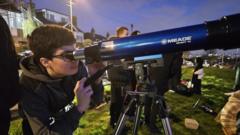
Tradition is often just a fancy word for peer pressure from dead people. Every year, we watch a ritualized performance of "moon spotting" that is as technically inefficient as it is culturally revered. We see images of elders pointing at the horizon, teaching the youth how to squint through haze, all in the name of preserving a "skill."
Let’s be honest. Squinting is not a skill. It is an atmospheric gamble.
The romanticized narrative says that passing down the art of naked-eye sighting keeps the community grounded. In reality, it keeps the community in a state of perpetual scheduling chaos. By clinging to an archaic, localized observation model in an era of atomic clocks and precision orbital mechanics, we aren't honoring the past. We are ignoring the physics of the present.
The Mathematical Certainty of the New Moon
The "consensus" suggests that there is a spiritual or communal value in the uncertainty of the lunar calendar. This is a fallacy. The birth of a new moon, or the astronomical conjunction, is a verifiable event. It occurs when the Moon and Sun have the same ecliptic longitude.
The position of the moon can be calculated centuries in advance with an error margin of less than a second. We use the Danjon limit to understand when the crescent becomes physically visible to the human eye—typically when the Sun-Moon elongation exceeds about $7°$.
Despite this, we still see "sighting committees" ignoring $21^{st}$ century astrophysics in favor of grainy binoculars and "vibe checks." When a sighting is announced that contradicts the hard math of the lunar arc, we don’t call it a miracle. We should call it an optical illusion or a high-altitude bird.
The High Cost of Seasonal Ambiguity
The "wait and see" approach to Eid isn't just a quirky cultural trait. It is a logistical nightmare with a massive price tag.
- Global Supply Chains: Logistics companies can’t pivot 1.8 billion people’s consumption patterns on a twelve-hour notice without massive waste.
- Labor Markets: Millions of workers are left in limbo, unable to book travel or confirm leave because the "moon spotters" are still arguing over a cloud bank in a different time zone.
- Economic Friction: The volatility of a floating holiday creates a "waiting tax" on businesses.
I’ve watched organizations lose tens of thousands of dollars in productivity because they couldn't commit to a fixed holiday schedule. We live in a world of "Just-In-Time" manufacturing and global synchronization. We no longer live in isolated agrarian pockets where a one-day shift in the calendar doesn't matter.
The Myth of the "Human Connection"
The argument for manual sighting usually rests on the idea of human connection to nature. This is sentimentalist junk.
Using a telescope is no more "natural" than using a mathematical formula. Both are human-made tools designed to interpret the universe. If you truly wanted a "natural" connection, you would ban the binoculars too. The moment you introduce any lens, you've already conceded that the naked eye is insufficient.
If the naked eye is insufficient, why stop at the lens? Why not move to the most accurate tool available: the calculation?
The real "skill" being passed to the next generation isn't how to see the moon. It’s how to perform a ritual of confirmation bias. We teach young people to look for what they expect to see, rather than what is actually there. This is the opposite of the scientific literacy we should be fostering.
The Geometry of Visibility
The difficulty of sighting the Hilal (the new crescent) isn't just about eyesight. It’s about the Lag Time—the interval between sunset and moonset.
$$T_{lag} = T_{moonset} - T_{sunset}$$
If the $T_{lag}$ is too short, the solar glare renders the moon invisible, regardless of how many "generations" of spotters you have lined up on a hill. Furthermore, the moon's altitude at sunset must be sufficient to clear the thickest parts of the atmosphere, which scatter light and create "false crescents."
We are training kids to battle atmospheric refraction and Rayleigh scattering with their bare eyes. It is the equivalent of teaching children to calculate the square root of 738,492 by hand while they have a calculator in their pockets. It’s a feat, sure, but it’s a useless one.
The Global vs. Local Deadlock
The "moon spotting" tradition enforces a fragmented reality. One country sees it; another doesn't. This creates a fractured religious experience that serves no one but the local authorities who get to claim the power of the "announcement."
A unified, calculated calendar is the only way to achieve global synchronization. The resistance to this isn't theological; it’s a resistance to losing the spotlight. The "sighter" wants to be the one who delivers the news. They want the prestige of the "discovery."
But there is nothing to discover. The moon is exactly where the math says it is.
Stop Teaching the Wrong Skill
If we want to prepare the next generation, we should stop teaching them how to squint at the horizon and start teaching them celestial mechanics.
Instead of passing down "sighting tips," pass down an understanding of:
- Ephemeris tables: The backbone of celestial navigation.
- Topocentric coordinates: Understanding how the observer's specific location on Earth changes the perceived position of the moon.
- Atmospheric physics: Why your eyes lie to you when looking through five miles of humid air.
The future belongs to the precise. The "romantic" era of uncertainty is a luxury we can no longer afford in a hyper-connected world. We need to stop pretending that a blurred vision of a crescent is more "authentic" than a perfect, digital calculation of its position.
One is an accident of weather. The other is an understanding of the Creator’s clockwork.
The next generation doesn't need to be better at looking at the sky. They need to be better at understanding it.
Throw away the binoculars. Open the spreadsheet.
Establish the calendar and let the world plan its life with the dignity of certainty.