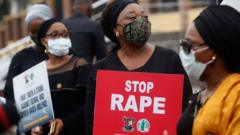
The arrest of 15 suspects following a series of sexual assaults at a high-profile Lagos music festival is not an isolated law enforcement victory. It is a frantic attempt at damage control by a police force that failed to secure the perimeter of one of the city's largest cultural exports. While the viral videos forced the hand of the Lagos State Police Command, the reality on the ground suggests a systemic breakdown where private security, state police, and event organizers prioritized ticket sales over the physical safety of female attendees.
The videos themselves were harrowing. They depicted a chaotic scene where the boundary between a celebratory crowd and a predatory mob vanished entirely. For several hours, the festival grounds became a legal vacuum. As the footage began to circulate globally, the backlash was swift, threatening the reputation of Nigeria’s booming entertainment sector. By the time the police moved to make arrests, the primary suspects had already blended back into the city of twenty million. The 15 individuals currently in custody represent a tiny fraction of the perpetrators, raising questions about whether these arrests are a substantive step toward justice or a public relations maneuver to quiet international sponsors. Learn more on a similar topic: this related article.
The Infrastructure of Insecurity
Large-scale events in Lagos have long operated on a precarious security model. Organizers typically hire a mix of private "bouncers," local vigilantes, and off-duty police officers. This creates a fragmented chain of command. When the crowd surged and the first reports of harassment began to surface, there was no unified response. Private security focused on protecting the VIP sections and the stage, leaving the general admission areas—where the density was highest and lighting was poorest—to descend into anarchy.
This is the hidden cost of the "Afrobeats to the World" movement. As the genre gains global dominance, the scale of the events has outpaced the logistical capabilities of the venues. We are seeing festivals designed for five thousand people pushing ten thousand through the gates. The math of safety is simple, yet it is consistently ignored. When you exceed the physical capacity of a space, the ability of security personnel to intervene in a crime becomes non-existent. They cannot reach the victim, and they cannot apprehend the attacker. More reporting by USA Today highlights related perspectives on the subject.
Beyond the Viral Footage
The focus on the viral videos masks a deeper, more pervasive issue regarding how sexual violence is handled within the Nigerian legal system. The police were quick to announce the arrests because the evidence was undeniable and public. However, the prosecution of these crimes in Nigeria faces a steep climb. Historically, sexual assault cases suffer from a lack of forensic support and a judicial process that can drag on for years, often resulting in the victim being intimidated into dropping the charges.
If the Lagos State Government wants to prove this isn't just optics, the prosecution must be as public as the arrests. Holding 15 people in a cell is easy. Navigating the Administration of Criminal Justice Law to secure meaningful convictions for sexual battery and aggravated assault is where the real work begins. There is also the matter of the organizers. In any other global entertainment hub, a security breach of this magnitude would lead to immediate license revocation and massive civil liability. In Lagos, the conversation has yet to turn toward the accountability of those who collected the gate fees.
The Failure of the Duty of Care
Every event organizer owes a duty of care to their patrons. This isn't a nebulous concept; it is a legal obligation to provide a safe environment. When women are being dragged into "mosh pits" to be assaulted while security stands ten feet away, that duty has been breached. The industry is currently hiding behind the excuse of "crowd trouble," but crowd trouble is predictable. Predators look for environments where they can hide in plain sight, and a poorly lit, over-capacity concert is their ideal theater of operations.
The police response, while necessary, is a reactive band-aid on a structural wound. The 15 men in custody are likely low-level offenders, the ones who weren't fast enough to run when the cameras turned their way. The ringleaders and the environment that emboldened them remain unaddressed. To fix this, the state must move beyond the "arrest and parade" cycle and begin enforcing strict security audits for any event over a certain capacity.
The Economic Risk of Silence
Nigeria’s creative economy is one of the few sectors showing consistent growth despite broader economic headwinds. It draws in tourism, foreign exchange, and cultural capital. However, this growth is fragile. If the narrative becomes that Nigerian festivals are "no-go zones" for women, the international talent and the diaspora audience will stop coming. The economic fallout would be measured in billions of Naira.
The police must now prove that these 15 arrests are the beginning of a specialized task force approach to event safety. We need a shift from "riot control" to "proactive protection." This involves:
- Mandatory undercover officers embedded within general admission crowds to identify harassment in real-time.
- Grid-based lighting requirements that eliminate dark pockets within the venue.
- Standardized reporting hubs on-site where victims can get immediate medical and legal assistance without having to fight through a crowd to find a gate.
The era of hoping for the best while selling as many tickets as possible is over. The viral videos were a warning shot. If the industry and the authorities continue to treat the safety of women as a secondary concern to the rhythm of the music, the next collapse will be permanent. The 15 men behind bars are a start, but they are not the solution.
Ensure the case files for these 15 suspects are tracked by independent legal observers to ensure the charges are not quietly downgraded once the media cycle moves on to the next scandal.