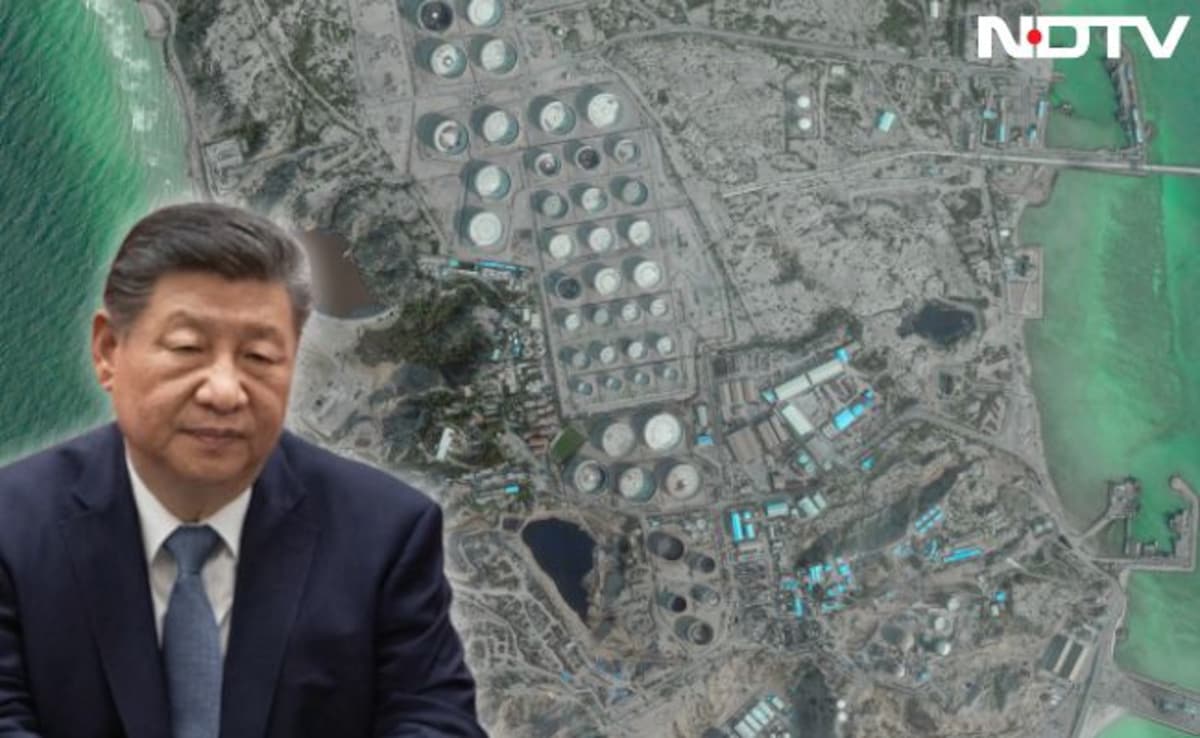
The smoke rising from the Persian Gulf isn't just a signal of regional war; it is the funeral pyre for China’s decade-long strategy of fueling its industrial machine with "black market" discounts. On March 14, 2026, the United States executed what President Trump described as a "powerful bombing raid" on Kharg Island. While the White House claims to have spared the actual oil piers to avoid a global price explosion, the message sent to Beijing was unmistakable. The safe, dark, and cheap corridor for Iranian crude is closed.
For the planners in Zhongnanhai, this is a nightmare realized. China currently relies on Iran for roughly 13% to 15% of its total crude imports. More importantly, nearly 90% of Iran’s total exports pass through the single chokepoint of Kharg Island. By demonstrating the ability to "obliterate" military targets on the island at will, the U.S. has effectively placed its hand on the throat of China’s energy supply. The panic in Beijing isn't about a lack of oil today—it’s about the permanent loss of the "Tehran Discount" and the looming collapse of the shadow fleet.
The Myth of the Untouchable Terminal
Kharg Island is a geological fluke that became a geopolitical juggernaut. Sitting 25 kilometers off the Iranian coast, it handles approximately 1.5 million barrels per day. For years, the conventional wisdom was that Kharg was "too big to fail." Analysts argued that any strike on the facility would send oil past $150 a barrel, causing a global depression that no U.S. president would dare trigger.
That gamble failed on February 28, 2026, when the first joint U.S.-Israeli strikes hit Tehran. The subsequent escalation has proven that the current administration is willing to risk market volatility to dismantle the Iranian regime’s financial backbone. Even if the pumps at Kharg are still technically functional, the insurance markets have already declared the island a dead zone. No legitimate tanker will go near it. This leaves China dependent on its "shadow fleet"—a ragtag collection of aging, uninsured vessels that spoof their GPS locations to spirit oil away in the dark.
But the shadow fleet is losing its shadows. Recent U.S. Department of State sanctions have targeted 14 specific vessels and 15 entities involved in this trade. When you combine high-kinetic military strikes with aggressive financial de-platforming, the cost of moving a barrel of Iranian oil to a Chinese "teapot" refinery in Shandong sky-rockets. The "discount" that once saved China billions of dollars is being eaten alive by risk premiums and middleman fees.
The Teapot Refinery Crisis
To understand why this matters to the average Chinese citizen, you have to look at the "teapots." These small, independent refineries in Shandong province are the primary buyers of Iranian crude. Unlike state-owned giants like Sinopec, which have global reputations to protect, the teapots operate in the regulatory gray. They have thrived on cheap, sanctioned oil that nobody else would touch.
If Kharg Island is neutralized—either by direct destruction of the storage tanks or by a sustained naval blockade—these refineries face a binary choice: shut down or buy from the open market. Buying from the open market means paying the "Brent Crude" price, which spiked past $100 on March 9.
The knock-on effect is a massive inflationary spike in the Chinese manufacturing sector. China’s economic growth target for 2026 was already at a modest 4.5% to 5%. Sustained triple-digit oil prices could shave another full point off that growth, threatening the social contract of the Communist Party. Beijing is now forced to tap into its Strategic Petroleum Reserve (SPR). While China is estimated to hold roughly 1.4 billion barrels—about 120 days of cover—this is a finite shield.
The Military Paradox of the Strait
The Iranian response to the Kharg threat has been to rattle the saber at the Strait of Hormuz. New Supreme Leader Mojtaba Khamenei has threatened to keep the passage closed. This is the ultimate "poison pill" for China.
While closing the Strait hurts the U.S. and its allies, it is a catastrophic self-inflicted wound for Beijing’s energy security. About 40% of China’s oil comes from the Middle East. If Iran shuts the Strait to "retaliate" against the U.S., it effectively blockades its own best customer.
China’s Energy Dependency at a Glance:
- Total Imports: 11 million to 11.5 million barrels per day.
- Middle East Share: Over 40%.
- Iran Share: 1.3 million to 1.5 million barrels per day.
- Strategic Buffer: ~120 days of net imports.
Beijing has attempted to mitigate this by deploying a spy ship to the Gulf and providing Iran with satellite monitoring data. But these are defensive measures. They cannot replace the physical flow of oil. The reality is that China’s "Great Wall of Steel" is remarkably fragile when it comes to the sea lanes.
Beyond Fossil Fuels
The Kharg Island crisis has vindicated one specific wing of the Chinese leadership: the green energy hawks. For years, the push for electrification was framed as an environmental goal. Today, it is pure survival. Every electric vehicle (EV) on the streets of Shenzhen is one less car reliant on a tanker that might get sunk in the Gulf of Oman.
However, the transition isn't fast enough. China’s electricity usage in 2025 was more than double that of the United States. While they lead the world in renewables, they still need massive amounts of oil for heavy industry, plastics, and aviation. You cannot run a global shipping fleet on solar panels yet.
The strategic failure here was Beijing’s over-reliance on "opportunistic" energy sourcing. By building a supply chain around sanctioned regimes like Iran and Venezuela, China bet that the West would never have the stomach for a total energy war. That bet turned sour the moment the first Tomahawk missile hit the military installations guarding the Kharg loading arms.
The Long Road to Diversification
China is now scrambling to find replacements. We are seeing a desperate pivot toward Russia, Central Asia, and Africa. The problem is infrastructure. You cannot build a pipeline from Siberia to Shandong in a weekend. The maritime routes from West Africa and Brazil are longer, more expensive, and—ironically—more exposed to the same U.S. naval dominance that China is trying to escape.
There is also the Venezuelan factor. In January 2026, the seizure of Nicolás Maduro further squeezed China's alternative sources. The walls are closing in on the "Alternative Energy Alliance" that Beijing spent decades cultivating.
What we are witnessing is the forced reintegration of China into the global, transparent oil market—at a time when prices are at their highest in years. The era of the "private deal" with pariah states is ending. If China wants to keep its factories running, it will have to play by the rules of a market it doesn't control, or it will have to step into the Middle Eastern fire to protect its interests directly.
The latter is a step Beijing is not yet ready to take. For all the talk of a "blue-water navy," the People's Liberation Army Navy (PLAN) lacks the logistical reach to secure the Persian Gulf against a determined adversary. For now, China’s only move is to watch the satellite feeds of Kharg Island and pray that the next round of strikes continues to "deliberately avoid" the piers.
Hope is a poor strategy for a superpower.