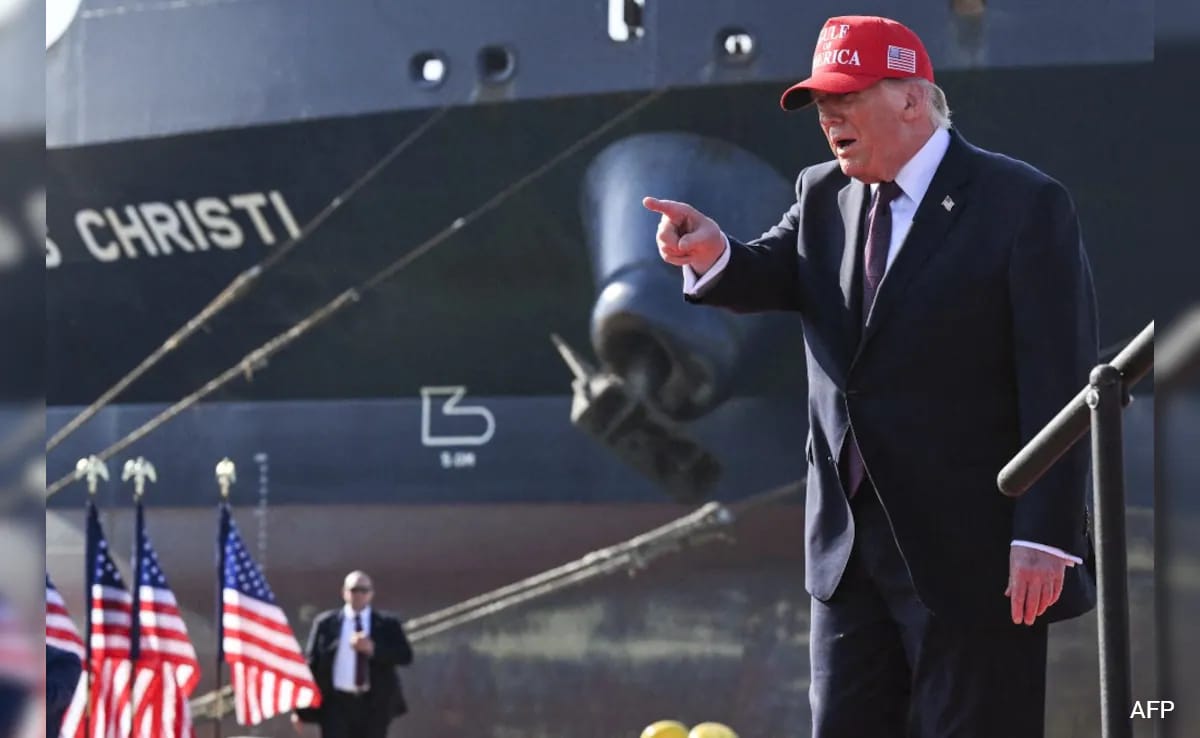
The steel hull of a Very Large Crude Carrier (VLCC) is roughly the size of three football fields. When it is fully loaded with two million barrels of oil, it sits deep in the water, a silent, rust-streaked leviathan cutting through the Persian Gulf. To a day trader in London or a logistics manager in Chicago, this ship is a data point. To a family idling their minivan in a suburban gas station line, it is the difference between a thirty-dollar fill-up and a sixty-dollar one.
But to the diplomats in Washington, these ships are something else entirely: they are the physical manifestation of a geopolitical tightrope. Expanding on this theme, you can also read: The Childcare Safety Myth and the Bureaucratic Death Spiral.
Recently, the gears of international policy shifted. The U.S. government quietly eased the pressure on tankers linked to Iranian oil interests. On paper, it was a technical adjustment of sanctions. In reality, it was a desperate reach for the thermostat of the global economy. When the world feels too hot—when inflation burns through middle-class savings and energy costs threaten to tip a dozen nations into recession—the people in power start looking for valves to turn. Even the ones they swore they had welded shut.
Consider a hypothetical captain named Elias. He isn’t a politician. He doesn’t care about the ideological rift between Washington and Tehran. He cares about the draft of his ship and the volatile market price of the "black soup" in his cargo holds. For years, Elias and his peers operated in a gray zone. Sanctions meant their ships were ghost vessels, turning off transponders to vanish from satellite tracking, weaving through a labyrinth of shell companies just to find a port that would take them. This shadow fleet was a byproduct of a "Maximum Pressure" campaign designed to starve a regime of its primary income. Analysts at Bloomberg have provided expertise on this trend.
It worked, for a while. It squeezed. It strained.
But pressure is a double-edged sword. When you remove a significant portion of the world's oil supply from the board, the remaining barrels become gold. The law of supply and demand is as unforgiving as the sea.
The Mathematics of the Dinner Table
Economics is often taught as a series of abstract graphs, but it is actually a story about what people can afford to eat. When oil prices spike, the cost of the diesel that powers the trucks carrying grain also spikes. The plastic packaging for the bread becomes more expensive. The electricity used to bake the loaf climbs. By the time that bread reaches a shelf in Ohio or a stall in Cairo, the price has doubled.
The U.S. administration looked at the global board and saw a looming shadow. Conflicts in Eastern Europe had already throttled natural gas. Tensions in the Red Sea made shipping a nightmare of insurance premiums and rerouted journeys. If they kept the thumb pressed firmly down on Iranian tankers, they risked a global price shock that could break the back of the post-pandemic recovery.
So, they loosened the grip.
This wasn't an act of diplomacy or a sign of thawing relations. It was a cold, calculated move to stabilize the market. By allowing these tankers more room to breathe, the U.S. effectively injected a surge of supply into a thirsty system. They chose a "controlled leak" over a total explosion.
The Ghost Fleet Comes Into the Light
The "Ghost Fleet" is not a metaphor. It is a collection of aging, often poorly maintained tankers that operate without standard insurance or oversight. Because they were sanctioned, they couldn't dock at major ports or use reputable maritime services. They became a roaming environmental hazard, منتقل (transferring) oil from ship to ship in the middle of the ocean under the cover of night.
By easing sanctions, the U.S. did more than just lower the price at the pump. They brought these vessels—at least partially—back into the realm of the visible. When a ship is sanctioned, it is desperate. Desperate ships take risks. They ignore safety protocols. They skip maintenance. The risk of a massive oil spill in the Strait of Hormuz was rising every day that the shadow fleet remained in the dark.
The move was a rare moment where environmental safety, economic stability, and geopolitical strategy intersected, even if it meant "playing ball" with an adversary.
The Moral Friction
There is a discomfort in this reality. To the person who believes sanctions should be absolute, this feels like a retreat. It feels like a betrayal of the goal to limit the funding of hostile actors. And they aren't entirely wrong. Money will flow back into coffers that the U.S. would prefer to keep empty.
But policy is rarely a choice between "good" and "bad." It is almost always a choice between "bad" and "worse."
Worse, in this case, was a global energy crisis that would have punished the poorest people on Earth. The single mother in a developing nation who relies on kerosene for light doesn't care about the nuclear ambitions of a country five thousand miles away. She cares that the light stays on. The U.S. gamble is that by easing the sanctions on these tankers, they can lower the global "fever" just enough to prevent a total collapse.
A World Held Together by Wires
We like to think of our lives as independent, but we are tethered to these tankers by a thousand invisible threads. The smartphone in your pocket, the sneakers on your feet, the medicine in your cabinet—all of it is a product of this global hydraulic system.
When the U.S. Treasury Department issues a memo about tanker designations, it feels like a boring, bureaucratic footnote. But that memo travels. It moves from a desk in D.C. to a brokerage in Singapore. It changes the route of a ship in the Indian Ocean. It alters the price of a gallon of milk in a grocery store in Marseille.
The tankers are moving again, more freely than they have in years. The black soup is flowing. The valves have been turned, and for now, the pressure gauge is dropping.
We live in a world where peace is often just a byproduct of a well-managed supply chain. We are kept afloat by the pragmatism of people who realize that sometimes, to save the ship, you have to let a little bit of the cargo go. The leviathans continue their trek across the horizon, carrying the weight of our comfort, our stability, and our contradictions, deep within their rusted hulls.
The lights stay on. For now.