The blue uniform of a Transportation Security Administration officer is designed to project a specific kind of boredom. It is the boredom of high-stakes repetition. We see it in the practiced snap of a nitrile glove, the rhythmic "laptops out of the bag," and the steady, unblinking gaze into an X-ray monitor. It is a performance of stability.
But stability is a luxury bought with a paycheck.
When the gears of government grind to a halt in Washington D.C., the friction doesn't stay on Capitol Hill. It bleeds into the fluorescent-lit corridors of O'Hare, Hartsfield-Jackson, and LAX. A government shutdown isn't just a political stalemate; it is a slow-motion mechanical failure of the American circulatory system.
Consider a hypothetical officer named Marcus. He has been with the agency for nine years. He knows the difference between a forgotten bottle of shampoo and the jittery sweat of someone trying to hide something darker. He is an expert in the mundane details of human behavior. But today, as Marcus stands at the podium checking IDs, his mind isn't on the luggage. It is on the text message from his landlord. It is on the light bill. It is on the fact that he is working one of the most stressful jobs in the country for a promise of "back pay" that might be weeks or months away.
He is working for free.
The TSA is an agency that cannot, by law, simply go home. They are essential. They are the thin line. But you cannot eat a sense of duty.
The Math of Exhaustion
The warning from leadership is blunt: a prolonged shutdown could lead to the closure of entire airport terminals or even whole airports. This isn't a threat or a political ploy. It is a matter of mathematical inevitability.
Security is not a static wall; it is a labor-intensive process. Every passenger requires a specific amount of man-hours to move from the curb to the gate. When the paychecks stop, the "call-outs" begin. This isn't a strike. It’s a survival mechanism. An officer who can’t afford gas to get to the airport cannot work. An officer who has to take a side job delivering pizzas to keep their kids fed cannot be at the X-ray machine.
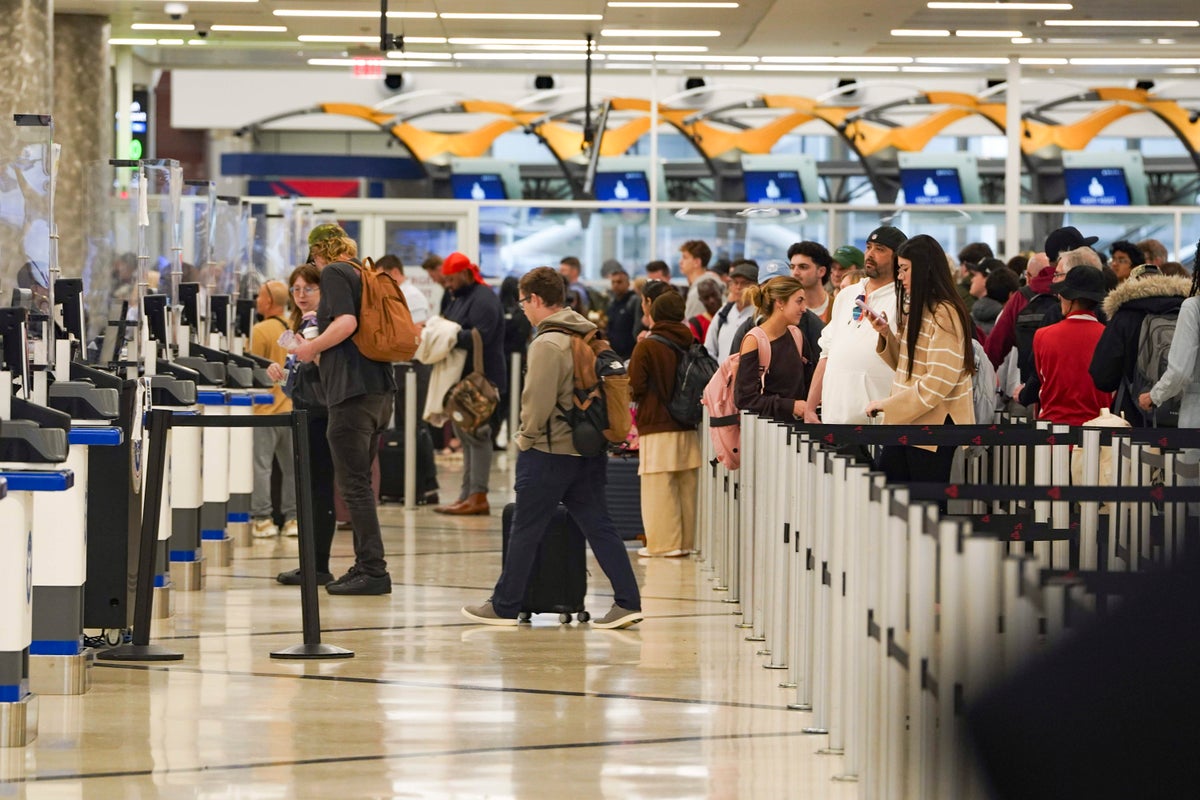
As the workforce thins, the remaining officers are stretched across more lanes. Tension spikes. The "standard" wait time of twenty minutes swells into two hours. Then three. Eventually, the math breaks. If you have 500 passengers per hour and only enough staff to clear 100, the terminal becomes a fire hazard. The doors have to close.
The aviation industry operates on a razor's edge of timing. A delay in security ripples through the entire network. A flight grounded in Chicago because the security lines are backed up means a crew in Dallas times out. It means a plane destined for London never leaves the tarmac. The global economy, which relies on the $1.2 trillion impact of the U.S. travel industry, begins to shudder.
The Human Cost of Hyper-Vigilance
We often treat airport security as an annoyance, a series of hoops to jump through before we get to our vacation or our business meeting. We forget that the person patting down a traveler is absorbing the collective anxiety of thousands of strangers every single day.
When you add financial instability to that environment, the risk shifts from inconvenience to safety. Fatigue is a silent intruder. It dulls the reflexes. It makes the eyes skip over a shadow on the screen. It makes a person less likely to notice the one anomaly in a sea of routine.
During the record-breaking 35-day shutdown of 2018-2019, the unscheduled absence rate for TSA employees hit 10 percent. That is one out of every ten people missing from the line. The remaining 90 percent weren't just doing their jobs; they were doing the jobs of their missing colleagues while wondering how to pay for childcare.
Imagine the mental bandwidth required to maintain 100 percent accuracy in a high-threat environment. Now, imagine trying to do that while your bank account is overdrawn. The stress isn't just a private burden; it is a systemic vulnerability.
The Fragility of the Hub
The modern airport is a cathedral of logistics. It functions because thousands of invisible threads stay taut. Food service workers, air traffic controllers, and security screeners all exist in a delicate ecosystem.
When a shutdown looms, these threads start to snap.
Air traffic controllers, arguably the most specialized workforce in the federal government, face the same dilemma as TSA officers. They are working one of the most cognitively demanding jobs on the planet without the basic security of a salary. The Federal Aviation Administration already faces a shortage of certified controllers. We are already operating at a deficit.
If a major hub like Atlanta or New York has to shutter a terminal because of staffing shortages, the results are catastrophic. We aren't just talking about missed family reunions. We are talking about the transport of life-saving organs. We are talking about the movement of cargo that keeps grocery store shelves full. We are talking about the literal movement of the world.
The irony is that the people who keep the system moving are often the ones the system treats as most expendable during a budget fight. They are used as pawns in a game where the stakes are played out in marble rooms, but the consequences are felt on the cold tile of a departure lounge.
The Sound of a Closing Gate
There is a specific sound an airport makes when it is dying. It’s not a bang. It’s the silence of a moving walkway that has been turned off to save power. It’s the echo of a voice over a loudspeaker announcing another cancellation. It’s the sound of a gate clicking shut because there simply isn't anyone left to man the post.
We take the miracle of flight for granted. We assume that when we buy a ticket, the path will be clear. We trust that the person behind the screen is focused, alert, and supported.
But trust is a two-way street.
The official warnings are getting louder because the breaking point is visible on the horizon. We are asking people to be the guardians of our skies while we refuse to be the guardians of their livelihoods. It is a debt that cannot be deferred forever.
Marcus stands at his podium. He looks at the line of travelers, hundreds deep, stretching toward the sliding glass doors. He takes a breath, adjusts his belt, and calls for the next passenger. He is still there. For now. But every time a paycheck fails to arrive, the light in the terminal gets a little dimmer, and the distance between the curb and the clouds grows just a little bit longer.
The terminal is still open, but the foundations are screaming.
The most dangerous thing about a government shutdown isn't the political noise; it’s the quiet moment when a dedicated professional decides they finally can’t afford to show up. That is when the gates truly close.