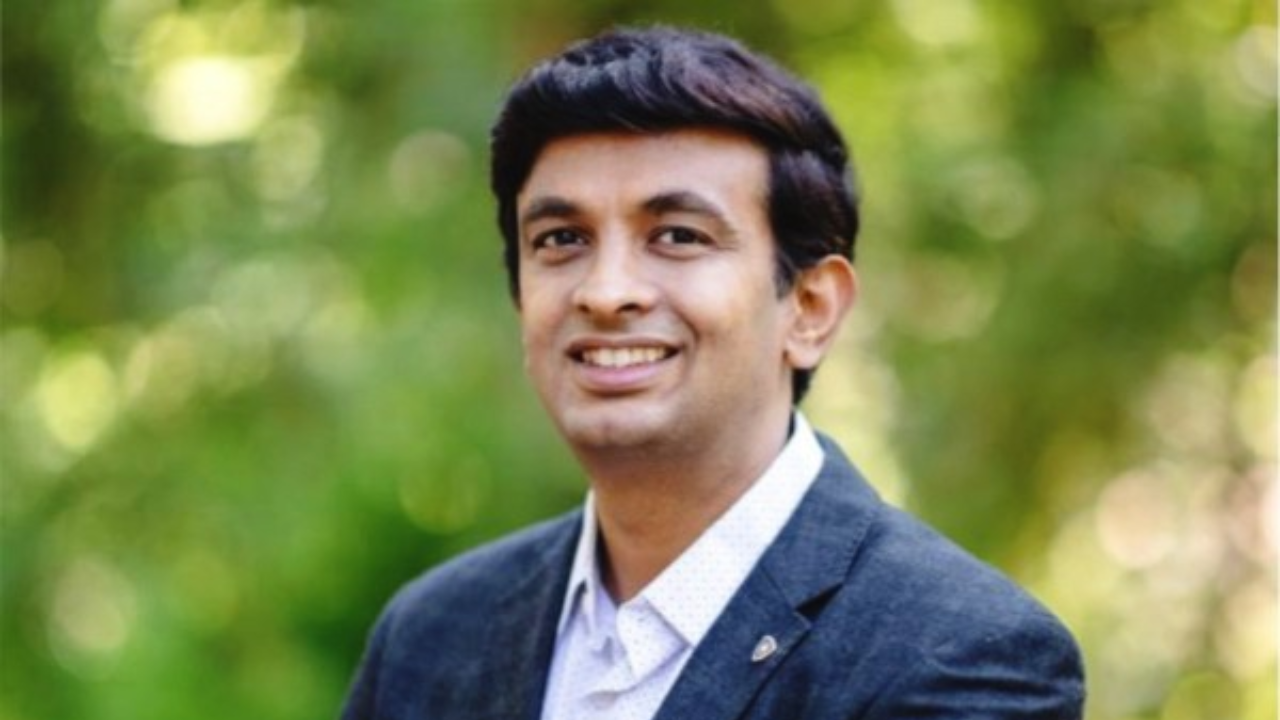
The air inside the Menlo Park headquarters of Meta has a specific, filtered quality. It smells of expensive roast coffee, high-end upholstery, and the invisible, buzzing electricity of a billion data points moving through the ether. For Nithin Hassan, this was the scent of success. He had made it. As a software engineer at one of the most powerful companies on the planet, he was living the version of the dream that usually ends with a comfortable house in Palo Alto and a predictable climb up the corporate ladder.
Then he walked away.
Success in the tech world is often measured by the weight of the "golden handcuffs"—those lucrative stock options and high-salaries that make it almost impossible to leave, even when the soul starts to itch for something more. To the outside observer, Hassan’s decision to quit a stable, prestigious role at Meta to return to India might look like a retreat. In reality, it was a calculated leap into a different kind of fire.
The Silicon Valley narrative is changing. For decades, the flow of talent was a one-way street heading west. You studied at an IIT, you grabbed a visa, and you found your fortune in the Bay Area. But the gravity is shifting. Hassan isn't just an individual; he is a data point in a growing trend of "reverse brain drain" where the most brilliant minds are realizing that the next great frontier isn't in a suburban office park in California, but in the chaotic, high-velocity markets of Bengaluru, Delhi, and Mumbai.
The Weight of a Digital Comfort Zone
Imagine sitting in a meeting where you are discussing a feature that will be seen by a hundred million people. It is exhilarating. But it is also insulating. When you work for a giant, you are a vital cog in a magnificent machine, but you are still a cog. The problems you solve are often incremental. You are optimizing a world that already exists.
Hassan felt the pull of the blank slate. In the United States, the infrastructure is mature. The systems are set. In India, the systems are being built in real-time. There is a raw, unpolished energy in the Indian startup ecosystem that Silicon Valley hasn't felt since the early 2000s. It is the difference between renovating a mansion and building a city from the ground up.
He didn't just leave a job; he left a lifestyle. To understand the stakes, you have to understand what a "techie" gives up. You give up the predictable weather, the easy commute, the proximity to the venture capital elite, and the safety net of a trillion-dollar balance sheet. You trade it for the dust of Indian roads, the complexity of a fragmented market, and the terrifying realization that if your startup fails, there is no corporate HR department to catch you.
Why India and Why Now
The logic behind Hassan’s move isn't just emotional or patriotic. It is cold, hard business. India is currently the third-largest startup ecosystem in the world. The country has crossed the threshold of a billion mobile connections. More importantly, the digital public infrastructure—things like UPI for payments and Aadhaar for identity—has created a foundation where a small team can build a massive business with startling speed.
Consider a hypothetical engineer named Arjun. Ten years ago, if Arjun wanted to build a fintech app in India, he would have spent two years just navigating the bureaucracy of bank integrations. Today, thanks to the groundwork laid by the government and early innovators, he can build a prototype in a weekend. Hassan saw this. He recognized that the friction of doing business in India was melting away, while the ceiling for growth was staying just as high as ever.
The invisible stakes are found in the "middle-class boom." As hundreds of millions of people gain steady internet access and disposable income, they aren't looking for Silicon Valley solutions. They want products built for their specific nuances, their languages, and their unique economic realities. You cannot build those products from a desk in Menlo Park. You have to be on the ground, breathing the same air as your customers.
The Loneliness of the Pivot
Leaving a "Big Tech" company is a social disruption. Your parents might worry. Your peers might think you’ve lost your edge. There is a specific kind of silence that follows when you tell people you’ve walked away from a salary that puts you in the top 1% of earners globally.
Hassan’s journey is a testament to a shift in the definition of "prestige." A decade ago, the Meta or Google badge on your LinkedIn profile was the ultimate prize. Now, for a certain breed of founder, the ultimate prize is ownership. It is the ability to say, "I built this, and it solved a problem for my people."
This isn't a story about rejection of the West. Hassan’s time at Meta was a masterclass in scale, discipline, and technical excellence. He didn't leave because he hated Meta; he left because he had learned everything he could and was ready to apply those lessons to a market that was hungry for them. He brought the Silicon Valley playbook back to a field that was ready for a new game.
The Cultural Resonance of the Return
There is a word in many Indian languages, Ghar Wapsi, which translates roughly to "homecoming." Usually, it carries religious or political weight, but in the tech sector, it has taken on a professional meaning. It represents the closing of a circle.
The first generation of Indian tech talent went abroad to prove they were the best in the world. They succeeded. They lead Microsoft, Alphabet, and Adobe. But this new generation, the one represented by people like Nithin Hassan, is different. They don't feel the need to prove they belong in the West. They already know they do. Now, they want to prove that they can build the future at home.
The challenges are real. India is not a monolith. It is a collection of markets, each with its own hurdles. Regulation can be opaque. Competition is fierce and often plays by different rules than the polite arenas of Northern California. But the reward for navigating that chaos is a level of impact that is nearly impossible to achieve in a saturated western market.
Beyond the News Cycle
When a headline says "Techie leaves Meta to build startup," it captures the "what" but misses the "why." The "why" is found in the quiet moments of realization. It's found when an engineer looks at their life and realizes they are comfortable, but they aren't challenged. It’s found when they see a gap in the world—a problem that needs solving—and realize they are uniquely positioned to fix it.
Hassan’s move is a signal. It tells us that the talent wars are no longer just about who can pay the most or who has the best office perks. It is about who can offer the most compelling mission. For a growing number of innovators, that mission is found in the vibrant, loud, and limitlessly potential-filled streets of India.
The golden handcuffs have been unlocked. The flight has landed. The work is just beginning.
Think of the sheer audacity required to look at a guaranteed fortune and say, "No thanks, I'd rather build something of my own." It is a rejection of the safe path in favor of the significant one. It is a bet on oneself, but more importantly, it is a bet on a country that is finally ready to meet its own potential.
Nithin Hassan is now a founder in a sea of founders. He is no longer protected by the blue logo of a social media giant. He is exposed, he is stressed, and he is likely working harder than he ever has in his life. He is also, for the first time, truly the architect of his own horizon.