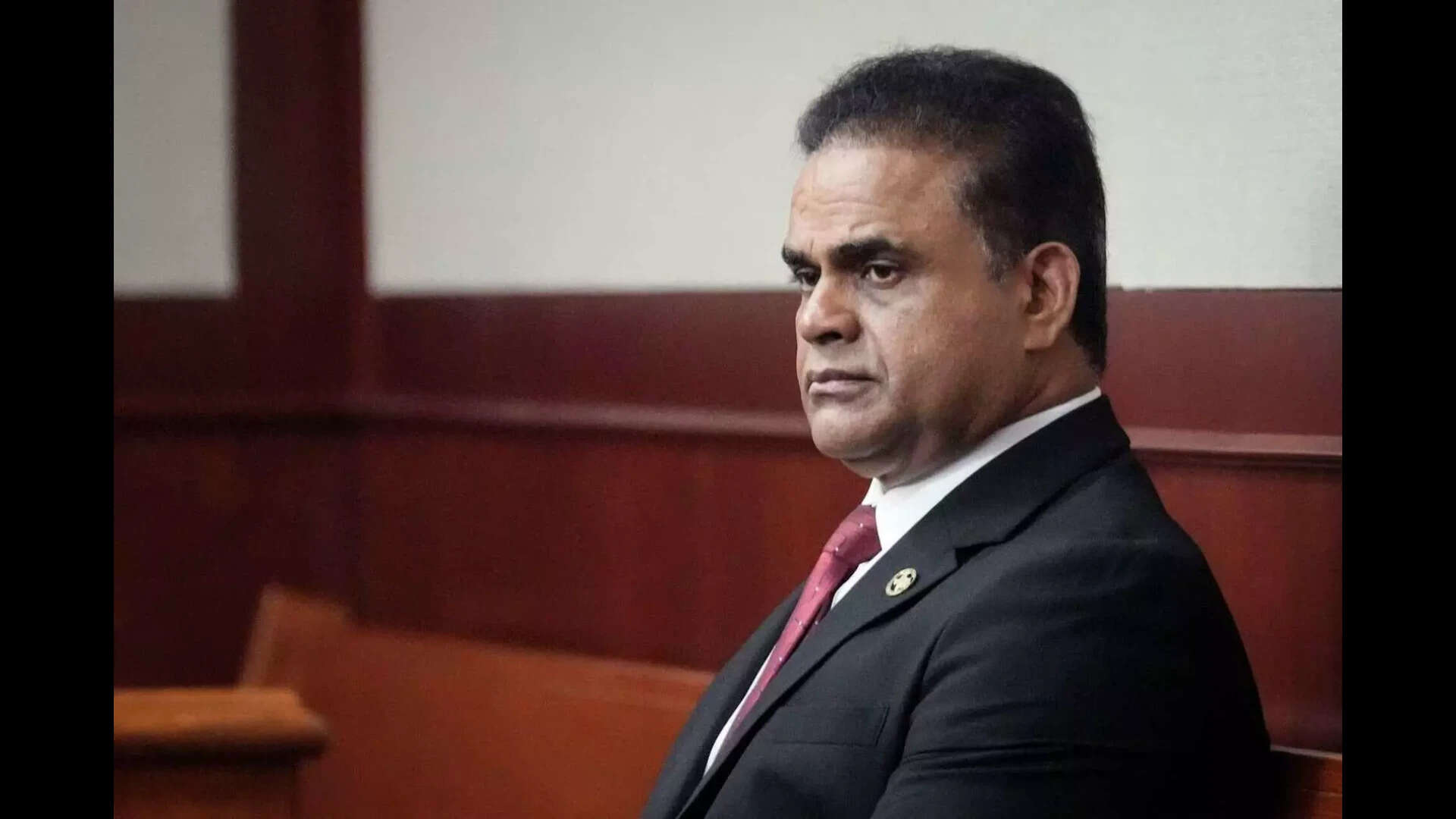
On March 20, 2026, the political career of Fort Bend County Judge KP George effectively ended in a Richmond, Texas, courtroom. A jury returned a guilty verdict on two felony counts of money laundering, concluding that the man who once symbolized the rising political power of the suburban Houston Indian-American community had treated his campaign treasury like a personal ATM. The conviction centers on a $46,000 shell game where donor money was diverted to cover a down payment on a private home.
This was not a simple clerical error. Prosecutors successfully argued that George intentionally falsified campaign records to hide the fact that he was liquidating political contributions for personal gain. Under Texas law, George faces immediate removal from office once a formal judgment is entered at his June 16 sentencing. For now, he remains out on a $20,000 bond, a disgraced incumbent waiting for a judge to decide if he will spend the next two to ten years in a state penitentiary.
The Mechanics of the $46,000 Down Payment
The prosecution built its case on a trail of bank transfers that began shortly after George’s 2018 election victory. Investigative records showed that George moved tens of thousands of dollars from his campaign account into his private holdings. While George’s defense team maintained these were legitimate "reimbursements" for personal loans he made to his own campaign, the numbers didn't align with the state-mandated filings.
In Texas, campaign finance is strictly regulated to prevent exactly what happened here. If a candidate loans their campaign money, it must be documented with precision. George failed to do this. Instead, he claimed the campaign fund contained significantly less than it actually did in public disclosures, while simultaneously siphoning off the "unseen" surplus.
- The Discrepancy: George reported a specific balance to the Texas Ethics Commission.
- The Reality: Internal bank records showed an excess of approximately $45,000 to $46,000 beyond what was reported.
- The Exit: That specific amount was transferred to personal accounts and immediately utilized for a real estate transaction.
The jury saw this as a deliberate attempt to bypass the law. By under-reporting the fund's total, George created a "shadow" pool of capital that he believed could be spent without oversight. It was a gamble that relied on nobody checking the math against the bank statements.
A Reputation Dissolved by Deception
The money laundering conviction is the final blow to a reputation already battered by a bizarre social media scandal involving George’s former chief of staff, Taral Patel. In 2025, Patel pleaded guilty to creating fake social media profiles to lob racist attacks at himself and George. The goal was to manufacture a narrative of victimhood to garner sympathy and political support.
Patel’s plea deal included an admission that George was aware of—and participated in—at least one instance of this identity misrepresentation. This established a pattern of behavior for the County Judge. To the public, he was a trailblazing immigrant success story. To the District Attorney’s office, he was a man comfortable with fabrication as a tool for survival.
The trial revealed a culture of entitlement within George’s inner circle. When the money laundering investigation began, George dismissed it as a "political witch hunt." He leaned on his status as the first person of color to hold the county’s highest office, suggesting the charges were racially motivated. However, the evidence presented by Assistant District Attorney Wesley Wittig was purely mathematical. Jurors were not asked to deliberate on identity politics, but on the movement of dollars from Column A to Column B.
The Removal Power of the Texas Local Government Code
Many residents are asking why George hasn't been escorted out of the building yet. The delay is a quirk of the Texas Local Government Code. While a guilty verdict is the "conviction," the legal removal from office technically triggers when the judge signs the final judgment during the sentencing phase.
What Happens Between Now and June 16
| Phase | Status | Impact on Fort Bend |
|---|---|---|
| Post-Verdict | Out on Bond | George remains the technical head of the Commissioners Court. |
| Pre-Sentencing | Legal Limbo | The DA’s office is expected to file for an immediate suspension to prevent him from conducting official business. |
| Sentencing | Final Judgment | Formal removal occurs. Commissioners will appoint an interim successor. |
The administrative vacuum is already being felt. Fort Bend is one of the fastest-growing and most diverse counties in the United States. It manages a billion-dollar budget and massive infrastructure projects. With the top executive now a convicted felon, the daily operations of the county are clouded by questions of legitimacy. Every contract signed and every vote cast by George between now and June will be scrutinized for potential legal challenges.
The Defense of "Reasonable Doubt"
Defense attorney Jerry Woodfill expressed shock at the verdict, arguing that the prosecution failed to prove criminal intent. The defense’s strategy was to frame the entire ordeal as a series of accounting mistakes made by a busy public official who wasn't a financial expert. They argued that because George had actually put his own money into the campaign years prior, he was entitled to take it back—regardless of how poorly the paperwork was handled.
The jury rejected this. In a felony money laundering case, the state only needs to prove that the defendant conducted a financial transaction involving the proceeds of "criminal activity" with the intent to promote that activity or hide the source. By falsifying the ethics reports (a crime in itself) to mask the personal use of the funds, the "laundering" cycle was complete.
The trial's most damning moments came from financial experts who walked the jury through the timeline of the home purchase. The down payment was due, the personal account was short, and the campaign transfer happened within 48 hours. It was a correlation that "clerical error" could not explain away.
A Community Left in the Lurch
The fallout extends beyond the Richmond courthouse. The Indian-American community in Fort Bend, which saw George’s 2018 victory as a watershed moment for representation, is now grappling with the wreckage. For many, the tragedy isn't just the lost leadership, but the ammunition this provides to those who look at immigrant success with suspicion.
George’s fall is a cautionary tale about the gravity of the "little things" in public office. It wasn't a multi-million dollar bribery scheme that brought him down. It was a $46,000 transfer for a house—a relatively small sum in the world of high-stakes politics, but a massive violation of the public trust.
The next few months will involve a scramble for power within the Fort Bend Commissioners Court. Potential successors are already being discussed in hushed tones in the hallways of the Justice Center. Whether the county chooses to appoint a placeholder or a long-term replacement remains to be seen, but the era of KP George is over. He entered the courtroom a powerful judge and left it a convicted felon, handcuffed and escorted by the very deputies who once stood at attention when he walked into the room.
Sentencing is set for June 16. Until then, Fort Bend County waits for the final signature that will officially close this chapter of its history.
Would you like me to analyze the potential candidates likely to be appointed as George's interim replacement?