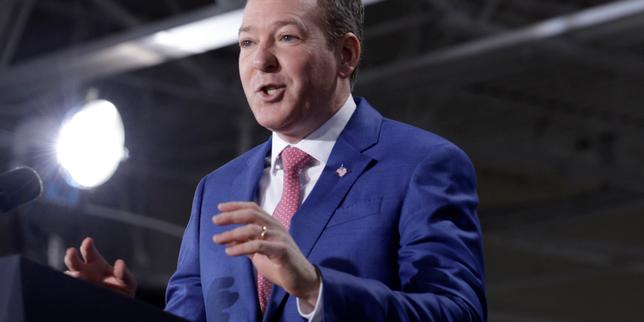
The administrative machinery of the United States government is currently undergoing a structural lobotomy. When the head of the Environmental Protection Agency (EPA) stands before a room of industry insiders and lobbyists to openly contest the physical properties of carbon dioxide, we are no longer discussing a difference in political philosophy. We are witnessing the intentional dismantling of the scientific method as a prerequisite for federal governance. This isn't just about the climate. It is about a fundamental shift where political ideology now dictates the validity of measurable data.
The recent rhetoric coming out of Washington signals a victory for a specific brand of fringe skepticism that has spent decades in the wilderness. By elevating these views to the level of official agency policy, the current leadership is doing more than just rolling back regulations; they are altering the genetic code of how the American government interacts with objective truth.
The Infrastructure of Denial
For over forty years, the EPA functioned on a relatively simple, if often contested, premise. The agency would gather data, subject it to peer review, and then craft rules based on the findings. It was a slow, bureaucratic process designed to insulate public health from the whims of whichever party held the White House. That insulation has been stripped away.
The current strategy focuses on "secret science" rules. On the surface, the demand for total transparency in scientific studies sounds like a win for accountability. In practice, it is a surgical strike against the most influential public health research ever conducted. Many of the foundational studies linking air pollution to premature death rely on confidential medical records. By requiring that all underlying data be made public—data that cannot be released due to patient privacy laws—the EPA effectively disqualifies the very evidence used to justify smog and soot restrictions.
This is a quiet, technical execution of environmental law. You don't have to win the debate on global warming if you simply pass a rule that says the evidence for it is inadmissible in court. It is a masterclass in using the language of transparency to achieve the goals of opacity.
The Cost of Ignoring Physics
Physics does not negotiate. While the political theater in Washington focuses on the "freedom" to pollute, the physical world is already sending the bill. We see it in the rising insurance premiums in coastal Florida and the lengthening wildfire seasons in the Pacific Northwest. These are not future projections; they are current line items on the American balance sheet.
The danger of an EPA that ignores its own scientists is the creation of a massive "intelligence gap." When the government stops measuring reality, it loses the ability to prepare for it. We are seeing a move toward a model where the agency serves as a legal shield for industry rather than a guardian of the commons. This transition creates a volatile environment for the very businesses the administration claims to protect. Markets hate unpredictability. When the federal government abandons international standards and long-standing scientific consensus, it leaves American companies navigating a fragmented global landscape where their products may no longer be compliant or competitive.
The Myth of Economic Tradeoffs
The core argument usually presented is that environmental protection is a zero-sum game played against economic growth. This is a false choice that ignores the history of American innovation. The Clean Air Act of 1970 didn't destroy the automotive industry; it forced it to develop the catalytic converter. It turned out that American engineers were quite good at solving problems when the law required them to do so.
By removing these requirements, the EPA is effectively telling American industry that it no longer needs to innovate. It is an invitation to stagnation. If you don't have to worry about emissions, you don't have to invest in the next generation of high-efficiency turbines or carbon-capture technology. You just keep burning the same fuel in the same way, while the rest of the world moves toward a more efficient, lower-carbon future. We are subsidizing obsolescence.
Judicial Deference and the Long Game
The real battle isn't happening in the press room; it is happening in the federal courts. For decades, the "Chevron deference" allowed agencies to interpret ambiguous laws as long as their interpretations were reasonable. The current administration is betting that a more conservative judiciary will use this period of deregulation to permanently weaken the "administrative state."
If the EPA can successfully argue that it lacks the authority to regulate greenhouse gases, it sets a precedent that could take decades to reverse. This isn't a temporary policy shift; it is an attempt to legally de-fang the executive branch’s ability to respond to large-scale ecological threats. The goal is a government that is legally incapable of acting, even if a future administration has the political will to do so.
The Erosion of Internal Expertise
Agencies are only as good as the people who work in them. We are currently seeing a historic brain drain within the EPA. Senior scientists with thirty years of experience are taking early retirement or moving to the private sector. They are being replaced by political appointees who, in many cases, have spent their careers suing the very agency they now lead.
This loss of institutional memory is catastrophic. When you lose the people who understand the complex chemical interactions of groundwater contamination or the atmospheric modeling of ozone, you can't just hire them back four years later. That knowledge evaporates. The result is a hollowed-out institution that can no longer perform its basic functions, like responding to chemical spills or evaluating the safety of new pesticides.
The Global Consequences of American Silence
The United States was once the primary driver of international environmental standards. By abdicating this role, we have created a power vacuum that is being filled by the European Union and China. While the EPA head tells a Washington crowd that the science is "uncertain," China is investing hundreds of billions into becoming the world's leader in solar technology and electric vehicle infrastructure.
They aren't doing this because they are more "green" than we are. They are doing it because they recognize that the 21st-century economy will be built on efficiency and carbon management. By turning our backs on the science, we aren't just losing our moral high ground; we are losing our market share. We are choosing to be the last defenders of the 19th-century energy model while the rest of the planet prepares for what comes next.
Redefining the Public Interest
Who is the EPA for? Under its current leadership, the "public" has been redefined to mean "shareholders of regulated industries." The original mission—to protect human health and the environment—has been treated as an obstacle to be bypassed.
The rhetoric used by agency leadership often frames environmentalism as an elite concern, detached from the needs of the working class. This ignores the reality that environmental degradation is deeply regressive. The people who live near coal ash ponds, the families whose children have higher lead levels in their blood, and the farmers whose crops are failing due to shifting weather patterns are not the "elites." They are the people the EPA was specifically designed to protect.
The Collapse of the Consensus
There used to be a bipartisan consensus that clean air and water were non-negotiable. Richard Nixon, a Republican, created the EPA. The 1990 amendments to the Clean Air Act passed with overwhelming support from both sides of the aisle. That consensus has been shattered by a well-funded campaign to turn basic chemistry into a partisan loyalty test.
When we reach a point where the head of an environmental agency is the primary cheerleader for the removal of environmental protections, the language itself has lost its meaning. It is an Orwellian inversion of the agency's purpose. We are now in an era of "anti-policy," where the primary goal of the regulator is to ensure that no regulation occurs.
The Long Road to Restoration
Fixing this isn't as simple as electing a new president. The damage being done to the EPA’s data sets, its legal authority, and its personnel will take a generation to repair. We are currently creating a "dark period" in American scientific record-keeping that will leave future researchers with a massive gap in their understanding of this decade's environmental impact.
The move to marginalize science isn't just a policy choice; it is a direct assault on the foundation of a modern, functioning society. A government that cannot or will not acknowledge the facts of the physical world is a government that cannot protect its citizens. The applause in that Washington conference room wasn't just for a speech; it was for the sound of a superpower choosing to look away from the horizon.
The true impact of this era will be measured in the parts per million of carbon in our atmosphere and the parts per billion of toxins in our water. No amount of political theater or legal maneuvering can change those numbers. We are currently conducting a high-stakes experiment on the only planet we have, and we have decided to fire the lab technicians and throw away the instruments mid-way through.
Stop expecting the institutions to save themselves. When the regulatory apparatus is turned against its own mission, the only remaining check is a public that refuses to accept a manufactured version of reality.


