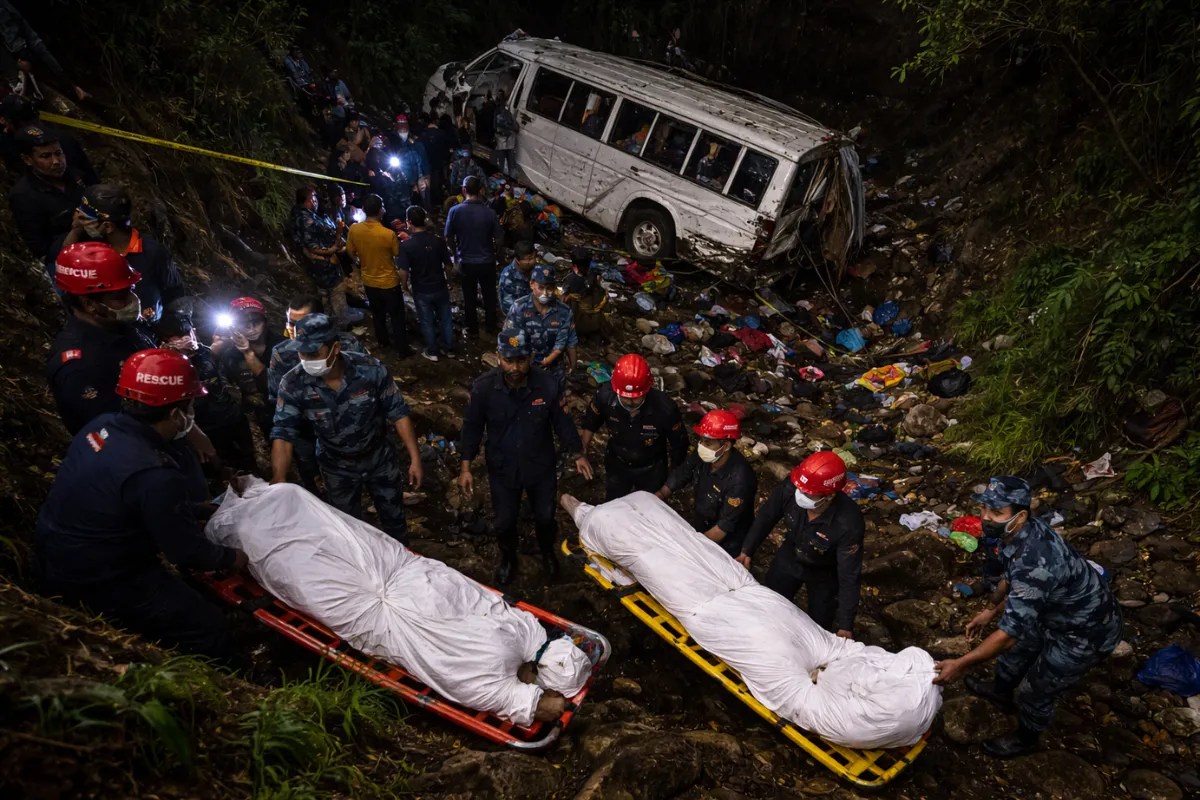
The sudden transition from a religious pilgrimage to a mass casualty event in Nepal highlights a systemic failure in cross-border transit safety and the complex logistical friction of international repatriation. When an Indian pilgrim bus veers off a Himalayan precipice, the resulting crisis is not merely a tragedy of human error; it is a breakdown of structural oversight, vehicle physics in high-altitude environments, and the bureaucratic inertia inherent in sovereign border relations. Solving the immediate need—returning the deceased to their families—requires a mobilization of the Indian Embassy that bypasses standard diplomatic speed in favor of emergency disaster response protocols.
The Kinematics of Himalayan Transit Failure
Accidents on the Prithvi Highway or the winding routes toward Kathmandu are rarely the result of a single variable. They are the output of a "Swiss Cheese Model" of failure, where multiple layers of protection fail simultaneously.
- The Gravitational Load Factor: Standard braking systems on commercial buses are often ill-equipped for the sustained thermal stress of Nepalese descents. As brake pads exceed their operating temperature, the coefficient of friction drops, leading to "brake fade." On a 7% grade, a fully loaded bus converts massive amounts of kinetic energy into heat; without electromagnetic retarders or exhaust brakes, mechanical failure becomes an inevitability rather than a risk.
- Infrastructure Deficit and the 'Soft Shoulder': Unlike many Indian highways, Nepalese mountain passes frequently lack reinforced crash barriers (W-beams). The "shoulder" is often composed of loose scree or uncompacted soil. Once a tire leaves the asphalt, the lack of lateral resistance ensures a roll-over event rather than a recoverable skid.
- Circadian Misalignment: Pilgrimage tours frequently operate on "exhaustion schedules." Drivers often push through the 2:00 AM to 5:00 AM window—the peak of the circadian trough—to reach temples by sunrise. Microsleep, even lasting only three seconds, is sufficient to miss a hairpin turn on a road with zero margin for error.
The Repatriation Pipeline: Bureaucratic and Physical Constraints
Once a fatality is confirmed on foreign soil, the Indian Embassy initiates a multi-stage repatriation engine. This process is governed by the Vienna Convention on Consular Relations but is practically limited by the geography of the Terai and the mid-hills of Nepal.
Phase I: The Identification and Legal Clearance
The first bottleneck is the "Post-Mortem and Police Report" loop. Nepalese law requires a rigorous forensic accounting of the cause of death before a body can be released. For Indian officials, the objective is to expedite these clearances without bypassing local legal requirements, which would risk future diplomatic friction. The Embassy’s role here is one of Linguistic and Legal Mediation, ensuring that the families—who are often in a state of shock and unfamiliar with Nepalese statutes—have an interface with the local district administration.
Phase II: The Logistics of the 'Dead Body Carriage'
Transporting remains across an international border involves three critical variables:
- Embalming Standards: To prevent biological hazards during transit, bodies must be chemically stabilized. In rural Nepal, access to certified embalming centers is limited, often requiring long-distance transport to Kathmandu or larger border towns like Birgunj or Nepalgunj.
- The No-Objection Certificate (NOC): The Indian Embassy issues a formal NOC, which acts as the "passport" for the deceased. Without this document, Nepalese customs (Bhansar) cannot legally permit the exit of the remains.
- The Last Mile Transport: The physical carriage is usually managed via ground transport. The Embassy coordinates with local NGOs or specialized funeral service providers to secure ambulances or hearses capable of navigating the rugged terrain back to the Indian states of Uttar Pradesh, Bihar, or beyond.
The Economic and Diplomatic Cost Function
Every hour of delay in repatriation increases the "Social Volatility Index" of the incident. High-profile accidents involving pilgrims carry significant political weight. The Indian government’s intervention is an exercise in Soft Power and Citizen Protection.
The cost of these operations is rarely borne by the families alone. The Indian Community Welfare Fund (ICWF) is the primary financial mechanism used by embassies to cover the costs of airlifting or transporting bodies of distressed Indian citizens. However, the reliance on government intervention underscores a deeper issue: the complete absence of mandatory travel insurance for cross-border bus pilgrims. If every pilgrim were required to hold a basic high-risk transit policy, the logistics could be privatized and accelerated, moving from a diplomatic "favor" to a contractual obligation.
Structural Hazards in the Indo-Nepal Transit Treaty
The current framework for vehicle movement between India and Nepal allows for relatively easy cross-border flow, but it lacks a Unified Safety Audit.
- Vehicle Age Disparity: Many buses used for pilgrimages are "retired" long-haul vehicles from Indian state fleets, sold into the private sector. These vehicles often lack modern stability control systems.
- The Permit Loophole: Temporary permits are issued with minimal inspection of the vehicle’s mechanical integrity. A bus that is "roadworthy" on the flat plains of Bihar is not necessarily "mountain-ready" for the steep inclines of the Trishuli River valley.
The cause-and-effect relationship between permit ease and accident frequency is clear: lower barriers to entry for sub-standard operators lead directly to higher mortality rates in high-altitude corridors.
Tactical Shifts for Future Pilgrimage Safety
To mitigate the recurrence of these mass casualty events, the strategy must shift from Reactive Repatriation to Proactive Risk Sequestration.
- Mandatory GPS and Speed Governors: Any Indian-registered commercial vehicle entering Nepal must be fitted with a GPS tracker monitored by a central transit hub. Real-time alerts for excessive speed on descent could trigger immediate fines or permit revocations.
- The "Mountain Endorsement" License: Just as pilots require ratings for specific aircraft, drivers navigating the Himalayan circuits should be required to hold a specialized endorsement. This certification would involve training in engine braking techniques and fatigue management specific to high-altitude driving.
- Pre-Border Mechanical Triage: Establishing joint inspection points at major crossings (like Raxaul-Birgunj) where vehicles are checked for brake lining thickness and tire tread depth before being allowed to ascend into the mountains.
The current operations by the Indian Embassy to bring home the victims are a necessary humane response to a structural failure. However, the long-term solution lies in redefining the "Pilgrimage Corridor" as a regulated industrial transport zone rather than a deregulated path of faith. The transition of the deceased is a matter of logistics; the preservation of the living is a matter of engineering and policy enforcement.
Authorities must now move to integrate the "Digital Health and Safety Ledger" for all cross-border buses, ensuring that every vehicle's maintenance history is transparent and verifiable at the border. Without this data-driven gatekeeping, the cycle of tragedy followed by diplomatic "emergency response" will remain the standard operating procedure.