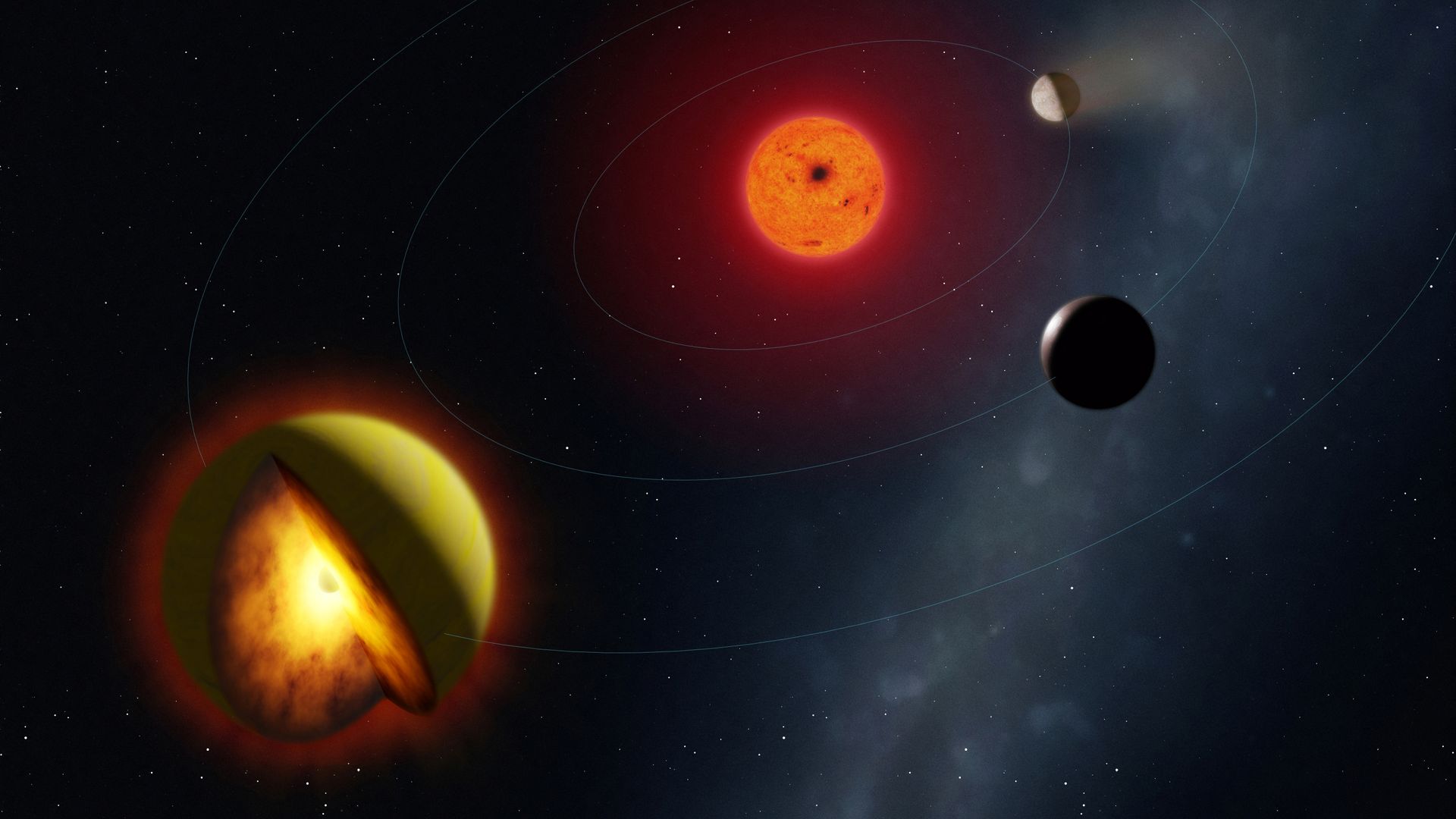
Astronomers have finally confirmed what it smells like on HD 189733b, and it is not a scent anyone would choose to bottle. Using data from the James Webb Space Telescope (JWST), researchers identified the presence of hydrogen sulfide in the atmosphere of this "hot Jupiter." This is the same molecule responsible for the stench of rotting eggs and human flatulence. While the tabloid headlines focus on the "stinky" nature of this distant world, the actual scientific revelation is far more consequential. We are no longer just looking at the silhouettes of planets; we are dissecting their chemical guts from 64 light-years away.
The Chemistry of a Planetary Hellscape
HD 189733b has long been a favorite subject for those studying extreme environments. It is a gas giant slightly larger than Jupiter, orbiting so close to its parent star that a "year" lasts only 2.2 Earth days. This proximity results in scorching temperatures of roughly 1,700 degrees Fahrenheit. But heat is only the beginning of the nightmare.
The detection of hydrogen sulfide ($H_{2}S$) is a landmark moment in spectroscopy. This molecule is incredibly sensitive to temperature and pressure, acting as a chemical marker for how sulfur—a fundamental building block of planets—is distributed in a solar system. On Earth, sulfur is a byproduct of biological decay and volcanic activity. On HD 189733b, it is a testament to a chaotic, high-energy environment where the very air is a cocktail of lethal elements.
The wind speeds on this planet are equally decorative of a "vision of hell." They have been clocked at over 5,000 miles per hour. At those speeds, the silicate particles in the atmosphere don't just hang in the air; they condense into glass. Imagine a world where it rains molten glass, sideways, at seven times the speed of sound. This is not just a hostile environment. It is a kinetic weapon in the form of a planet.
Why Sulfur Matters to Our Own Origins
Sulfur is one of the "big six" elements required for life as we understand it. By finding it in the atmosphere of a gas giant, scientists can begin to map out where sulfur sits in the "snow line" of other star systems. This helps us understand if our own solar system is an outlier or a standard model.
For decades, we relied on models that assumed these hot Jupiters were mostly hydrogen and helium. The JWST has shattered that simplicity. The presence of $H_{2}S$ suggests that sulfur is a major player in the formation of these massive worlds. If sulfur is abundant there, it raises questions about how it was delivered to rocky planets like Earth. Was our sulfur baked in from the start, or was it delivered by the same cosmic collisions that brought us water?
The Problem With the Stinky Planet Narrative
The media fixates on the smell because it is relatable. Everyone knows the sulfurous reek of a stagnant swamp. However, this focus ignores the staggering technical achievement required to see these molecules.
To find hydrogen sulfide, astronomers had to filter out the light of the host star, which is millions of times brighter than the planet. They used the Mid-Infrared Instrument (MIRI) on the JWST to observe the planet as it passed in front of its star. As the starlight filtered through the planet's atmosphere, specific wavelengths were absorbed by the gas. This creates a "spectral fingerprint."
The data wasn't clean. It never is. The researchers had to account for stellar activity—sunspots and flares on the host star that can mimic the signals of a planet's atmosphere. This is the "dirty work" of astronomy that rarely makes it into the viral articles. It involves months of data scrubbing and mathematical modeling to ensure that the "smell" isn't just noise from a grumpy star.
The Overlooked Heavy Metals
While the headlines screamed about the smell, the study also looked for methane. Surprisingly, they didn't find any. In a planet this hot, methane shouldn't be there, but its absence confirms that the planet's atmospheric chemistry is driven by extreme heat rather than complex organic processes.
More importantly, the researchers measured the "metallicity" of the planet. In astronomy, any element heavier than hydrogen or helium is considered a metal. HD 189733b has a high concentration of these heavy elements. This suggests that during its formation, it gobbled up a massive amount of solid material—planetesimals and icy rocks—before migrating inward toward its star.
The Logistics of Cosmic Surveillance
We are currently in a golden age of planetary characterization, but it is an expensive and slow process. The JWST is a finite resource. Every hour spent sniffing the atmosphere of a "stinky" planet is an hour not spent looking at the first galaxies or searching for water on a temperate, Earth-sized world.
There is a brewing debate in the scientific community about the "Hot Jupiter Tax." Because these large, hot planets are easier to observe, they dominate the data sets. They provide the "low-hanging fruit" for high-impact papers. Meanwhile, the smaller, rockier planets—the ones that might actually host life—require dozens of observations to yield even a fraction of the same data quality.
We are learning a lot about hellish gas giants, but are we learning about ourselves?
The Atmospheric Erosion Crisis
HD 189733b is literally evaporating. The intense radiation from its star is stripping away its atmosphere at a rate of up to 600 million kilograms per second. It leaves a trailing tail of gas behind it, like a macabre comet.
This process of "photoevaporation" is critical to understanding the "Neptune Desert"—a region close to stars where we almost never find mid-sized planets. It seems that if a planet isn't massive enough to hold onto its gas against the stellar wind, it gets stripped down to its rocky core. HD 189733b is massive enough to survive, for now, but it is a dying world.
The infrared signatures picked up by the JWST show a planet in a state of constant chemical flux. The sulfur isn't just sitting there; it's being cooked, blasted by UV rays, and recycled through vertical mixing in the deep atmosphere. This isn't a static ball of gas. It is a giant, high-pressure chemical reactor.
Beyond the Rotting Egg Smell
The next phase of this research won't be about smell. It will be about weather. By observing HD 189733b at different points in its orbit, astronomers are creating a 3D map of its atmosphere. They are looking at the temperature differences between the "day side" (which always faces the star) and the "night side."
On HD 189733b, the hottest point isn't actually the spot directly under the sun. The fierce winds mentioned earlier actually push the heat around the planet, shifting the "hot spot" to the east. This tells us about the viscosity and heat-carrying capacity of the atmosphere.
The Future of the Hunt
We are moving toward a time when we will do this for planets in the TRAPPIST-1 system. Those are Earth-sized worlds orbiting a cool red dwarf star. If we find hydrogen sulfide there, the conversation changes instantly. On a rocky world, sulfur could be a biosignature.
But for now, HD 189733b serves as the ultimate laboratory. It is a place where physics is pushed to its breaking point. It reminds us that the universe is not designed for our comfort. Most of the real estate in the galaxy is more akin to a pressurized oven filled with toxic gas and shards of flying glass than the pale blue dot we call home.
The discovery of hydrogen sulfide is a proof of concept. It proves that our instruments are now sensitive enough to detect the subtle chemical traces of a world we can never visit. It isn't just about the smell of rotting eggs. It's about the fact that we can smell anything at all from trillions of miles away.
Check the latest data releases from the Mikulski Archive for Space Telescopes to see the raw light curves yourself.