Ukraine has crossed the threshold into a new era of mechanized attrition, completing over 24,500 missions with Unmanned Ground Vehicles (UGVs) in the first months of 2026 alone. This isn't a pilot program or a series of experimental trials. It is a fundamental shift in how territory is held and how blood is spared. By shifting the burden of the "three Ds"—dull, dirty, and dangerous tasks—from soldiers to remote-controlled platforms, the Ukrainian military is attempting to solve a math problem that has plagued every commander since 1914: how to cross the "no man’s land" without losing an entire generation of infantry.
The numbers represent a staggering scale of integration. These 24,500 sorties include everything from the delivery of hot meals and ammunition to the "kamikaze" strikes that disable main battle tanks. While the world watched the sky during the first phase of the drone war, the ground has quietly become the most active theater for automation.
The Logistics of Survival
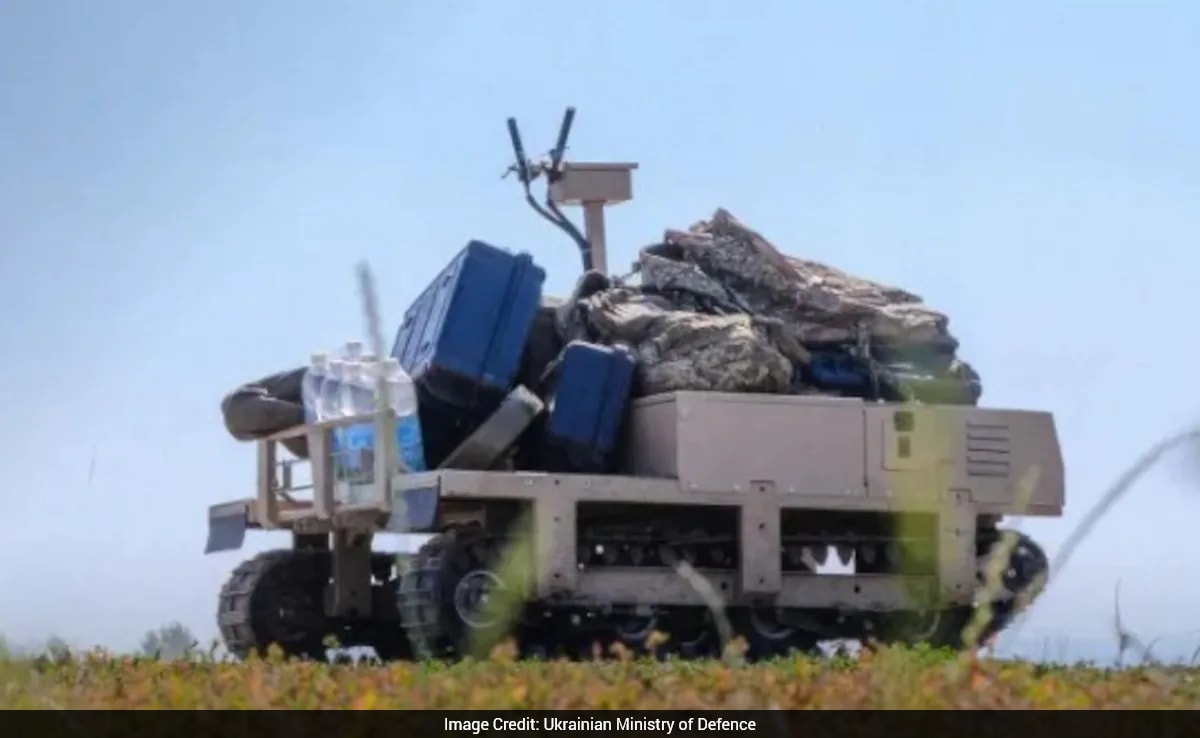
The most frequent missions aren't the ones that make the evening news. They are the logistics runs. In the Donbas, where traditional supply lines are constantly sighted by Russian reconnaissance drones, moving a crate of mortar shells or a gallon of water can be a death sentence for a human driver.
Ukraine is now using small, four-wheeled electric sleds to bridge the "last mile." These machines have a low thermal signature and move at a walking pace, making them nearly invisible to infrared sensors. They don't breathe, they don't sweat, and they don't hesitate when artillery starts falling nearby. By automating the delivery of supplies to forward trenches, the military has reduced casualty rates among logistics units by an estimated 30 percent in high-intensity sectors.
But the real breakthrough is in medical evacuation. The "Ironclad" and similar heavy-duty UGVs are being outfitted with protected litters. Extracting a wounded soldier usually requires four able-bodied infantrymen to carry a stretcher, turning five people into a single, slow-moving target. A robot requires only one operator, often tucked away in a bunker kilometers away, to steer the casualty to safety.
Weapons of the Mud
Beyond the logistics, a more aggressive breed of ground robot is stalking the tree lines. We are seeing a surge in "minelayer" robots. These platforms can carry dozens of anti-tank mines, dropping them in precise patterns under the cover of darkness.
Traditional minelaying is a loud, conspicuous process involving heavy trucks or engineers working by hand. A UGV can crawl into a gap in the front lines, deposit a lethal surprise for an advancing armored column, and retreat without ever alerting the enemy’s acoustic sensors.
Then there are the combat platforms. Equipped with 7.62mm or 12.7mm machine guns, these "turrets on wheels" are being used to hold defensive positions. A single soldier can monitor three or four robots from a tablet. When the enemy attempts a trench raid, they are met not by human defenders, but by a wall of lead directed by an operator who is physically immune to the suppressive fire the enemy is pouring into the position.
This creates a psychological chilling effect. How do you demoralize a force that isn't there? You can't capture a robot. You can't interrogate it. You can only destroy it, and in this war of attrition, the cost of a Russian Lancet drone or a tank shell used to destroy a $5,000 UGV is a win for the Ukrainian budget.
The Infrastructure of Automation
The surge to 24,500 missions did not happen in a vacuum. It is the result of a decentralized industrial base that looks more like a Silicon Valley startup culture than a traditional defense industry. Hundreds of small workshops across Ukraine are churning out these units, often using off-the-shelf components from the civilian RC car and agricultural sectors.
Standardized Power and Parts
Success in the field has come from a move away from "boutique" military hardware. Early in the conflict, every volunteer group had their own design. Now, the Ukrainian Ministry of Digital Transformation is pushing for standardization.
- Modular Batteries: Using the same cells found in electric bikes and scooters allows for quick field swaps and easy sourcing.
- Open-Source Software: Many of these robots run on modified versions of ArduPilot or PX4, allowing a wide pool of civilian coders to contribute to the mission logic.
- Commercial Radios: By utilizing Mesh network technology, these robots can relay signals to one another, extending their range deep into radio-jammed territory.
The Electronic Warfare Barrier
The biggest obstacle isn't the terrain; it is the spectrum. Russian Electronic Warfare (EW) is some of the most sophisticated in the world. To counter this, Ukrainian engineers are increasingly turning to wire-guided systems or high-level autonomy.
A wire-guided UGV is essentially un-jammable. It trails a thin fiber-optic cable behind it as it moves. This allows the operator to see a high-definition video feed and control the unit even in the most intense EW environments. While the cable limits the range and can become snagged, in the static environment of trench warfare, it has become a reliable solution for short-range combat and observation.
The Myth of the Terminator
Despite the hype, we are far from seeing fully autonomous death machines roaming the plains. Every one of these 24,500 missions involved a human in the loop. The "killer robot" narrative overlooks the immense technical difficulty of navigating a bombed-out landscape.
Mud is the great equalizer. A robot that works perfectly on a test range in Kyiv will get stuck in the deep, clay-heavy mud of the Zaporizhzhia front. Engineers are constantly fighting a war against physics—calculating torque, ground pressure, and center of gravity.
Furthermore, the sensors required for true autonomy—LiDAR and advanced computer vision—are expensive and fragile. In a war where a drone's lifespan might be measured in days or even hours, putting $50,000 worth of sensors on a frame doesn't make sense. The goal is "expendable utility," not "technological perfection."
Strategic Implications of a Ground-Robot Front
The massive uptick in missions signals a change in Ukrainian strategy. They are moving toward a "porcupine" defense. By saturating the front with UGVs, they force the Russian military to expend vast amounts of ammunition and resources on targets that do not result in Ukrainian casualties.
This is a war of economic and demographic attrition. Russia has a larger population and a larger pool of recruits. Ukraine cannot afford a 1-to-1 casualty ratio. The only way to win is to ensure that for every Ukrainian life lost, the cost to the occupier is exponentially higher in terms of equipment and personnel.
We are seeing the creation of "buffer zones" where no human soldier on either side can safely stand. These areas are controlled by remote sensors and mobile robot platforms. If an enemy infantry group attempts to move through this zone, they are spotted by a scout UGV, and a combat UGV or an FPV drone is dispatched to intercept them before they ever see a Ukrainian soldier.
The Maintenance Burden
The hidden cost of this 24,500-mission milestone is the massive logistical tail required to keep these machines running. A robot doesn't need food, but it needs charging stations, spare parts, and skilled technicians.
The Ukrainian military has had to create a new MOS (Military Occupational Specialty) practically overnight. These are the "Robot Wranglers." They aren't just operators; they are field engineers who can solder a broken circuit board in a dugout or rebuild a gearbox using parts scavenged from a washing machine.
This decentralized repair network is vital. Because the production is spread across hundreds of small sites, there is no single factory that Russia can strike to shut down the UGV program. It is a "cloud" of manufacturing that is as resilient as the internet itself.
Ethical Gray Zones and the Future of Combat
As the number of missions grows, the pressure to remove the human from the loop increases. If a connection is lost due to jamming, should the robot be programmed to return to its starting point? Or should it be allowed to identify and engage a target on its own to complete its mission?
Currently, the official stance is that a human must always pull the trigger. But the technical capability for autonomous engagement already exists. In the heat of a defensive collapse, the temptation to "unleash" the machines to hold a line at all costs is immense.
We are also seeing the emergence of UGV "swarms"—groups of small robots working in coordination. One might act as a radio relay, another as a scout with thermal cameras, and a third as a strike platform. This level of coordination requires sophisticated AI on the edge, pushing the boundaries of what we consider "controlled" warfare.
The Global Arms Market Reset
The success of these platforms is sending shockwaves through the global defense industry. For decades, the trend was toward larger, more expensive, and more complex platforms like the M1 Abrams or the Bradley Fighting Vehicle. Ukraine is proving that a swarm of $10,000 robots can, in many scenarios, be more effective than a $10 million tank.
Defense contractors in the West are now scrambling to catch up. The data being gathered from these 24,500 missions is the most valuable commodity in the military world right now. It is real-world performance data against a peer adversary. This data shows exactly where the points of failure are, how the sensors react to smoke and debris, and how the enemy tries to counter them.
The era of the "exquisite" weapon system is ending. The era of the "good enough" mass-produced robot has arrived.
The Human Element of Robotic Warfare
There is a misconception that more robots mean a less "human" war. In reality, it changes the nature of the trauma. The operators sitting in basements, watching through a grainy camera feed as their robot is blown apart or as they use it to take a life, are still participants in the violence.
The psychological toll on UGV operators is a growing area of concern for the Ukrainian medical corps. There is a strange, jarring disconnect between the safety of the control room and the visceral reality of the video feed. Operators describe a sense of "digital ghosting," where they feel more present in the machine than in their own bodies.
Despite this, the demand for these systems from the front lines is insatiable. Every commander wants more "eyes" and more "steel" that doesn't require a funeral if it fails.
The Cost of Inaction
If the international community fails to recognize the scale of this shift, they will be preparing for a type of war that no longer exists. The 24,500 missions carried out by Ukraine are a warning. The battlefield is becoming a high-speed, automated environment where the slowest link is the human nervous system.
Investment is moving away from traditional armor and toward electronic warfare, signal processing, and low-cost robotics. The goal is no longer just to have the biggest gun, but to have the most resilient network.
Ukraine's ground robots have proven that automation is not a luxury; it is a survival strategy. The lessons being learned in the dirt of the Donbas will dictate the design of every military force for the next fifty years. The war hasn't just become automated—it has become a race to see who can iterate the fastest in a world where the hardware is disposable, but the data is eternal.
Stop looking for a single "game-ending" weapon. The revolution is the sum of these 24,500 small, gritty, and often mud-caked missions. The future of infantry is not a super-soldier; it is a soldier who manages a fleet of expendable machines.
The infantryman of 2026 doesn't just carry a rifle. They carry a controller, a spare battery, and the heavy weight of knowing that while the machine can be replaced, the window for human error is closing forever.