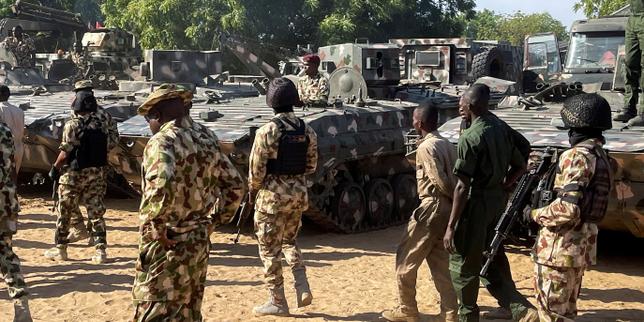
The massacre at the Askira Uba military base did more than just claim the lives of Nigerian soldiers. It decapitated a regional command structure. When Brigadier General Dzarma Zirkusu and his three subordinates were ambushed and killed by Islamic State West Africa Province (ISWAP) militants, the strike sent a clear signal that the insurgency has entered a lethal new phase of tactical sophistication. This was not a random hit-and-run by a ragged band of extremists. It was a precision operation executed with advanced weaponry and chilling intelligence.
Nigeria’s long-standing conflict in the northeast is no longer a simple counter-insurgency. It has morphed into a high-stakes chess match where the state is losing its most valuable pieces. While official government statements often lean on rhetoric about "degrading" the enemy, the reality on the ground suggests a massive disconnect between high-level strategy and the brutal survival requirements of front-line outposts.
The Anatomy of a High Level Ambush
The fall of a General on the battlefield is a rare and catastrophic event in modern warfare. Brig. Gen. Zirkusu was the commander of the 28 Task Force Brigade. He was moving to reinforce troops in Askira Uba when his convoy was intercepted. The militants didn’t just use small arms; they deployed Mine-Resistant Ambush Protected (MRAP) vehicles and high-caliber anti-aircraft guns mounted on "technicals."
These are not weapons purchased from a back-alley bazaar. They are often captured from the Nigerian military itself. ISWAP has perfected the art of the "recycled war," where the army’s own hardware is turned against its commanders. The ambush was timed with such precision that it suggests a leak within the security apparatus or a sophisticated electronic surveillance capability that the Nigerian military has yet to counter effectively.
Why the Current Strategy is Falling Short
For years, the Nigerian Defense Headquarters has relied on a "Super Camp" strategy. The idea was to consolidate troops into large, heavily fortified bases to prevent them from being overrun in smaller, isolated outposts. On paper, it makes sense. In practice, it has created vast "no-man's lands" between the camps.
Insurgents now move freely through the rural corridors between these hubs. They tax the local population, set up checkpoints, and gather intelligence. By the time a mobile reinforcement unit—like the one led by Zirkusu—leaves the safety of a Super Camp to respond to an attack, they are entering a kill zone that has been prepared for hours, if not days.
The military is essentially blinded the moment they step outside their gates. Without consistent aerial surveillance and real-time drone support, these convoys are sitting ducks. The heavy reliance on ground movement in predictable corridors is a fatal flaw that ISWAP has mapped with deadly accuracy.
The ISWAP Evolution
We have to stop looking at ISWAP as a mere offshoot of Boko Haram. They are a different beast entirely. While Boko Haram under Abubakar Shekau was defined by erratic brutality and the mass kidnapping of schoolgirls, ISWAP has focused on building a "shadow state."
They have spent the last few years winning over—or at least neutralizing—local populations by providing basic justice and security that the Nigerian state fails to deliver. This "hearts and minds" campaign, backed by the global logistical network of the Islamic State, gives them a human intelligence network that the Nigerian Army cannot match. When a General moves, someone in a nearby village sees it. Someone with a burner phone makes a call.
The technical shift is equally alarming. We are seeing the use of Suicide Vehicle-Borne Improvised Explosive Devices (SVBIEDs) that are armored to withstand small-arms fire. These are "poor man's cruise missiles." They are driven directly into the heart of military formations, causing mass casualties and chaos before the infantry even joins the fight.
The Intelligence Gap and the Human Factor
Corruption and fatigue are the silent killers in this conflict. Soldiers have been deployed in the northeast for years with minimal rotation. Morale is a finite resource. When troops see their commanders killed and their equipment seized, the psychological toll is immense.
Beyond morale, there is the persistent issue of inter-agency rivalry. The army, the air force, and the intelligence services often operate in silos. In the Askira Uba attack, questions remain about why air support was delayed. In modern warfare, a gap of thirty minutes is an eternity. By the time the jets arrived, the damage was done, the General was dead, and the militants had vanished back into the Sambisa forest or across the borders into neighboring territories.
The Failure of Regional Cooperation
The Multinational Joint Task Force (MNJTF), consisting of Nigeria, Chad, Niger, and Cameroon, was supposed to be the "silver bullet" for this regional crisis. However, national interests often get in the way of collective security. Borders in the Lake Chad Basin are porous, and insurgents treat them as doors rather than walls.
When the Nigerian Army pushes, the militants retreat into Niger or Cameroon. If the neighboring forces aren't ready to hammer them from the other side, the cycle simply repeats. The death of Zirkusu highlights the need for a truly integrated command where a General’s movement is protected by a regional umbrella of intelligence, not just a localized escort.
Hardware is Not the Only Answer
Nigeria has recently spent billions on high-end hardware, including A-29 Super Tucano aircraft from the United States. These are excellent platforms for counter-insurgency. However, a plane in the air cannot fix a broken command structure on the ground.
The focus must shift toward tactical decentralization. Small, highly mobile units with their own organic drone capabilities and secure communication links are much harder to ambush than a lumbering convoy of trucks. The military needs to stop acting like a conventional 20th-century army fighting a border war and start acting like a 21st-century specialized force.
This means investing heavily in:
- SIGINT (Signal Intelligence) to intercept insurgent communications before they can coordinate ambushes.
- Night-vision capabilities to ensure that the "ownership" of the dark doesn't belong solely to the insurgents.
- IED Detection technology that is integrated into every lead vehicle, not just a few specialized units.
The Harsh Reality of the Lake Chad Basin
The terrain itself is a combatant. The receding waters of Lake Chad have created a labyrinth of islands and marshes that provide perfect cover for insurgent training camps. This isn't a problem you can bomb your way out of. It requires a permanent presence—not just "clearing" an area only to abandon it two weeks later.
When the military leaves, the "tax collectors" of the insurgency return. To the local farmer, the state is a fleeting visitor, while the insurgent is a permanent neighbor. Until the Nigerian government can provide a permanent security presence that allows for local governance to take root, military victories will remain pyrrhic.
The Economic Engine of the Insurgency
Follow the money. ISWAP isn't just funded by ideological donors; they have seized control of the lucrative fish and salt trade in the Lake Chad region. This gives them a steady stream of "sovereign" income. They are effectively a rebel state with a functioning economy.
The Nigerian military’s strategy of burning markets or banning certain trades to "starve" the insurgents often backfires by radicalizing the local merchants who lose their livelihoods. A more surgical approach to disrupting the financial networks of the insurgency—targeting the middle-men in the cities rather than the fishermen in the trenches—is required.
The Political Dimension
War is an extension of politics by other means. In Abuja, there is often a sense of "insurgency fatigue." With elections always on the horizon and various internal security crises in the Northwest and Southeast, the Northeast is sometimes treated as a manageable wound rather than a terminal threat.
This complacency is what leads to the deaths of men like Dzarma Zirkusu. You cannot manage a wound that is actively being salted by a professionalized, well-funded extremist organization. The death of a Brigadier General should be a moment of national reckoning, yet it is often buried in the 24-hour news cycle, replaced by the next political scandal or economic tremor.
The loss of senior leadership in the field suggests that the insurgents have better "eyes" on the military than the military has on them. This is an intelligence failure of the highest order. It suggests that the perimeter of the "Super Camps" is not just physical, but mental. The commanders have become siloed, and the insurgents have become the masters of the open road.
The Nigerian Army must move away from the "fortress mentality." A fortress is just a cage if you cannot safely leave it. The path forward requires a brutal assessment of how ISWAP is able to track high-level targets with such lethal accuracy. It requires a purge of potential collaborators within the ranks and a radical shift in how movement is conducted in contested zones.
The era of the predictable convoy is over. If the military continues to move in the same patterns, using the same roads, with the same lack of integrated air cover, Askira Uba will not be the last time a General's stars are found in the dust of a Northeast road. The insurgency has adapted. The question remains whether the Nigerian state is capable of doing the same before the next ambush is sprung.
The blood of the leadership is a high price to pay for a lesson in tactical stagnation. The current approach is failing because it treats the enemy as a ghost to be chased rather than a competitor for the state's own sovereignty. Until the military can secure the space between the camps, the "Super Camp" strategy will remain a blueprint for a slow-motion defeat.


